 Society

Digital transformation opens new prospects for sports medicine in HCM City
1.
|
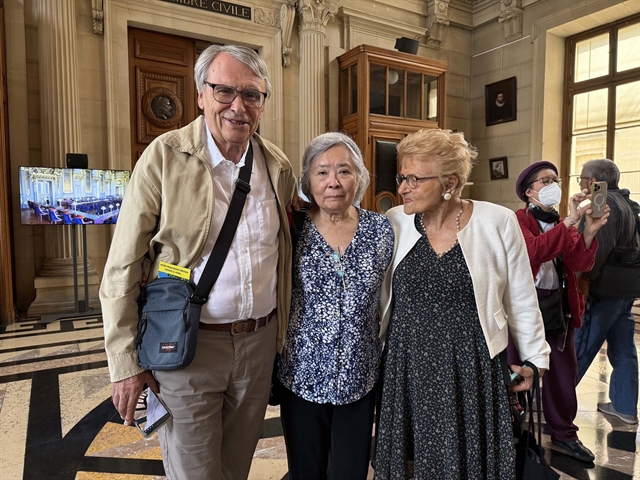
| Trần Tố Nga (centre) and her staunch supporters of the Agent Orange/dioxin lawsuit. — VNA/VNS Photo Hữu Chiến |
PARIS — Following a hearing at France’s Court of Cassation on Tuesday, lawyers representing Vietnamese-French plaintiff Trần Tố Nga expressed their hope that the court will overturn a ruling by the Paris Court of Appeal, thereby paving the way for judicial examination of the merits of her lawsuit against US chemical companies that manufactured Agent Orange (AO)/dioxin used during the war in Việt Nam.
Speaking to the press after the hearing, lawyer Paul Mathonnet said the case concerns not only Nga personally but also the issue of victims’ access to justice.
According to Mathonnet, the central legal question before the Court of Cassation is whether the activities of the US chemical companies constituted commercial operations or acts carried out in the exercise of state sovereignty. The defendant companies argue that they are entitled to jurisdictional immunity because they produced AO under contracts and technical specifications set by the US Government. However, the lawyer stressed that supplying goods to a government does not amount to exercising public authority and therefore does not qualify a company for immunity, which is generally reserved for states and entities entrusted with a part of public powers.
He noted that neither the trial court nor the appellate court has so far examined the substance of the case, as proceedings have focused exclusively on the issue of jurisdictional immunity. If the Court of Cassation annuls the appellate ruling on September 16, the case could be referred back to a lower court for further review, allowing, for the first time, a debate on the responsibility of the chemical companies for the consequences of Agent Orange.
Lawyer Bertrand Repolt said that the defendants are private commercial enterprises that merely fulfilled government contracts under specific technical requirements. Producing goods according to government specifications, he argued, does not transform private companies into state agencies or representatives. He added that the companies manufactured and marketed the herbicide before, during and after the war in Việt Nam, further demonstrating that their activities were commercial rather than governmental.
If the Court of Cassation overturns the Paris Court of Appeal’s August 22, 2024 ruling, the case is likely to be referred to a different panel of the appellate court for reconsideration in line with the higher court’s legal guidance. Only then would the parties be able to debate key issues, including the toxicity of AO, whether Nga was exposed to the chemical, and the possible link between her health conditions and such exposure.
For her part, Nga said she found it difficult to understand why the chemical companies continue to deny the toxicity of Agent Orange when the US Government had previously allocated approximately US$800 million in compensation to American veterans exposed directly or indirectly to the chemical in Việt Nam. She also noted that US authorities have recognised 17 diseases that may be associated with AO exposure.
Nga called on representatives of the chemical companies and their legal teams to visit Việt Nam and witness firsthand the lives of AO victims. Meeting families whose children suffer from birth defects or other AO-related conditions, she said, will help them better understand the hardships endured by victims.
She reaffirmed that the lawsuit is not a personal battle but a quest for justice on behalf of millions of victims, pledging to continue pursuing the case regardless of the court’s final ruling. — VNA/VNS
Society
 Society
 Society
 Society
 Society
 Society
.jpeg) Society
Society
 Society
 Society
 Society
 Society
 Society
 Society
 Society
 Society