 Society
Việt Nam, Singapore promote cooperation through Party-to-Party channel
1.
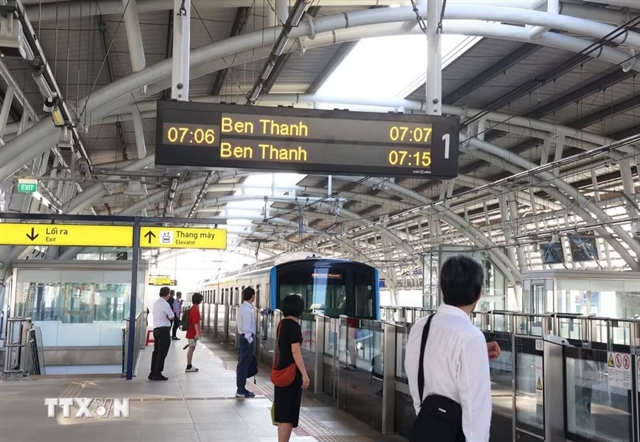 |
| Passengers wait for a train on Metro Line No. 1 at Thảo Điền Station in HCM City. — VNA/VNS Photo Hồng Đạt |
HCM CITY — HCM City’s expanding urban railway network is shifting from a standard public transport scheme into a strategic catalyst designed to entirely restructure the southern metropolis’s urban space over the coming decades.
Under the Politburo’s Resolution No. 09-NQ/TW on the development of HCM City in the new era, the city aims to complete 200 kilometres of urban railway by 2030, before finalising the entire network by 2045.
As the city formulates its 100-year master plan, the metro has been designated as the structural "backbone" to implement the Transit-Oriented Development (TOD) model, fostering new growth poles and raising long-term competitiveness.
Immense pressure, breakthrough mechanisms
According to updated planning, the city’s future urban railway network will span a total length of 1,024 kilometres across 27 lines.
The city is tasked with completing around 187km by 2030—requiring an estimated initial investment exceeding US$19 billion—and approximately 450km by 2035.
This massive workload is several times larger than what the city achieved over the past two decades, demanding a radical overhaul in investment mechanisms and resource mobilisation.
Early last year, the National Assembly issued Resolution No. 188/2025/QH15, granting specific breakthrough mechanisms for urban railway development in Hà Nội and HCM City. This marked a fundamental shift in investment mindset and execution.
Following this mechanism, the HCM City People’s Committee assigned the Management Authority for Urban Railways (MAUR) to prepare investments for seven metro lines, alongside two lines extending into former Bình Dương Province.
For the 2025-30 period, the municipal steering committee is prioritising six key projects: Metro Line No. 2 (Bến Thành-Tham Lương and Bến Thành-Thủ Thiêm sections), Metro Line No. 6 (Phase 1: Tân Sơn Nhất Airport-Phú Hữu), Bến Thành-Cần Giờ Line, Thủ Thiêm - Long Thành regional railway, and Bình Dương New City–Suối Tiên Line.
Dr Châu Vũ, deputy chief of the Office of the city National Assembly and People's Council Delegation, said Resolution 09-NQ/TW guides the city towards a multi-centric, multi-polar megacity model.
"If the metro is viewed merely as a transport project, HCM City will miss the opportunity to restructure its entire urban development model," he said, adding that high-capacity public transport must serve as the structural framework for the megacity.
Phạm Ngọc Tuấn, head of the Faculty of Planning at the HCM City University of Architecture, emphasised that a strategic infrastructure framework is vital for the city’s competitiveness in its 100-year vision.
High-capacity public transport systems—including the metro, regional rail, and high-speed rail—should eventually handle 60 to 80 per cent of travel demand across the metropolitan region, reducing reliance on personal vehicles, he said.
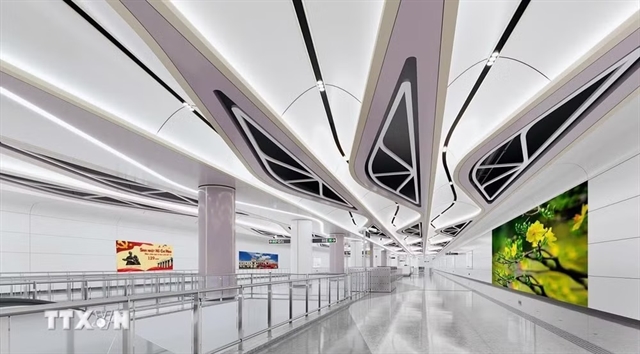 |
| An artist's impression of Tao Đàn Station on the planned Metro Line No. 2 in HCM City, which connects Bến Thành and Tham Lương. — Photo courtesy of MAUR |
Unlocking urban space through private investment
Lê Thanh Hải, director of the Economic Application Consulting Centre under the HCM City Institute for Development Studies (HIDS), said urban and regional railways must be treated as the top priority.
Reflecting on Metro Line No.1, which took over 20 years from planning in the early 2000s to official operation in late 2024, he said: “The city must abandon traditional Official Development Assistance (ODA) processes.”
Instead, it needs to adopt Public-Private Partnerships (PPP) combined with "value capture" models, similar to those successfully utilised in Singapore and Hong Kong, where property development around stations helps fund the railway, he said.
Signs of acceleration are already visible, with major private conglomerates stepping in to study or build these vital extensions.
Vingroup is researching the Bến Thành-Cần Giờ line, while Thaco is studying the Bến Thành-Thủ Thiêm section of Metro Line No.2 and the Thủ Thiêm-Long Thành link.
Over the next decade, the city intends to complete the core network—including Metro Lines No. 2, 3a, 4, and 5—while extending Line No.1 to Bình Dương and Đồng Nai.
Prioritising TOD corridors
According to experts, long-term planning must focus on corridors that are already operational or hold high potential for restructuring.
The most urgent task is the Metro Line No.1 corridor (Văn Thánh - An Phú - Rạch Chiếc - Phước Long - Bình Thái - Suối Tiên).
“This is an immediate opportunity that is currently being missed," Hải said.
Despite running since late 2024, most stations still lack comprehensive TOD integration, surrounded only by isolated high-rises, he said.
He asked the city to complete detailed TOD planning for these stations within the next 12 to 24 months to avoid spontaneous, uncoordinated urbanisation.
Key priority areas include streamlining density at An Phú-Thảo Điền, developing an eastern hub at Rạch Chiếc, and building a tech-education TOD hub at Suối Tiên.
In addition, the Bến Thành-Thủ Thiêm-Ba Son core will serve as a multi-modal financial heart, while the Thủ Thiêm-Long Thành corridor will connect the city to the new airport.
Furthermore, urban planning must balance demographics and social welfare.
Nguyễn Đình Hòa, an expert from the HCM City Institute of Economics and Management, proposed a mandatory quota requiring 30 to 40 per cent of construction floor area around metro stations to be allocated for affordable social housing or long-term rentals.
“This ensures that low-income groups — the primary users of public transit — have access to housing, thereby optimising metro ridership and preventing urban socio-economic disparity.”
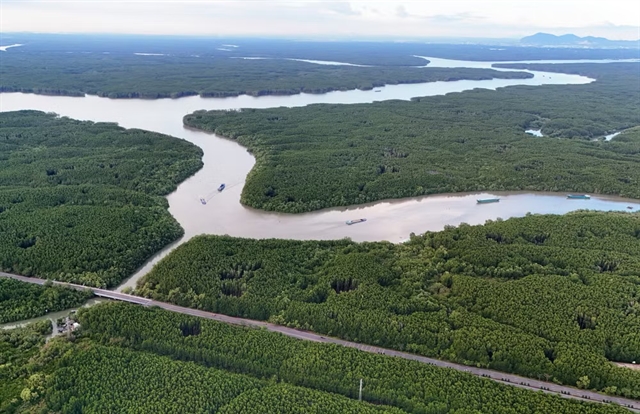 |
| The planned Bến Thành - Cần Giờ metro line will run along Rừng Sác Highway, laying the foundation for the green transition of the coastal commune. — VNA/VNS Photo Hồng Đạt |
Experts said that TOD should not be misinterpreted as merely building high-density real estate next to train stations.
Genuine TOD requires an integrated, multi-functional design that prioritises pedestrians, offers authentic public spaces, and utilises land-value capture financial mechanisms to fund public assets.
To realise this vision, the city has proposed a "Strategic Development Framework and Macro Urban Capacity" that sets a realistic population ceiling of 18-20 million by 2040, and 22-25 million by 2060.
It plans to transition towards hyper-dense urban nodes within a 300-to-500-metre radius around metro stations, such as along the Metro Line 1 axis or the Thanh Đa Peninsula.
Urban planners also recommend that the city abandon piecemeal land clearance in favour of large-scale land consolidation.
Under this strategy, the State would reclaim and re-plan entire zones, allowing affected residents to be resettled on-site in modern, synchronised apartment complexes.
With the institutional backing of Resolution 09-NQ/TW and the draft Law on Special Urban Areas, the city is well-positioned to unlock its spatial potential, transforming itself from a congested city into a highly liveable, globally competitive regional megacity. — VNS
Society
 Society
 Society
 Society
 Society
 Society
 Society
 Society
 Society
 Society
 Society
 Society
.jpeg) Society
Society
 Society
 Society