 Society
Việt Nam, Singapore promote cooperation through Party-to-Party channel
1.
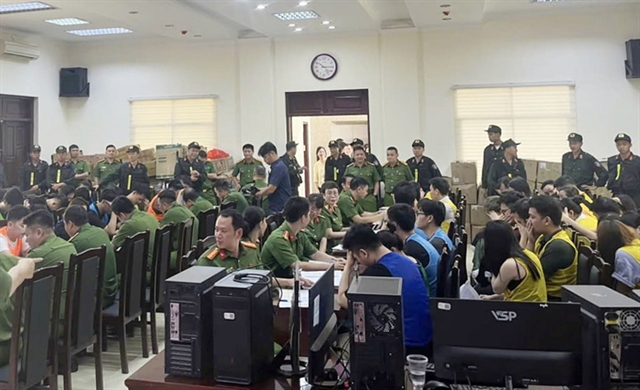 |
| Police questioning the suspects. The suspects carried out fraud in two main ways: selling holiday packages and transferring them in order to misappropriate money from victims. Photo courtesy of the Hà Nội City Police. |
HÀ NỘI — Hà Nội City Police announced on June 17 that 187 people had been prosecuted in the initial phase of an investigation into a holiday package fraud scheme.
The suspects carried out fraud in two main ways: selling holiday packages and transferring them in order to misappropriate money from victims.
In reality, the companies involved did not sell, transfer, or lease holiday packages to any customers. Those targeted were mainly elderly people, deceived by promises that they could resell holiday cards at high prices.
Many of the companies also built entire ecosystems designed to create a closed loop through which to defraud the public.
In connection with the scheme, the Ministry of Public Security has issued a warning about organisations and individuals exploiting the "holiday contract" business model to steal money from members of the public. They typically make phone calls offering free travel vouchers and invitations to attend seminars at luxury hotels and resorts.
The most common tactic is to lure people with enticing advertisements using phrases such as "five-star holiday", "luxury resort stay", "special offer", "only a few places remaining", or "today only". Those who attend the seminars are introduced to cheap resort holiday packages that can be used over many years, with promises of easy transferability or returns on investment.
The fraudsters then use pressure tactics to compel customers to sign contracts and make large immediate payments.
Police have warned the public to exercise caution with businesses that offer abnormally high commissions and brokerage fees – such as 20 to 40 per cent – as a means of drawing people into their networks. — VNS
Society
 Society
 Society
 Society
 Society
 Society
 Society
 Society
.jpeg) Society
Society
 Society
 Society
 Society
 Society
 Society
 Society