 Society
Int’l cooperation helps address nuclear power workforce shortages
1.
|
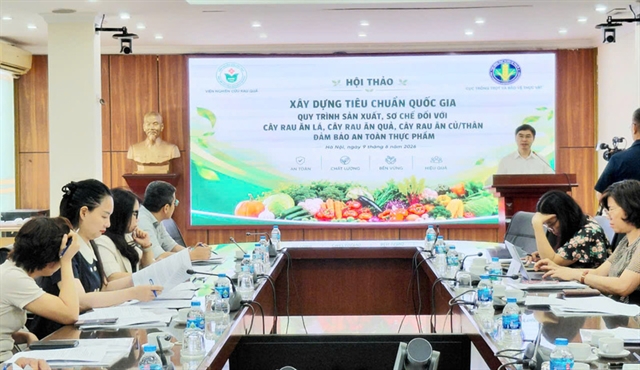
| A general view of the workshop. VNS Photo Trần Như |
HÀ NỘI — A new National Standard (TCVN) covering the production and preliminary processing of vegetables to ensure food safety is being developed to create a unified technical framework, simplify procedures and reduce compliance costs while maintaining strict quality control.
The Department of Crop Production and Plant Protection under the Ministry of Agriculture and Environment (MAE), in co-ordination with the Fruit and Vegetable Research Institute, held a workshop on June 9 to gather feedback on the draft standard.
The workshop brought together representatives from units under the MAE, standards and quality measurement agencies, local authorities, research institutes, universities, businesses, co-operatives, certification bodies and experts in crop production and food safety.
The aim was to finalise the draft before submission for appraisal and publication, with the goal of producing a standard that is scientifically grounded, consistent with production realities, easy to apply, transparent and cost-efficient to implement.
The organising committee noted that vegetables are an essential food group with a direct impact on public health, and that quality, safety and traceability affect both consumer rights and the competitiveness of Việt Nam's vegetable sector.
Nguyễn Xuân Điệp of the Fruit and Vegetable Research Institute said that after more than 15 years, VietGAP had laid an important foundation for safe agricultural production and traceability, but the rate of adoption remains low. In 2025, about 1.15 million hectares are under vegetable cultivation nationwide, yet the area certified under VietGAP stands at just over 8,000 hectares, equivalent to about 0.5–0.6 per cent of the total.
One of the main reasons is the gap between technical requirements and the capacity of smallholder producers and co-operatives to comply. Certification costs, record-keeping, documentation and monitoring remain high, making it difficult to scale up the model.
At the same time, the market is increasingly demanding higher standards of food safety, information transparency and sustainable development, requiring a more flexible and practical approach.
According to the drafting committee, the new TCVN does not replace existing standards such as VietGAP, ASEAN GAP, GLOBALG.A.P or ISO 22000:2018, but builds on, updates and adjusts them to better suit domestic production conditions.
The standard has been developed to meet three main objectives: to provide a unified technical basis for management, inspection and traceability; to reduce compliance and certification costs for businesses and co-operatives; and to offer a simple, easy-to-implement procedure for farm households.
At the workshop, Nguyễn Quý Dương, Deputy Director of the Department of Crop Production and Plant Protection, stressed the need to clearly define the standard's scope of application and objectives.
He noted that most smallholder producers are currently fulfilling food safety commitments in accordance with legal regulations, an approach suited to the reality of dispersed production, but one that also calls for more effective management tools.
There are currently many different standards systems in use, including VietGAP, GlobalGAP, Rainforest Alliance, organic standards from the United States Department of Agriculture (USDA) and the EU, and environmental and sustainable development standards such as the EU Deforestation Regulation (EUDR). Each set of standards serves distinct objectives and suits different groups of producers.
It is therefore necessary to develop a simpler, more feasible standard to broaden opportunities for smallholder farmers and small-scale producers to participate in safe production supply chains.
Dương also called for clarity on whether the standard is intended for practical application or for certification purposes, as each objective entails different technical requirements. Provisions on land, water sources, fertilisers and plant protection products also need to be integrated coherently to ensure consistency with the existing standards framework.
He added that implementation should be supported by tools such as technical handbooks, production logs, assessment checklists and traceability systems.
Experts noted that the aim of the new standard is not to create a framework that is more or less stringent than existing ones, but rather to develop a practical, easy-to-apply tool capable of being widely adopted under real production conditions.
After incorporating feedback from management agencies, experts, businesses and co-operatives, the drafting committee will continue to refine the draft, with publication expected in 2026.
The issuance of the new TCVN is expected to contribute to standardising vegetable production in a safe, transparent and sustainable manner, enhance traceability, strengthen consumer confidence and broaden access to markets with high food safety and quality requirements. — VNS
Society
 Society
 Society
 Society
 Society
 Society
 Society
 Society
 Society
 Society
 Society
 Society
 Society
 Society
 Society