 Society
Int’l cooperation helps address nuclear power workforce shortages
1.
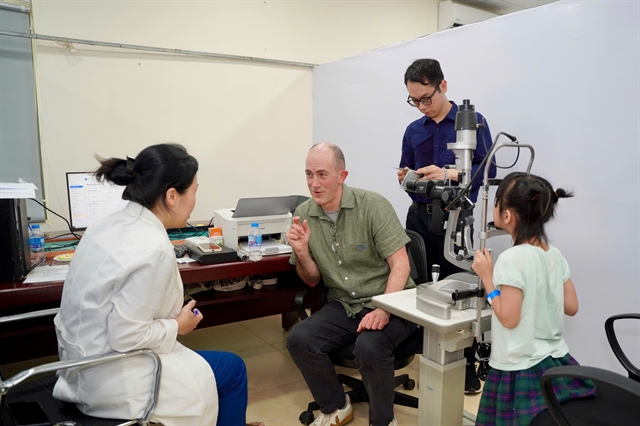 |
| Dr Timothy Robert Fricker, Director of Research and Education at the National Institute of Vision Research, Australian College of Optometry, and also Professor Emeritus at Hanoi Medical University, examines a girl at the event. — VNS Photo Thanh Hải |
HÀ NỘI — Ophthalmological experts warn that parents need to change their mindset to protect their children's eyesight, given the alarming increase in refractive errors in recent years.
According to statistics from the Vietnam Ophthalmological Society, the rate of refractive errors in children is increasing rapidly, especially in large urban areas. The rate of refractive errors among children in Việt Nam currently ranges from 34-35 per cent, while in urban areas it can reach 43-50 per cent, making it a significant public health concern.
Experts said that one of the reasons many children miss the 'golden period' for treatment is the common belief among parents that eye care is only necessary when children start school. Meanwhile, many congenital eye diseases or refractive errors can appear very early and need to be detected in the first few years of life.
 |
| Director of Đông Đô Hospital Dr Đinh Thị Phương Thủy speaks at the event. — VNS Photo Thanh Hải |
Speaking at a scientific seminar on June 7, Director of Đông Đô Hospital Dr Đinh Thị Phương Thủy said that the rate of myopia in Vietnamese children is increasing at an alarming rate, reaching 50-70 per cent in some areas, along with other visual disorders such as astigmatism and amblyopia.
“These are problems that occur silently but directly impact children's learning, development, and future, Dr Thủy said.
One of the main concerns is that many cases are detected when the disease has already progressed, reducing the effectiveness of treatment and causing long-term effects on children's vision.”
According to Dr Thủy, one of the important reasons for the increase in the rate of myopia is the change in the living environment and lifestyle habits of modern children. While many years ago, children spent most of their time playing outdoors, running and jumping in fields, playgrounds, or open spaces, today they spend most of their time within four walls and surrounded by technological devices.
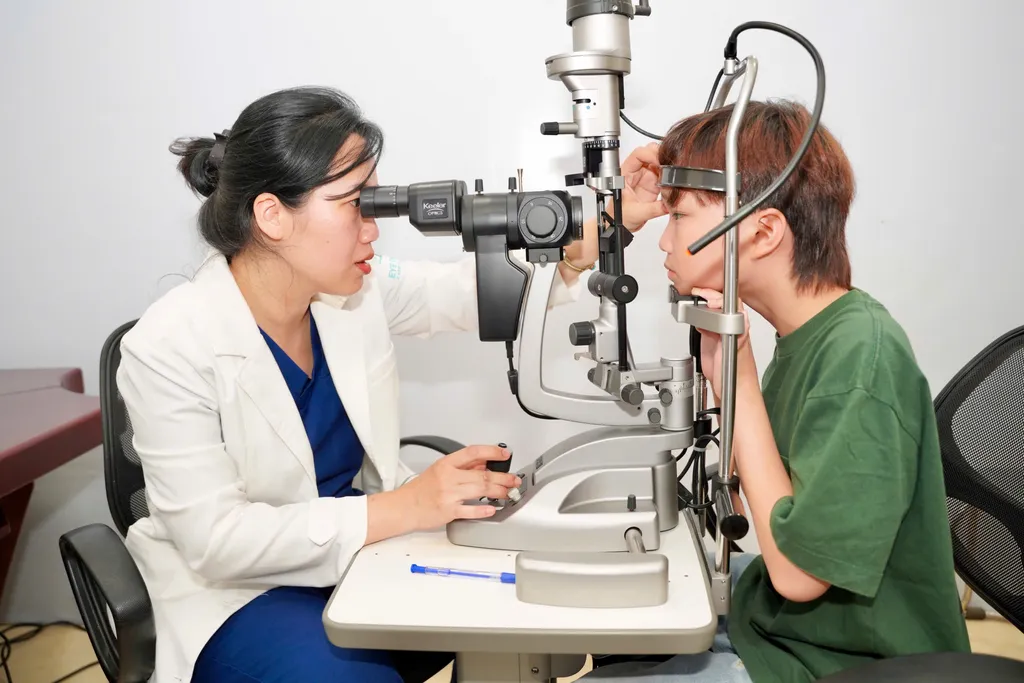 |
| Đông Đô Hospital's pediatric eye specialist, Dr. Đoàn Lê Trang, examines a boy at the event. — VNS Photo Thanh Hải |
She said: "Natural light is considered a particularly important factor for eye development. When children are active outdoors, their eyes are exposed to very high-intensity light sources, ranging from approximately 10,000 to over 100,000 lux.
"This light source stimulates the retina to release dopamine, a natural substance that helps prevent excessive growth of the eyeball axis – a direct cause of myopia.
"Meanwhile, indoor learning and living environments typically have light intensities of only about 300 to 500 lux, which is significantly lower than natural light conditions.
"Lack of exposure to outdoor light reduces dopamine levels, which allows the eyeballs to elongate and increases the risk of myopia."
Furthermore, ophthalmologists said that children today frequently spend long periods looking at things up close, from studying and reading to using smartphones, tablets, and other electronic devices. When the eyes constantly adjust to a distance of 20 to 40 centimetres for many hours, the lens has to work continuously, eventually leading to over-adjustment, transforming pseudomyopia into true myopia.
To protect children's eyesight, the most important measure is to increase outdoor activity time to at least two hours per day, as natural light (even on cloudy days) helps reduce the risk of developing myopia and supports eye health. Children can play sports, walk or engage in normal activities
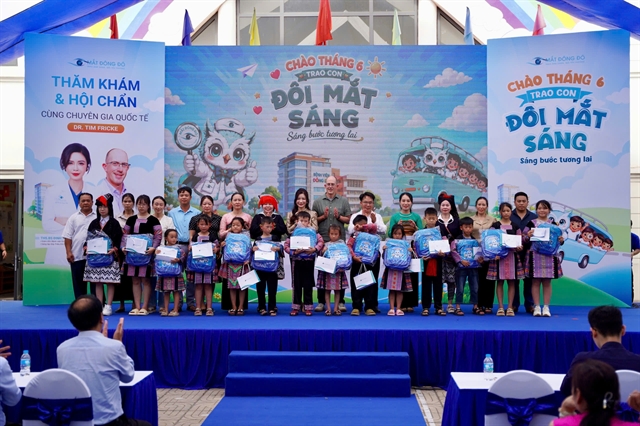 |
| Gifts are presented to ethnic and minority students from Pà Cò Primary and Secondary School in Phú Thọ Province. — VNS Photo Thanh Hải |
Experts also believe that regular eye exams play a particularly important role in the early detection of refractive errors. Many children are unaware of their vision abnormalities or do not know how to express them to adults. Therefore, the attention of parents and schools is crucial in early detection, timely intervention, and prevention of long-term consequences for vision.
The workshop was part of the 'Children's Eye Examination Day' programme organised by Đông Đô Hospital, with the participation of over 300 children and parents, along with many experiential activities, games, and free eye screenings for children.
During the programme, doctors screened hundreds of children for refractive errors, including ethnic and minority students from Pà Cò Primary and Secondary School in Phú Thọ Province.
The programme is part of a series of community activities aimed at helping Vietnamese children have healthy eyes, reduce the risk of refractive errors and develop comprehensively in both academics and physical health, attracting hundreds of children to have their refractive errors checked. — VNS
Society
 Society
 Society
 Society
 Society
 Society
 Society
 Society
 Society
 Society
 Society
 Society
 Society
 Society
 Society