 Society

SCEX completes level 4 information system security assessment, moving closer to official operations
1.
.jpg)
|
| Clams from Đồng Tháp Province’s Gò Công coastare renowned for their quality meat and attractive appearance. — VNA/VNS Photo |
ĐỒNG THÁP — Coastal aquaculture is emerging as a key driver of economic growth in the Mekong Delta province of Đồng Tháp, where authorities are expanding farming zones for shrimp, clams, and blood cockles to create jobs and improve incomes.
Taking advantage of its 32km Gò Công coast, the province has developed large-scale aquaculture areas in the coastal communes of Gò Công Đông and Tân Phú Đông.
These have become an important source of livelihood for thousands of farmers, and support seafood processing and exports.
Tân Phú Đông has about 6,600ha of marine aquaculture, producing around 44,000 tonnes of seafood annually.
Alongside traditional shrimp farming, local farmers have increasingly adopted advanced techniques such as two-stage brackish-water shrimp farming.
The model delivers average yields of 40-70 tonnes per hectare as against the 15-20 tonnes typically achieved through conventional methods.
A growing number of farmers have also invested in high-tech shrimp farming, which now covers more than 140ha.
One of the most successful examples is the operation run by Ngô Minh Tuấn, who manages five enclosed greenhouse shrimp farms spanning 36ha.
Last year, they produced more than 400 tonnes of white-leg shrimp, generating billions of đồng in profits.
Tuấn said high-tech farming allows producers to better control water quality and environmental conditions, improve productivity, and reduce disease risks.
Rather than expanding the farming area, he is focusing on more investment in technology to increase output and lower costs, he said.
The commune is also home to the Phú Tân Aquaculture Cooperative, which manages 282ha of tidal flats in the Cồn Ngang area for clam farming and has around 4,000 members.
According to its director Trần Hoàng Hải, extreme weather conditions this year have caused clam mortality in some farming areas, but preparations are under way for the first commercial harvest of the year.
Lê Thanh Đằng, chairman of the Tân Phú Đông People's Committee, said the development of the Nam Gò Công project and its associated irrigation infrastructure had significantly supported aquaculture and fisheries activities.
The investments have helped expand shrimp farming areas and improve the exploitation of marine resources, creating substantial income for local households while contributing to economic restructuring, he said.
Authorities have also intensified training programmes, technical workshops, and technology transfer activities to help farmers improve production efficiency and adopt more sustainable farming models.
In neighbouring Gò Công Đông, authorities maintain and develop a clam farming area covering about 2,200ha. Annual production averages around 20,000 tonnes.
Gò Công clams are well known for their quality and are widely consumed both within and outside the province.
Nguyễn Văn Út, a local clam farmer, said traders were currently purchasing commercial clams directly from farming grounds at VNĐ25,000-27,000 ($0.95-1.03) per kilogramme, depending on size.
|
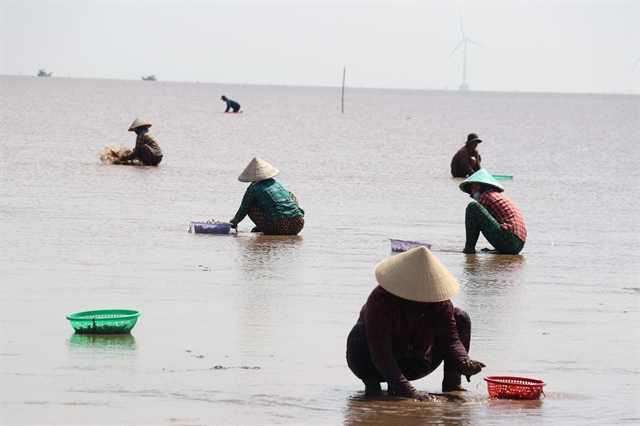
| During the harvest season, Gò Công clam farming areas attract 3,000-3,500 workers.— VNA/VNS Photo |
With average yields of about 20 tonnes per hectare, farmers can earn more than VNĐ500 million ($19,000) from each hectare of clam farming, he said.
The clam industry plays an important role in generating employment and supporting coastal communities. During the annual harvest season, clam farming areas along the Gò Công coast provide work for around 100,000 labourers, with daily earnings ranging from VNĐ1 million to VNĐ1.2 million ($38-46).
Nguyễn Tuấn Duy, chairman of the Gò Công Đông People's Committee, said local authorities had worked with the International Collaborating Centre for Aquaculture and Fisheries Sustainability and Oxfam to establish a sustainable clam management area that meets international standards.
The Gò Công clam farming area has received certification from the Aquaculture Stewardship Council, becoming the fourth certified clam farming area in Việt Nam and the fourth in the world to achieve the standard.
The certification is expected to strengthen the reputation of Gò Công clams, expand market access, and create favourable conditions for exports.
To support the long-term development of the sector, the provincial Department of Agriculture and Environment is implementing a project to establish a 350-ha conservation area for clam broodstock and juvenile clams.
Đồng Tháp currently has more than 22,800ha off aquaculture, producing over one million tonnes of farmed and captured seafood each year.
The province is promoting investment incentives to attract businesses involved in aquaculture services, seafood processing, and exports.
At the same time, it is investing in infrastructure, developing seafood processing clusters, and encouraging investment in coastal economic zones.
Officials expect these efforts to strengthen the marine economy, create sustainable employment opportunities, and improve living standards for coastal residents. — VNS
Society
 Society
 Society
 Society
 Society
 Society
 Society
 Society
 Society
 Society
 Society
 Society
 Society
 Society
 Society