 Society
Việt Nam News reporters win global journalism prize about child drowning
1.
|
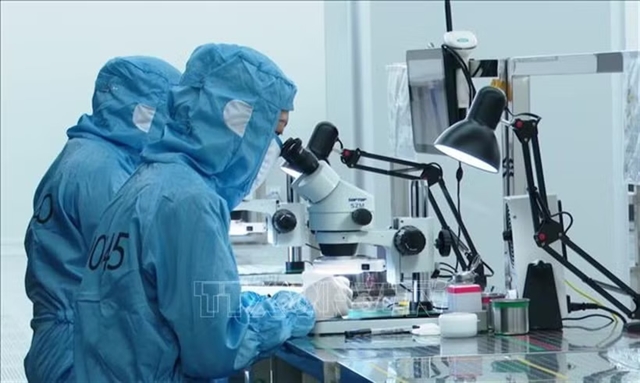
| Manufacturing cameras at the Sunny Opotech Vietnam Co., Ltd. in the Yên Bình Industrial Park, Thái Nguyên Province. — VNA/VNS Photo |
SINGAPORE — Overseas Vietnamese (OV) intellectuals in Singapore have expressed expectations that the state visit to Singapore and his anticipated keynote speech at the Shangri-La Dialogue by General Secretary of the Communist Party of Việt Nam and President of Việt Nam Tô Lâm will help open up new cooperation mechanisms between the two countries in strategic technology sectors.
They believe stronger links between the two countries’ intellectual and innovation resources could help drive breakthroughs in technology development and national competitiveness.
Building a global “brain circulation” network
Lê Anh Đức, an AI expert at Google Asia-Pacific and head of the science, technology and innovation division of the Vietnamese community's liaison board in Singapore, said Việt Nam must continue reforming governance thinking and developing high-quality human resources to achieve its development targets for 2030 and 2045.
He held that Politburo Resolution No. 57-NQ/TW has created favourable conditions for addressing workforce challenges in science, technology and innovation. In the context of globalisation, Việt Nam should move beyond the traditional concept of “brain drain” and instead build a global “brain circulation” network to connect OV expertise with domestic development needs.
He said the Vietnamese community in Singapore is working to serve as a bridge for this flow of knowledge. The recent upgrading of bilateral ties to a Comprehensive Strategic Partnership, together with the top Vietnamese leader’s ongoing visit, is expected to encourage overseas intellectuals to move from networking towards action and co-creation.
The OV community also expects the visit to lay the groundwork for breakthrough cooperation mechanisms, firstly in semiconductors and artificial intelligence. While Singapore is increasing investment in semiconductors, artificial intelligence and strategic technology centres, Việt Nam is pushing ahead with semiconductor industry development and digital transformation.
Given this, the expatriates hope the two countries can establish an interconnected cooperation mechanism in the technology supply chain, from sharing research, testing, and development infrastructure to training human resources, thereby forming a technology alliance able to compete with others in the ASEAN region and the world, the expert went on.
Đức also highlighted many OVs' interest in cross-border digital identity and data connectivity. He said linking Singapore’s Singpass platform with Việt Nam’s VNeID system could facilitate tourism, e-commerce and bilateral financial transactions while helping establish advanced regional standards for digital governance.
Some experts perceived that there remains significant room for Việt Nam–Singapore cooperation in science, technology and innovation. Potential breakthrough areas include the VNexus global digital knowledge platform connecting OV experts with domestic demand; joint research programmes between Việt Nam’s National Foundation for Science and Technology Development (NAFOSTED) and Singapore’s National Research Foundation (NRF); shared semiconductor R&D infrastructure; and cooperation in technology and data governance.
Assoc. Prof. Dr Dương Minh Hải from the Department of Mechanical Engineering at the National University of Singapore said Việt Nam possesses key advantages, including a young population, strong adaptability to technology, a dynamic entrepreneurial spirit and deeper integration into global supply chains.
If the country can capitalise on the current wave of technological shift, it could make significant advances in several strategic sectors, he said.
Hả istressed that Việt Nam should view investment in science and technology as an investment in its future. He also called for building a stronger innovation ecosystem linking the State, universities, research institutes, businesses and startups, while creating more opportunities for young talent and breakthrough ideas.
With strong political commitment and support from scientists, businesses and younger generations, Việt Nam could gradually transition from a processing-based economy to one driven by innovation and high technology, Hải noted.
Supporting young scientists
OV intellectuals also voiced support for the Programme for Excellent Basic Research for 2026–35 (PEBR), which aims by 2030 to support and connect at least 500 PhD holders, doctoral candidates, postdoctoral researchers and young scientists, including 100 capable of leading international-level independent research teams.
According to Đức, the target is achievable if Việt Nam effectively mobilises intellectual resources both at home and abroad. He said the country needs experts who not only possess deep academic expertise but are also capable of applying technology to solve practical challenges.
Đức proposed expanding science and technology programmes for young people, introducing flexible mechanisms to invite OV experts to participate in major national projects, and strengthening partnerships between universities and businesses. He also suggested creating favourable conditions for Vietnamese students and researchers abroad to return for internships, research and startup activities in the homeland.
Regarding talent attraction policies, he said Việt Nam should empower experts to play a greater role in shaping national science and technology strategies, establish flexible advisory mechanisms for OV intellectuals, and selectively invest in leading research institutions. He also proposed introducing data-sharing frameworks and regulatory sandboxes to support innovation and technology experimentation.
Hải described these orientations as strategically important amid intensifying global technology competition. He said Việt Nam should create opportunities for young scientists early in their careers through seed funding programmes, transparent academic environments and merit-based evaluation systems.
Hải said Việt Nam–Singapore cooperation in science, technology, innovation and digital transformation holds enormous potential because the two economies complement each other well. Promising areas for collaboration include AI, digital transformation, green technology, semiconductors and startup ecosystems.
He stressed that future cooperation should move beyond simply purchasing technology towards jointly researching, testing and commercialising new technologies, helping create a stronger and more sustainable foundation for strategic innovation cooperation within ASEAN. — VNA/VNS
Society
 Society
 Society
 Society
 Society
 Society
 Society
 Society
 Society
 Society
 Society
 Society
 Society
 Society
 Society