 Society
Vietnamese Prime Minister meets Cambodian National Assembly President
1.
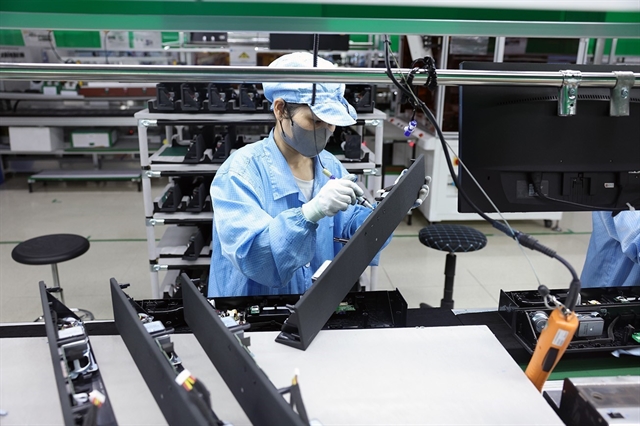 |
| A worker inspects products on a speaker assembly line at a factory in Đông Mai Industrial Park, Quảng Ninh. — VNA/VNS Photo |
QUẢNG NINH — For decades, the northeastern province of Quảng Ninh was synonymous with coal. Its economy was built around mining, thermal power and heavy industry, making it a major industrial centre in Việt Nam.
Now, Quảng Ninh is trying to reinvent itself.
As the country pushes for a more sustainable and higher-value growth model, the province has been steadily shifting away from an economy dominated by resource extraction towards one increasingly driven by manufacturing and processing.
Between 2021 and 2025, Quảng Ninh’s manufacturing and processing sector grew by an average of around 20 per cent annually, according to provincial data. Its share of the province’s gross regional domestic product rose from 11.4 per cent in 2021 to about 13.25 per cent in 2025.
The momentum has continued this year. In the first quarter of 2026, eight of Quảng Ninh’s nine key manufacturing products met or exceeded official growth targets.
Provincial authorities have spent the past several years trying to make Quảng Ninh more attractive to industrial investors. Administrative reforms have been paired with major infrastructure spending, including highways, ports, industrial parks and economic zones designed to strengthen the province’s role in regional supply chains.
Location has also worked in Quảng Ninh’s favour. Bordering China and sitting along key trade routes, the province has developed one of northern Việt Nam’s most extensive transport and logistics networks.
It now has a modern seaport system, expressways linking it to neighbouring provinces and cities, an international airport and several major border crossings, including Móng Cái International Border Gate.
Trade through the Móng Cái crossing has grown rapidly alongside the province’s industrial expansion. From the start of 2025 to mid-November, import-export turnover through the border gate exceeded US$5.32 billion, accounting for more than 97 per cent of Quảng Ninh’s total trade turnover.
For manufacturers, the province’s logistics network offers a practical advantage: lower transport costs, shorter delivery times and easier access to the Chinese market and the wider Northeast Asian region.
That, in turn, has helped attract investment into newer industries. Electronics and electronic components, automotive support industries, high-tech construction materials and renewable energy equipment manufacturing are all beginning to expand in the province.
By the end of 2025, Quảng Ninh had 1,273 businesses operating in the processing and manufacturing sector. Across the province’s industrial parks and economic zones, 158 production projects and factories were already in operation, many focused on textiles, electronics, machinery and supporting industries.
The province’s growing manufacturing base has also reshaped its trade profile. Exports nearly doubled from $3.49 billion in 2021 to $6.51 billion in 2025, while imports rose from $3.16 billion to $5.57 billion over the same period. Where Quảng Ninh once relied heavily on raw materials and border commerce, industrial production is now playing a much larger role in driving trade growth.
Still, the transition is far from complete.
Much of the province’s manufacturing output remains concentrated in relatively low-value industries such as textiles, clinker, cement and synthetic fibre production. Local officials have also acknowledged weaknesses in research and development, innovation and digital transformation among many businesses.
Connections between companies, universities and research institutes also remain limited, making it harder for local industries to move into more technologically advanced production.
Provincial planners say the next phase of development will focus less on expanding industrial output and more on improving quality and technological sophistication.
The province is now prioritising projects involving high technology, clean energy and energy-efficient manufacturing while also trying to organise industrial development more strategically across different areas.
Under plans for 2026-2030, the Quảng Yên-Đông Mai-Sông Khoai corridor is expected to become a centre for electronics, electrical equipment and high-tech industries.
Hải Hà is being positioned as a hub for export-oriented manufacturing and supporting industries, while the Móng Cái area is expected to expand logistics and industries linked to border trade.
Meanwhile, Uông Bí, Đông Triều and Hạ Long are expected to focus on engineering, materials production and technical services.
Labour policy has become another part of the province’s industrial strategy. Authorities say they will expand vocational training, increase the share of technically skilled workers and retrain employees from traditional industries for jobs in manufacturing and high-tech sectors.
At the same time, officials have pledged stricter oversight of delayed or underperforming projects while prioritising environmentally sustainable investment.
Coal is still deeply tied to Quảng Ninh’s economy and identity. But the province’s long-term ambitions now clearly extend beyond mining.
What is emerging instead is a province trying to reposition itself as a manufacturing and logistics hub, more closely connected to regional supply chains and better aligned with Việt Nam’s broader push towards higher-value industrial growth. — VNS
Society
 Society
 Society
 Society
 Society
 Society
 Society
 Society
 Society
.jpeg) Society
Society
 Society
 Society
 Society
 Society
 Society