 Society
Vietnamese Prime Minister meets Cambodian National Assembly President
1.
|
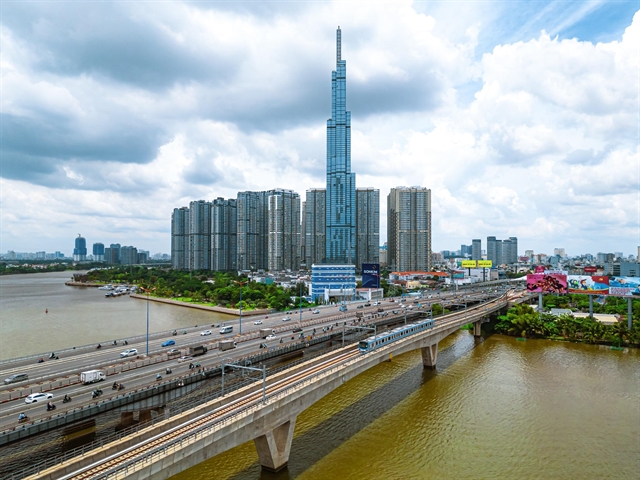
| HCM City’s skyline is seen from above. Urban railway development is central to the city’s long-term strategy to become a globally connected metropolis. — VNA/VNS Photo |
HCM CITY — The Politburo of the Communist Party of Việt Nam has set an ambitious vision for HCM City to become a global city by 2075, setting out economic growth targets, infrastructure benchmarks and special legal mechanisms to boost the southern economic hub’s global competitiveness.
HCM City currently contributes about a quarter of Việt Nam’s economic output, making its long-term transformation central to the country’s broader development strategy.
The resolution on the construction and development of HCM City in the new era, issued earlier this month, sets out a long-term roadmap to transform the metropolis into a smart, modern and sustainable urban centre on par with leading cities worldwide.
Under the resolution, by 2030, HCM City is expected to become a civilised, modern, dynamic and innovative metropolis serving as the country’s leading centre for economic, cultural, social, scientific and technological development, innovation, logistics and international integration, while holding a prominent position in Southeast Asia.
By 2045, the city is envisioned as a major economic, cultural, scientific and innovation hub of Asia, recognised as a globally attractive destination with a high quality of life and deep international integration.
By 2075, marking 100 years since national reunification, the city is expected to attain global city status, characterised by comprehensive development, green and sustainable growth, advanced climate resilience and living standards comparable to those of developed urban centres worldwide.
Double-digit growth
The Politburo set a minimum annual gross regional domestic product (GRDP) growth target of 10 per cent for the 2026-2045 period.
By 2030, HCM City is expected to achieve per capita GRDP of at least US$14,000, with the digital economy accounting for about 40 per cent of total output.
The city is also tasked with completing around 200 kilometres of urban railway lines, raising its Human Development Index (HDI) to around 0.9, and largely resolving chronic urban challenges including flooding, environmental pollution, traffic congestion and drug-related issues.
By 2035, per capita GRDP is projected to reach at least $25,000, with the digital economy contributing 60 per cent of GRDP.
By 2045, the target rises to at least $75,000 per capita, alongside full connectivity of the urban railway network and the achievement of net-zero emissions.
For the 2046-2075 period, the city is required to maintain annual GRDP growth of at least 6 per cent.
By 2075, per capita GRDP is expected to exceed $100,000, while social equity, environmental protection and human development indicators are to remain at high levels.
The ambitious targets underscore the scale of institutional reform, infrastructure investment and regional coordination needed as the city faces mounting pressures from rapid urbanisation and climate change.
New growth model
To achieve these goals, the resolution calls for a new growth model driven by science and technology, innovation, digital transformation, higher labour productivity and enhanced competitiveness.
The city is directed to strengthen research and technological capabilities in strategic sectors including information technology, artificial intelligence, semiconductors, biotechnology, clean energy, advanced materials, marine technologies and the green economy.
The Politburo also called for special policies to attract investment and technology transfer, particularly in core and foundational technologies, while expanding high-tech parks, concentrated digital technology zones, science and technology urban areas, research institutes and universities.
A stronger science and technology market is expected to attract multinational corporations to establish research, innovation and technology transfer centres in the city.
The resolution also outlines plans for HCM City to develop into a national marine economic centre, focusing on maritime industries, logistics, oil and gas, renewable energy, tourism and sustainable coastal urban development, while strengthening regional and international financial and logistics hubs.
Special urban law needed
A special urban law for HCM City will be drafted to create an exceptional legal framework, enabling the city to pilot new policies and apply mechanisms beyond existing regulations to maximise development potential and mobilise resources more effectively.
The Politburo also instructed the city to formulate a comprehensive master plan with a 100-year vision aimed at expanding development space and improving climate resilience.
New satellite urban areas are to be developed around the metropolitan core, alongside major infrastructure projects including the Cái Mép Hạ port cluster, the Cần Giờ international transshipment port, regional railway connections, expanded metro systems and upgraded maritime and inland waterway transport networks.
The resolution emphasises that the city’s development must remain people-centred, with a focus on improving living standards and fostering a civic identity rooted in patriotism, resilience, solidarity, compassion, dynamism and creativity. — VNS
Society
 Society
 Society
 Society
 Society
 Society
 Society
 Society
.jpeg) Society
Society
 Society
 Society
 Society
 Society
 Society
 Society