 Society
Vietnamese Prime Minister meets Cambodian National Assembly President
1.
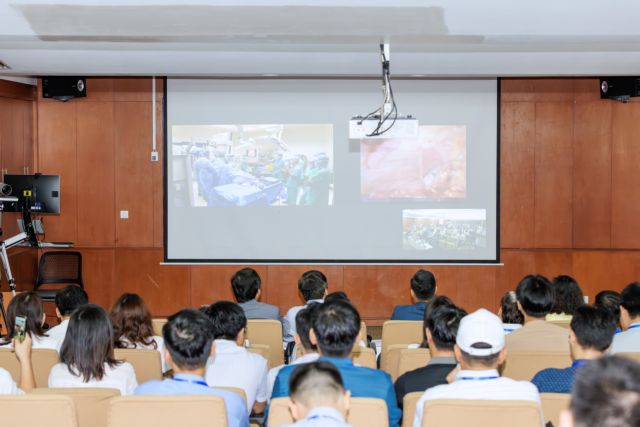 |
| A large number of Vietnamese doctors monitored the robotic gastrectomy procedure live from the FV Hospital operating room. — Photo courtesy of the hospital |
HCM CITY — Robotic gastric cancer surgeries using the da Vinci Xi system were broadcast live from the operating room at FV Hospital as part of the sixth HCM City International Gastric Cancer Forum 2026.
Held from May 13 to 16 at University Medical Center, HCM City, the forum focused on the latest trends in minimally invasive treatment, multimodal therapy strategies, and the application of advanced technologies in gastrointestinal surgery.
The event gathered more than 500 local and international experts in surgery, endoscopy, chemotherapy, pathology, and robotic surgery from Japan, South Korea, mainland China, Taiwan (China), Malaysia, and other countries and territories.
On May 13 and 14, four live demonstration surgeries were performed at FV Hospital and broadcast to audiences at both FV Hospital and the University Medical Center HCM City.
The procedures included two robotic total gastrectomy procedures using the da Vinci Xi system, one laparoscopic distal gastrectomy with D2 lymph node dissection for a patient with locally advanced gastric cancer, and one laparoscopic procedure for a 60-year-old patient with precancerous gastric lesions.
The robotic surgeries were carried out by leading Japanese specialists alongside doctors from FV Hospital and the University Medical Center HCM City.
The team included Prof. Koichi Suda, deputy director of Fujita Health University Hospital; Prof. Ichiro Uyama, head of the Department of Endoscopic and Robotic Surgery at Fujita Health University, who has performed more than 1,000 robotic surgeries for gastric and esophageal cancer; Assoc. Prof. Masaya Nakauchi, a specialist in robotic gastrectomy and esophagectomy; Dr. Phan Văn Thái, head of the General Surgery Department at FV Hospital; and Dr. Nguyễn Viết Hải from the Gastrointestinal Surgery Department of the University Medical Center HCM City.
The remaining two laparoscopic procedures were performed by surgeons from the two hospitals, with support from Noriyuki Inaki, a leading Japanese expert in laparoscopic surgery and post-gastrectomy reconstruction.
One of the robotic surgeries involved a 51-year-old woman with diffuse infiltrative gastric cancer with signs of metastasis who had nearly lost the ability to eat. The complex operation lasted more than seven hours and successfully removed the patient’s entire stomach.
“This was a very difficult case. In Japan, surgery might no longer have been indicated because of the advanced stage of the cancer. However, thanks to the da Vinci Xi robotic system, which provides enhanced visualization and highly flexible manipulation in complex anatomical areas, we were able to perform the procedure with great precision. This case clearly demonstrates the advantages of robotic surgery,” Prof. Ichiro Uyama said after the operation.
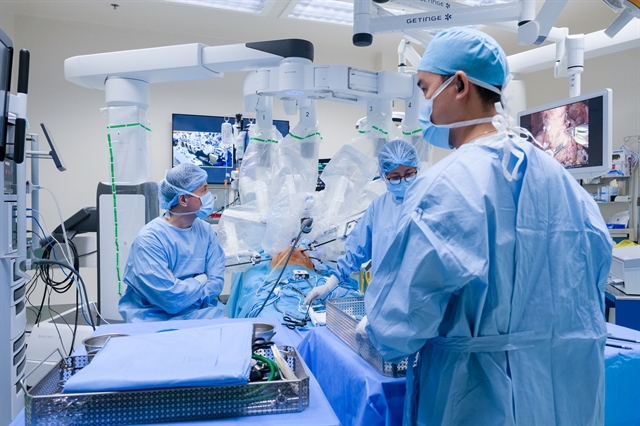 |
| The total gastrectomy procedure was broadcast live to the auditorium at FV Hospital. — Photo courtesy of the hospital |
According to organisers, hosting an international conference with the participation of leading global experts and hundreds of domestic surgeons helps strengthen the international profile of Việt Nam’s surgical sector.
Dr. Jean-Marcel Guillon, CEO of FV Hospital, said the event reflected the hospital’s commitment to promoting collaboration between Vietnamese and international healthcare institutions.
“Through these partnerships, advanced surgical techniques in cancer treatment can be updated, shared, and transferred to improve treatment quality for patients in Việt Nam,” he said.
Robotic surgery remains a highly specialised field requiring substantial investment, resulting in only a limited number of next-generation robotic systems being available in Việt Nam.
Since the da Vinci Xi robotic system was introduced at FV Hospital, the hospital has developed a collaborative model aimed at facilitating training and certification for surgeons and specialists from other hospitals, allowing them to use FV’s robotic system in patient treatment, Guillon added.
Meanwhile, Assoc. Prof. Võ Duy Long, deputy head of the Department of Gastrointestinal Surgery at the University Medical Center HCM City, described robotic surgery as the next evolution of laparoscopic surgery.
“We are entering the era of robotic surgery, not only in gastric cancer treatment but across many surgical specialties,” he said.
The da Vinci Xi robotic system uses high-resolution 3D imaging and flexible robotic arms, enabling surgeons to perform more precise lymph node dissections while minimising damage to healthy tissue, reducing blood loss, and supporting faster recovery.
As Việt Nam’s healthcare sector expands the adoption of minimally invasive technologies, collaboration between public hospitals, private hospitals, and international surgical centres is expected to improve access to advanced surgical technologies for both doctors and patients. — VNS
Society
 Society
 Society
 Society
 Society
 Society
 Society
 Society
 Society
 Society
 Society
 Society
 Society
 Society
 Society