 Society
VPBank Đất Sen Hồng Music Marathon returns with 15,500 runners in Đồng Tháp
1.
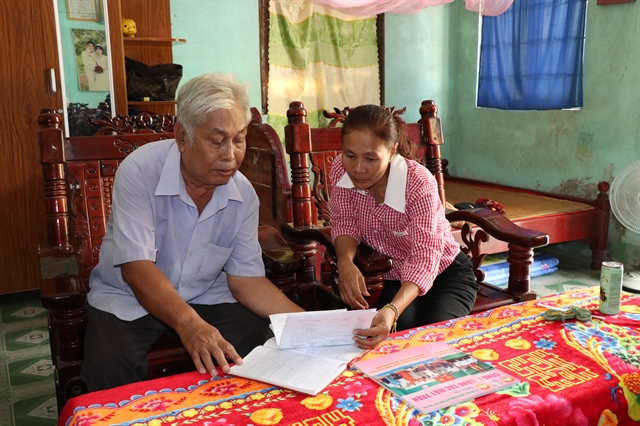 |
| Kim Thành, a respected Khmer man in Bình Phú Commune’s Nguyệt Lãng C Hamlet and head of the hamlet Fatherland Front Working Committee, discusses plans to support Khmer households with Thạch Thị Đa Ny, head of the hamlet People’s Board. — VNA/VNS Photo Thanh Hòa |
VĨNH LONG — Respected individuals in Khmer communities across Vĩnh Long Province are playing a key role in improving livelihoods, preserving traditions and building rural solidarity.
By serving as a bridge between local authorities and Khmer communities, they have helped build public consensus and improve infrastructure in rural areas.
One typical example is Thạch Uông, 62, in Chợ Hamlet in Bình Phú Commune.
For years, he has been active in grassroots work as a member of the hamlet Fatherland Front Working Committee, head of the hamlet Red Cross Association and a contributor to elderly affairs.
Chợ Hamlet has more than 564 households, with Khmer residents accounting for more than 42 per cent of the population.
Uông regularly mobilises philanthropists to provide gifts for poor, near-poor and disadvantaged families during major holidays and festivals.
He has also connected donors with two families in particularly difficult circumstances to build Đại đoàn kết (Great solidarity) houses.
One of his most notable achievements was working with local authorities to persuade 34 households to voluntarily donate more than 3,000sq.m of land for three rural roads stretching over 1.5km.
The new roads have improved transport and the delivery of goods while making it easier for children to travel to Ánh Dương Kindergarten, Phương Thạnh A Primary School and Phương Thạnh Secondary School.
Alongside his social work, Uông has run free Khmer language classes for local children since 1986.
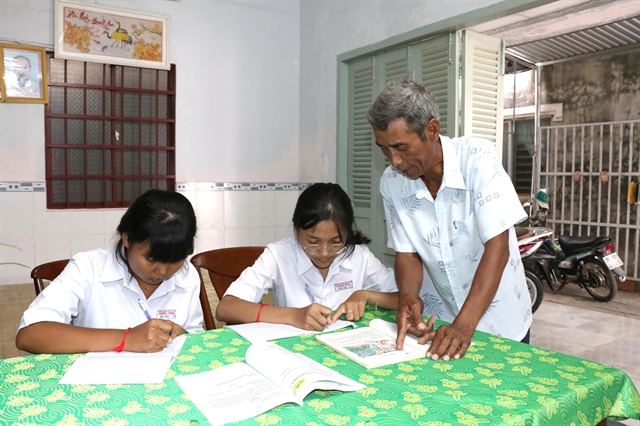 |
| Thạch Uông, a respected Khmer man in Bình Phú Commune's Chợ Hamlet, teaches the ethnic language to local students. — VNA/VNS Photo Thanh Hòa |
Thạch Ngọc Trâm, a seventh-grade student at Phương Thạnh Secondary School, said she had attended Uông’s summer classes for many years.
“I can now read and write Khmer better. I also understand and appreciate my people’s language, customs and cultural identity more.”
Thạch Riêng, head of the Chợ Hamlet People’s Board, said the locality had changed significantly thanks to the contributions of respected figures such as Uông.
About 15 years ago, more than half of households in the hamlet were poor. The number has now fallen to just two.
The average annual income has risen to VNĐ82 million (US$3,110) per person.
In Nguyệt Lãng C Hamlet in Bình Phú Commune, Kim Thành, 64, and head of the hamlet Fatherland Front Working Committee, is another example of effective grassroots mobilisation in Khmer communities.
He has encouraged local residents to help build new-style rural areas, donate land for roads, construct drainages, and improve the environment. He also regularly mediates local disputes, helping maintain security and order.
Local authorities said the role played by respected community figures had helped many areas win public support for infrastructure projects, environmental improvements and sustainable poverty reduction programmes.
The poverty rate among ethnic minorities in the province fell to 1.16 per cent last year, while 99 per cent of rural residents now have access to clean water.
Kiên Banh, deputy chairman of the Vĩnh Long Fatherland Front Committee, said the province had 445 respected figures among ethnic minority communities.
“They have made important contributions to socio-economic development, new-style rural area building and strengthening national unity in local communities.”
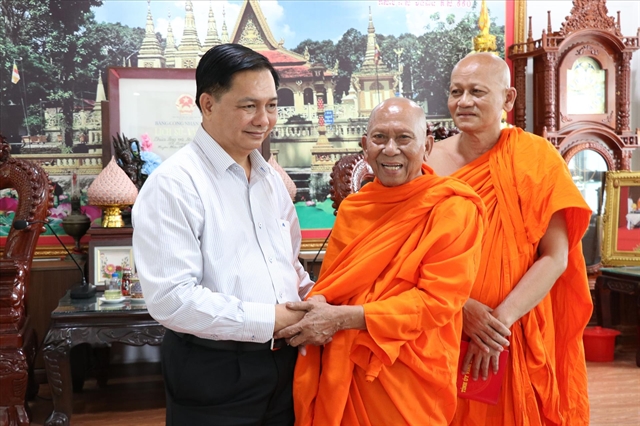 |
| Trần Văn Lâu, Secretary of the Vĩnh Long Province Party Committee, visits and extends greetings to Most Venerable Thạch Sok Xane, head of Âng Pagoda in Nguyệt Hóa Ward, on the occasion of the 2026 Chol Chnam Thmay, the Khmer New Year festival, which was celebrated from April 14 to 16. — VNA/VNS Photo |
Vĩnh Long is home to some 353,000 Khmers, or more than 10 per cent of its population, most of whom live in rural areas.
The province has one of the largest Khmer populations in the Cửu Long (Mekong) Delta and has in recent years implemented ethnic policies aimed at improving both the material and spiritual lives of Khmer people.
Programmes supporting agricultural production, vocational training, and preferential loans have helped many Khmer families improve their livelihoods.
During Khmer festivals, the province organises activities and programmes to help people celebrate in a joyful manner.
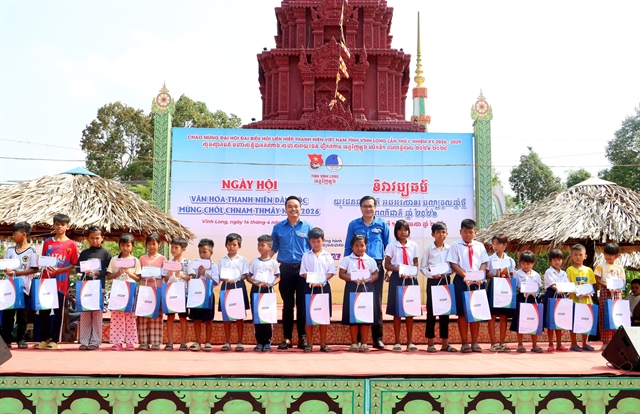 |
| Disadvantaged Khmer students with outstanding academic performance in Vĩnh Long Province are awarded scholarships on the occasion of the 2026 Chol Chnam Thmay festival. — VNA/VNS Photo |
During Chol Chnam Thmay, the traditional Khmer New Year festival held from April 14 to 16 this year, the province organised a gathering for around 800 participants, including officials, respected community figures and religious dignitaries.
Authorities also sent delegations to visit religious establishments and organisations, extend New Year greetings and present gifts to exemplary individuals.
Nearly 5,000 gift packages worth almost VNĐ2.5 billion (US$94,900) were distributed to disadvantaged Khmer households to help them celebrate the festival.
The province also organised cultural and sporting events, healthcare programmes, and public awareness campaigns to help the Khmers celebrate safely and with gaiety. — VNS
Society
 Society
 Society
 Society
 Society
 Society
 Society
 Society
 Society
 Society
 Society
 Society
 Society
 Society
 Society