 Society
Rural tourism needs to cash quantities over goods sold
1.
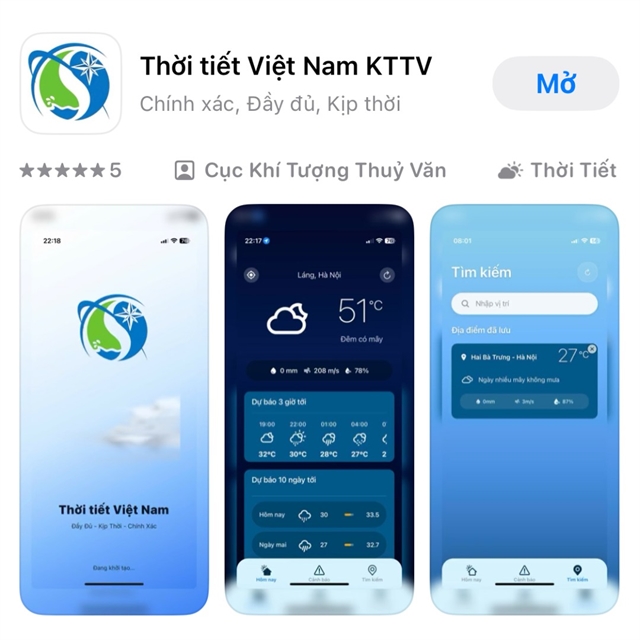 |
| The Vietnam Weather app is available free on iOS and Android. — Photo laodong.vn |
HÀ NỘI — Amid increasingly frequent extreme weather events, social media platforms have become frontline alert networks, delivering geotargeted guidance and timely response advisories that help authorities and residents monitor storms, floods, heavy rainfall and mitigate disaster risk.
The Vietnam Meteorological and Hydrological Administration (VNMHA) and the National Centre for Hydro-Meteorological Forecasting (NCHMF) maintain official channels on Facebook and Zalo, updating daily conditions and issuing rapid warnings on dangerous phenomena including heavy rain, tropical depressions and storms.
Forecasters also go live on Facebook during fast-evolving events to brief the public on the latest developments and recommended actions.
For Nguyễn Văn Minh in Hà Nội's Thư Lâm Commune, those official pages have become daily essentials.
“They’re very timely and closely reflect real conditions, which helps me plan my work proactively,” he told Vietnam News Agency.
Social media’s speed and reach are clear advantages, said Vũ Hùng of Phúc Lợi Ward, Hà Nội. But he urged users to rely on official channels and reputable experts.
"It’s convenient, but people should seek information from specialised agencies and credible forecasters,” he said.
One such expert is Dr Nguyễn Ngọc Huy, known online as 'Huy Nguyễn', who has more than two decades of experience in climate adaptation and disaster risk reduction. With nearly one million followers, his posts regularly draw thousands of interactions. Many users credit his precise, timely guidance with helping families safeguard lives and property.
“I share weather, storm and flood information naturally, it’s my field,” Huy said.
“Accurate, timely warnings on social media help people respond proactively and reduce losses.”
Targeted alerts at scale
Digital platforms allow alerts to reach millions quickly, in the right place and language, said Dr Trương Bá Kiên, Deputy Executive Director at the Centre for Meteorological and Climate Research.
Information is analysed in real time, supporting command and control at NCHMF and local disaster management committees, crucial during sudden downpours or rapidly approaching storms.
Yet the same viral dynamics that spread official warnings can amplify errors or rumours.
NCHMF Director Mai Văn Khiêm said social media has created a multi-dimensional weather information space, but also heightened scrutiny.
“Even small adjustments to forecasts can be picked apart, creating psychological pressure on forecasters,” he said.
“What troubles them most are comparisons like, ‘State-paid forecasters are less accurate than social media or TikTok analysts'.”
Experts warn that false posts can spark panic and unnecessary hoarding, or foster dangerous complacency. Tracing the origins of misleading content is difficult when it’s relayed across multiple accounts and platforms.
With demand for weather updates surging alongside social media use, accuracy and timeliness are under sharper public scrutiny.
Agencies and experts stress that raising public awareness of official sources is essential. They urge directing users to the NCHMF, provincial and municipal meteorological stations, and government channels.
People should be taught to distinguish verified updates from rumours or unverified posts. They also emphasise explaining the risks of misinformation, which can disrupt production plans and lead to life‑threatening decisions during storms. Users should be encouraged to cross-check content against official sources before sharing.
Finally, they recommend creating a recognisable verification badge for official weather channels and applying it consistently across websites, apps, and social platforms. — VNS
Society
 Society
 Society
 Society
 Society
 Society
 Society
 Society
 Society
 Society
 Society
 Society
 Society
 Society
 Society