 Society

Tighter controls on livestream sales
1.
|
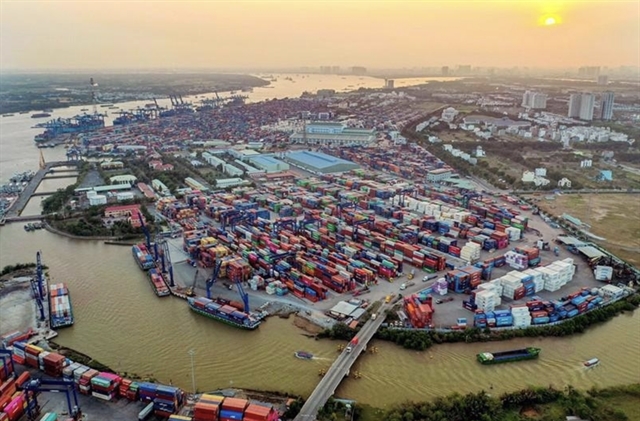
| Cát Lái Port in Thủ Đức City is a leading logistics service hub for HCM City and the region. Photo: vneconomy.vn |
HCM CITY — With new special mechanisms under recent National Assembly resolutions, HCM City is positioning itself to redefine its role in regional trade and logistics networks, aiming to become a leading logistics hub in Southeast Asia.
Experts say the opportunity comes at a critical juncture, as competition among regional economic centres intensifies and new transhipment hubs continue to emerge.
The National Assembly’s Resolution 98/2023/QH15 – and its subsequent expansion under Resolution 260 issued in December 2025 – is seen as a major policy lever enabling HCM City to pursue this transformation. The updated framework provides the city with greater flexibility to implement breakthrough policies in planning, infrastructure and institutional reform.
According to Associate Professor Nguyễn Thường Lạng of the National Economics University, the challenge is not only to expand economic scale but also to elevate the city’s development position. He suggested that HCM City should pursue a multi-pillar model, encompassing an economic hub, a technology centre, a financial and monetary centre, and an international connectivity hub.
Within this framework, trade and logistics are expected to play a central role. With its strategic geographical location, large market size and existing infrastructure base, the city has strong potential to become an international logistics hub closely linked to Việt Nam’s import-export activities.
At the same time, the development of supporting sectors such as finance, tourism and aviation could help form a comprehensive economic ecosystem, enhancing value creation across supply chains.
The city’s growing technological foundation, including its high-tech park and emerging innovation ecosystem, is also expected to play a key role. Experts emphasise that logistics development should go beyond transportation, integrating digital technologies, data and high-value services to increase competitiveness.
To realise this vision, however, a long-term strategy of sufficient scale will be required. Lạng suggested that HCM City should target an economic expansion of 30-35 times by 2050. Once such a vision is clearly defined, policy mechanisms – particularly those under Resolution 260 – must be aligned to support long-term development goals.
Experts have also underscored the importance of developing industrial belts linked to deep-water ports, alongside the planned Cần Giờ international transhipment port and a synchronised logistics system connected with free trade zones. These elements are expected to form closed supply chains and strengthen the city’s integration into global logistics networks.
Phạm Bình An, deputy director of the HCM City Institute for Development Studies, said the city is expanding its urban space towards a multi-centre megacity model, in which industrial, logistics and service hubs are interconnected into a unified value chain.
Major logistics and port projects have been identified as key pillars in this strategy, including Mỹ Xuân 6 Port, Long Sơn general port and the Long Bình inland container depot cluster. These projects are not standalone developments but part of an inter-regional logistics network linked to the Cái Mép – Thị Vải port complex and the broader transport system of the Southeast region.
The city also possesses significant maritime development potential, with around 110 kilometres of coastline stretching from Cần Giờ to Vũng Tàu, Hồ Tràm and Côn Đảo.
In particular, the Cái Mép – Thị Vải deep-water port cluster is among the world’s major container ports, capable of handling direct shipping routes to trans-Pacific and European markets. Meanwhile, ports such as Cát Lái and Hiệp Phước, together with logistics networks in Bình Dương Province, are contributing to a more integrated transport and import-export ecosystem.
Investment in seaport infrastructure is therefore viewed as a strategic priority, especially as HCM City continues to serve as a leading growth pole, contributing more than 23 per cent of the country’s gross regional domestic product.
The municipal Party Congress for the 2025-30 term has identified three key pillars of the marine economy: maritime economy and logistics; oil, energy and renewable energy; and tourism and coastal urban development.
Chairman of the municipal People’s Committee Nguyễn Văn Được said that under the city’s planning orientation, a modern Cái Mép – Cần Giờ port system will be developed as a central logistics hub for both the city and the southern region.
From a financial perspective, Nguyễn Hữu Huân, vice chairman of the executive board of the Vietnam International Financial Centre in HCM City, noted that the development of a maritime financial centre linked to logistics and international trade would open up significant opportunities.
As services such as shipbuilding finance, marine insurance, trade finance, commodity derivatives and maritime risk management are expanded, enterprises could benefit from reduced capital costs while helping to establish a liquid maritime financial market closely tied to real economic flows.
Experts believe that with the right combination of strategic vision, institutional innovation and infrastructure investment, HCM City has the potential to strengthen its position as a major regional trade and logistics hub. — VNS
Society
 Society
 Society
 Society
 Society
 Society
 Society
 Society
 Society
 Society
 Society
 Society
 Society
 Society
 Society