 Society
Việt Nam, Cambodia seek to bolster all-round ties: PMs
1.
|
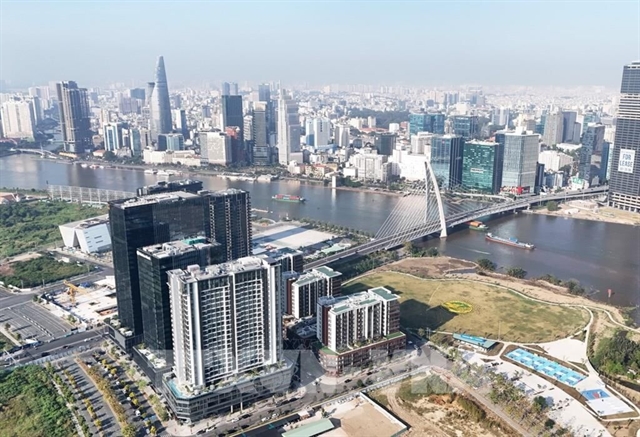
| A panoramic view of HCM City’s skyline featuring the bustling city centre and the rapidly developing Thủ Thiêm Peninsula. — VNA/VNS Photo Hồng Đạt |
HCM CITY — Fifty-one years since its liberation, HCM City has firmly established its position as Việt Nam’s primary economic locomotive, while building a comprehensive foundation for a transformative era of growth.
Rising from the destruction of war, the city has evolved from a stagnant economy into the nation’s largest commercial and industrial hub.
In the early post-liberation years, the city was a pioneer in adopting bold reforms, such as "breaking the fences" and implementing experimental management models.
These initiatives not only solved immediate shortages but also laid the critical groundwork for the national Đổi Mới (Renewal) process in 1986.
Economic prowess
As a result of these continuous efforts, the city's economic scale has reached unprecedented levels. By the end of 2024, the Gross Regional Domestic Product (GRDP) exceeded VNĐ1.7 quadrillion (US$67 billion), marking a 7.17 per cent year-on-year increase.
Remarkably, the city contributed over VNĐ502 trillion ($19.7 billion) to the State budget, accounting for approximately 27 per cent of the national total.
A landmark milestone was reached on July 1, 2025, when HCM City officially merged with Bình Dương and Bà Rịa-Vũng Tàu provinces.
This strategic expansion created a massive development corridor covering 6,772sq.km with a population exceeding 14 million people.
This merger represents more than just an administrative change; it is a strategic shift from a "single-pole" urban model to a multi-centric structure.
Guided by the "three zones - one special zone - three corridors - five pillars" framework, the city's economic scale in 2025 is projected to reach VNĐ3 quadrillion ($118 billion), contributing 23.5 per cent to national GDP, with a per capita GRDP of $8,755.
|
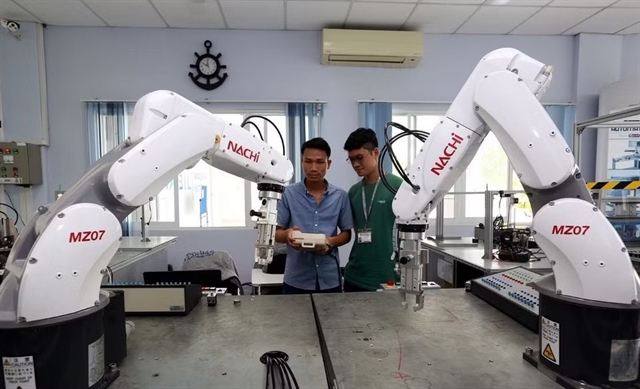
| Trainees operate robots at the HCM City Hi-Tech Park Training Centre. Science, technology, and innovation are the core engines driving the city’s high-quality growth and regional competitiveness. — VNA/VNS Photo Danh Lam |
Infrastructure and urban connectivity
To support this expanded space, the city has aggressively modernised its infrastructure. Key achievements include:
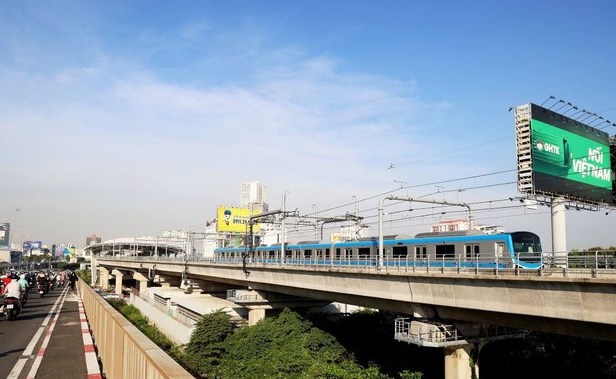
Mass transit: The successful operation of Metro Line No. 1 (Bến Thành-Suối Tiên) marks a turning point in high-capacity public transport.
Connectivity: The city now manages over 4,000km of roads, with critical projects like Ring Road 3 and strategic logistics hubs currently under accelerated construction.
Urban expansion: Beyond the traditional core, modern urban areas like Thủ Thiêm and Phú Mỹ Hưng have redefined the city's skyline, reducing population pressure on the inner city while fostering new growth poles.
Transitioning from labour-intensive industries, the city has successfully pivoted toward a knowledge-based economy.
It is now the nation’s largest startup hub, home to over 2,000 startups—accounting for 50 per cent of Việt Nam's total.
This ecosystem is currently valued at $5.2 billion, the third-highest in Southeast Asia.
By 2025, Total Factor Productivity (TFP) contributed 59 per cent to GRDP growth, reflecting a strong shift toward high-tech sectors such as AI and biotechnology.
|
| The Bến Thành-Suối Tiên Metro Line serves as a backbone for HCM City’s new multi-centric urban structure. — VNA/VNS Photo Hồng Đạt |
Furthermore, the inauguration of the International Financial Centre in February 2026 has added a vital pillar, elevating the city's status within the regional financial network and driving institutional reform.
Parallel to economic growth, the city emphasises social pillars as the foundation for long-term stability.
The education system has expanded to 2,300 schools, while the healthcare network features 130 hospitals with 40,000 beds, serving as a specialised medical hub for the entire southern region.
Notably, the city has implemented humane policies, such as providing 100 per cent health insurance support for students and seniors aged 65-75.
Cultural milestones have also been achieved, with UNESCO designating the city as a "Creative City of Film" in 2025.
After 51 years, the city stands at the threshold of a new era.
With an expanded footprint and a multi-centric vision, the city named after late President Hồ Chí Minh continues to fulfill its mission as a dynamic, livable metropolis and a primary driving force for national prosperity. — VNS
Society
 Society
 Society
 Society
 Society
 Society
 Society
 Society
 Society
 Society
 Society
 Society
 Society
 Society
 Society