 Society
Project to build big-data legal database approved
1.
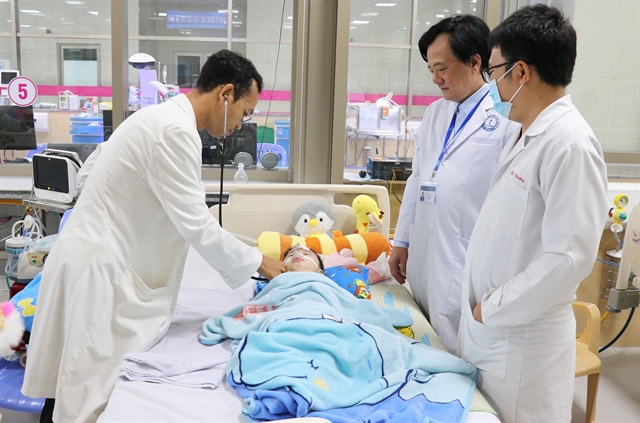 |
| Doctors at Tiền Giang General Hospital examine a child patient in the Mekong Delta province of Đồng Tháp. — VNA/VNS Photo Hữu Chí |
HÀ NỘI — The health sector will expand its satellite hospital network by adding at least 200 facilities nationwide through 2030, with an aim of ensuring that local residents can access safe, high-quality, timely and convenient health care services close to where they live.
This is a key component of the Satellite Hospital Development Project for the 2026-2030 period that was recently approved by the Ministry of Health.
Under the project, priority will be given to selecting satellite hospitals among health care facilities and medical centres located in disadvantaged, remote and isolated areas, often situated far from core 'hub' hospitals.
One major objective is to strengthen access to high-quality medical services for more rural populations.
The project requires 100 per cent of participating hub and satellite hospitals to implement remote professional support systems.
These include online training, multi-level teleconsultations, specialist advisory services and digital platforms supporting diagnosis and treatment, in line with prevailing regulations and each facility’s practical conditions.
In practice, several hub hospitals are already providing regular remote professional support to satellite facilities at the local level.
The ministry has applauded the results, noting that diagnoses and treatment decisions at local facilities are now made more quickly and accurately, while also reducing the risks associated with transferring patients to higher-level hospitals.
Guided reverse referrals
A notable new feature of the scheme is the promotion of 'guided reverse referrals'.
Under this model, patients who have completed treatment at central or highly specialised hospitals will be transferred back to appropriate satellite hospitals, accompanied by full medical records, treatment protocols and detailed clinical guidance.
Hub hospitals will continue to provide treatment guidance, consultations and telemedicine support to satellite hospitals using technology, ensuring continuity of care until patients are discharged and attend follow-up appointments.
The project also stipulates that all participating health care personnel must be directly involved in handling emergency cases, severe illnesses, high-risk conditions and other clinical situations where referral to higher or equivalent levels of care could delay intervention or increase the risk of mortality, complications or long-term sequelae.
At the same time, all such personnel will receive ongoing training, retraining, professional development, support and supervision to enhance their clinical capacity.
Reducing referrals by 20 per cent
With these measures in place, the project sets a target of reducing by at least 20 per cent the number of patients referred to higher or equivalent levels of technical expertise for conditions and procedures that have already been transferred, supported or trained at satellite hospitals, compared to pre-implementation levels.
Eligible satellite hospitals will be able to receive direct and simultaneous support from one or more hub hospitals.
Deputy Minister of Health Trần Văn Thuấn said the project aims to consolidate, strengthen and expand the nationwide network of hub and satellite hospitals in a manner aligned with regional health care needs and the broader development orientation of the health care system.
The ministry also encourages qualified private hospitals to participate in the scheme.
By 2030, the project is expected to be implemented nationwide, with a focus on specialties that see high referral rates and demand for advanced techniques.
These include oncology, nuclear medicine, surgery, trauma and anaesthesia-intensive care, cardiology, emergency medicine, intensive care and toxicology, stroke care, respiratory medicine, obstetrics, paediatrics, haematology and blood transfusion, endocrinology, dermatology, psychiatry, diagnostic imaging and burn treatment. — VNS
Society
 Society
 Society
 Society
 Society
 Society
 Society
 Society
 Society
 Society
 Society
 Society
 Society
 Society
 Society