 Society
Cần Thơ strengthens water management, tackles illegal groundwater extraction
1.
|
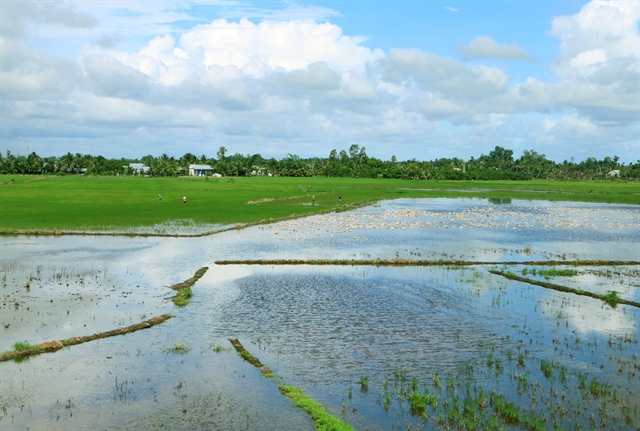
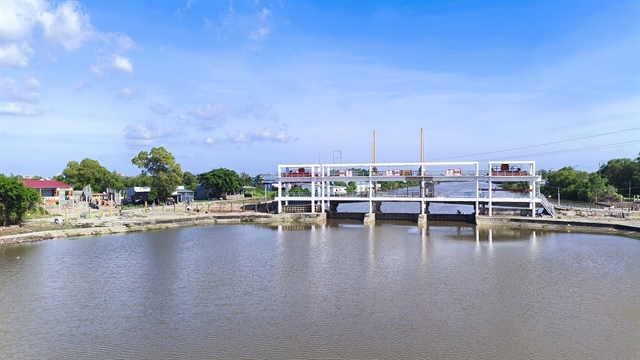
| A saltwater exclusion gate and freshwater storage structure in Cà Mau Province. The Politburo wants effective measures to prevent saltwater intrusion and ensuring water security in the Mekong Delta. — VNA/VNS Photo Chanh Đa |
HÀ NỘI — The Communist Party of Việt Nam's Politburo has concluded that comprehensive long-term solutions are needed to limit subsidence, erosion, flooding, drought and saltwater intrusion and ensure water security in the Mekong Delta region – a populous region and also the country's biggest agriculture production area.
These solutions are called for in the Politburo’s Conclusion 26, which has been signed by Trần Cẩm Tú, Standing Secretary of the Secretariat.
According to the conclusion, these problems are becoming more complex and severe in the delta region due to climate change and recent shifts in the quantity and quality of water from the upstream Mekong River, as well as excessive extraction of riverbed sand and groundwater beyond natural replenishment capacity.
The Politburo has asked Party committees, Party organisations, authorities, management agencies, the Việt Nam Fatherland Front and mass associations at all levels to strengthen education on adapting to climate change.
It has also asked experts to more accurately identify the nature and causes of subsidence, erosion, flooding, drought and saltwater intrusion in the Mekong Delta to devise root-cause solutions with a specific roadmap.
In its conclusion, the Politburo emphasised the importance of residents' livelihoods and placed focus on production and socio-economic development, as well as maintaining the environment, national defence and security in the region.
Reviews and supplements to the national master plan in the second quarter of this year should include content on the issue, as should regional, sectoral and local plans, to make appropriate adjustments.
Next year, authorities will work on finishing the review and institutionalise the Party's guidelines and orientations into a system of laws and guidance documents for relevant sectors.
These include water resources, irrigation, disaster prevention and control, land, forestry, construction, mineral resources and hydrometeorology.
Environmentally friendly materials
The Politburo has directed the development of mechanisms and policies to support and encourage shifting crop structures and planting seasons that are more suitable to natural conditions.
At the same time, agro-aquaculture models adapted to climate change should be applied, and farmers should change to crop varieties and methods that use less water, are better suited to the ecological zone and improve production efficiency.
Protecting and enhancing the quality of mangrove forests and managing and exploiting carbon credits and other forest-derived benefits are also required.
Effective management of river basin water resources, irrigation systems, dikes and urban flood control is also needed.
Other tasks include developing, adjusting and realising plans for efficient and economical water use, storing water in canals, natural lakes and floodwater storage in deep-flooded areas, and creating plans and solutions for using water to cope with drought and salinity.
The Politburo has directed the arrangement and relocation of residents in areas frequently affected by flooding, with high risks of subsidence and erosion.
Research and application of technology should also be accelerated, with the integration of artificial intelligence and digital transformation in management, forecasting, monitoring and impact assessment of subsidence, erosion, flooding, drought and saltwater intrusion.
According to the conclusion, research into using recycled and environmentally friendly materials to replace riverbed sand is also crucial.
The Politburo has prioritised allocation of resources from the State budget, including loan capital and foreign aid, for tasks to prevent and combat the problem, along with strengthening inspections and the prohibition of wastefulness.
Appropriate policies are also needed to encourage and attract off-budget and public-private partnership investments in projects to prevent riverbank and coastal erosion, planting and restoring coastal mangrove forests, and building or upgrading water supply systems. — VNS
Society
 Society
 Society
 Society
 Society
 Society
 Society
 Society
 Society
 Society
 Society
 Society
 Society
 Society
 Society