 Society

Lotte, Phát Đạt combine strengths in Thu Thiem project
1.
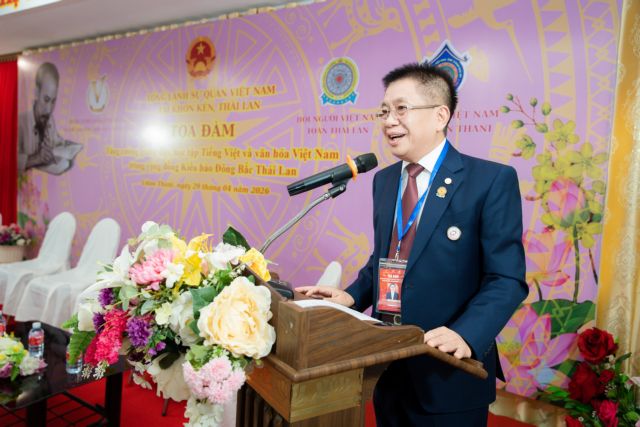 |
| President of the General Association of Vietnamese in Thailand and President of the Thai-Vietnamese Business Association, Hồ Văn Lâm, addresses the "Enhancing the Teaching and Learning of Vietnamese Language and Culture in the Northeast Thailand Community" seminar on April 29. — Photos courtesy of Nguyễn Duy Anh. |
HÀ NỘI — Twice a week, the lights at Khánh An Vietnamese School in "Vietnam Town" in Thailand’s Udon Thani Province flicker on, as the rhythmic sounds of children reciting numbers, letters, and Vietnamese poetry fill the air.
These are the voices of overseas Vietnamese children and Thai students who share a deep love for the Vietnamese language.
Founded in 2017, the school is recognised as one of the pioneering institutions for Vietnamese language education in Thailand.
"There were periods when teaching Vietnamese was not just about what happened in the classroom, it was a silent act of preservation within every family and by every teacher," said Nguyễn Thị Xuân Oanh, a teacher at the school.
She was sharing her memories and experience at the "Enhancing the Teaching and Learning of Vietnamese Language and Culture in the Northeast Thailand Community" seminar held in Udon Thani on April 29.
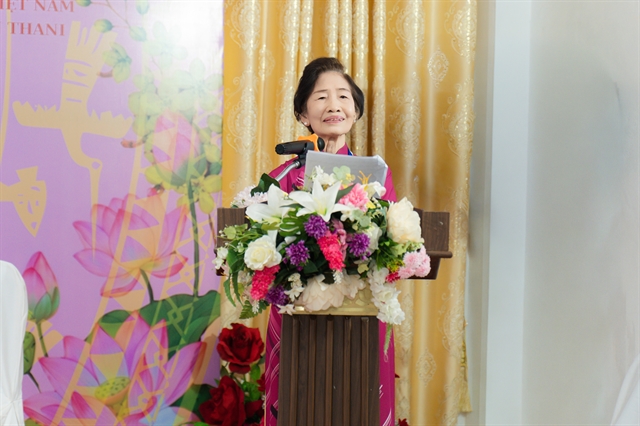 |
| Nguyễn Thị Xuân Oanh, a teacher at the Khánh An Vietnamese School in "Vietnam Town" in Thailand’s Udon Thani Province. |
What began in simple classrooms with nothing more than blackboards, chalk, and a profound love for the mother tongue, Khánh An has evolved into a cradle for the Vietnamese language movement in the region. From these humble beginnings, the language has not only survived but has flourished, weaving itself into the fabric of community life across generations.
"To this day, though some of our teachers on Thai soil have grown old or passed away, the spirit and love for the Vietnamese language continue to be preserved and passed down with fierce intensity," Oanh emotionally remarked.
From "national soul" to the community’s heart
For the Vietnamese diaspora, the language is far more than a mere tool for communication, it is a vessel for memory and a sacred thread connecting each individual to their homeland and roots. In Northeast Thailand – home to over 100,000 Vietnamese, the effort to maintain the language is not simply an educational task, it is a profound journey to preserve cultural identity.
Against this backdrop, the seminar served as more than just a professional exchange; it was an opportunity to reflect on the community's long history, from the early days of hardship to the dedicated efforts seen today in keeping the mother tongue alive.
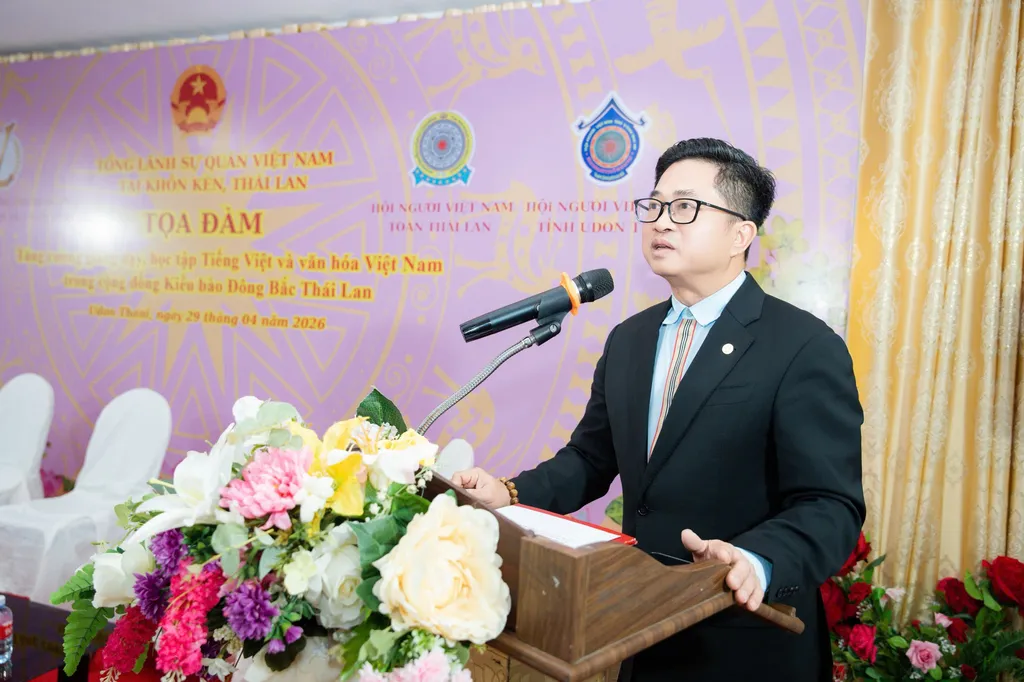 |
| The Consul General of Việt Nam in Khon Kaen, Đinh Hoàng Linh, emphasises that the Vietnamese language is the "soul and essence of the nation". |
In his opening remarks, the Consul General of Việt Nam in Khon Kaen, Đinh Hoàng Linh, emphasised that the Vietnamese language is the "soul and essence of the nation," serving as the foundation for maintaining cultural identity and connecting the overseas community with their homeland.
He recalled a historic milestone from nearly a century ago, when late President Hồ Chí Minh opened Vietnamese language classes for the community in Udon Thani, laying the very first foundation for the Vietnamese education movement in Thailand.
Nurturing Vietnamese through generations
While Vietnamese communities in many other countries consist primarily of the first and second generations, the Vietnamese language in Northeast Thailand has endured through the third and fourth generations — a rare and precious achievement.
According to member of the Vietnam Fatherland Front Central Committee and the General Secretary of the Global Network for Vietnamese Language and Culture Teaching, Nguyễn Duy Anh, this long-standing continuity is the unique value of the Vietnamese community in Thailand.
“This sustainability stems not only from formal classrooms but also from the way the language is nurtured within families, through community activities, and in the collective memory of multiple generations,” he told Việt Nam News.
"In this region, Vietnamese is not just taught, it is lived within the community," he said.
From the community’s perspective, Lương Xuân Hòa, Vice President of the General Association of Vietnamese in Thailand and President of the Vietnamese Association in Udon Thani Province said that for overseas Vietnamese, the language is not merely a tool for communication but a sacred thread connecting them to their homeland.
“Safeguarding the Vietnamese language is synonymous with preserving identity and memory, ensuring that generations of Vietnamese living far from home remain connected, particularly as the community has weathered many historical ups and downs,” said Hòa.
Sharing this perspective, President of the General Association of Vietnamese in Thailand and President of the Thai-Vietnamese Business Association, Hồ Văn Lâm, asserted that the promotion of the Vietnamese language should be integrated into the community’s life as a whole, spanning from education and the economy to family life and social exchanges.
“When Vietnamese is utilised in daily routines, professional environments, and community networking, the language will not only be sustained but will also continue to be nurtured and flourish,” said Lâm.
However, amidst the context of deep global integration, challenges remain. Many delegates at the seminar noted that today’s youth tend to use the local language (Thai) more frequently, while the environments where Vietnamese is spoken — both in the home and in social circles — are gradually shrinking.
Other hurdles include as a shortage of teachers, a lack of suitable learning materials, and the absence of a natural environment for daily conversation. These issues have been documented across many Vietnamese communities worldwide.
Addressing these practical realities, various solutions were proposed, with a strong emphasis on the pivotal roles of families, schools, and community associations in cultivating a sustainable learning environment.
Need for a Vietnamese language ecosystem
One of the most highly regarded strategies discussed at the seminar was the strengthening of connections between communities through the Global Network of Vietnamese Language and Culture Teaching. Since its inception in 2025, the network has attracted hundreds of teachers and volunteers from over 130 countries and territories, becoming a vital platform for sharing expertise, educational materials, and teaching methodologies.
According to Anh, the most significant factor is not the statistics, but the growing consensus within the community: preserving the Vietnamese language is essential to maintaining the cultural foundation and the long-term vitality of the Vietnamese diaspora.
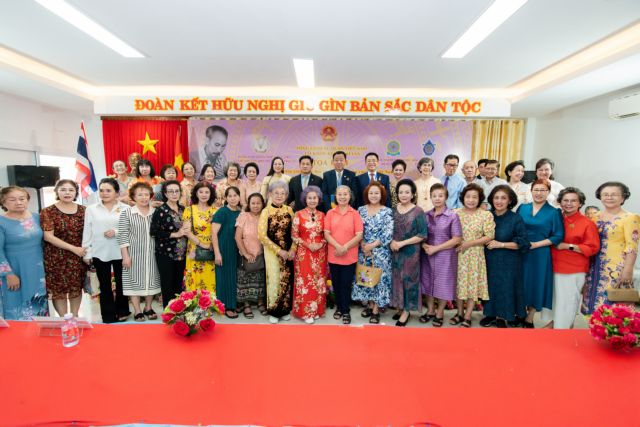 |
| Generations of teachers of Vietnamese language in Udon Thani Province, Thailand, attend the seminar on April 29. |
Moving beyond grassroots community initiatives, delegates also emphasised the crucial role of official policies and support from Việt Nam. Key proposals included: integrating Vietnamese as a foreign language into the curricula of local schools; expanding the "Vietnamese Bookcase" model within the community; increasing cultural activities and festivals centred around the Vietnamese language; and creating practical environments for the use of Vietnamese in daily life and employment.
These solutions aim to build a comprehensive Vietnamese language ecosystem where the language does not merely exist within the confines of a classroom but is present in every aspect of life. — VNS
Society
 Society
 Society
 Society
 Society
 Society
 Society
 Society
 Society
 Society
 Society
 Society
 Society
 Society
 Society