 Sci-Tech

Vietnamese, French leaders witness exchange of cooperation documents
1.
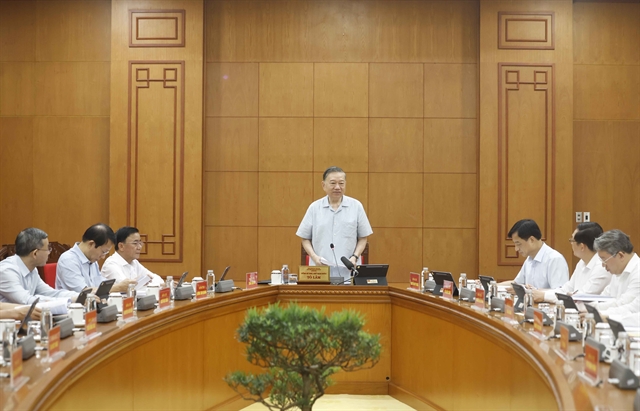 |
| Party General Secretary and State President Tô Lâm speaks at the meeting on quantum technology on Thursday. — VNA/VNS Photo |
HÀ NỘI — Quantum technology must not remain confined to laboratories, project proposals or patent filings, but instead must be developed to produce real products.
That was the message from Party General Secretary and State President Tô Lâm speaking at a high-level working session on Thursday.
The session centred on a scheme titled 'Research and Development of Quantum Technology in Service of Socio-Economic Growth, National Defence and Security'.
Party General Secretary and State President Tô Lâm acknowledged that relevant agencies had shown initiative in tracking global trends and outlining initial priorities, but said the work needed to go further.
Quantum technology, he said, was 'a very new, very difficult, and fast-moving issue' with direct implications for national security, digital transformation and long-term competitiveness.
The top leader insisted that quantum technology must be embedded within the implementation of Resolution 57 and linked explicitly to goals in national security, semiconductors, artificial intelligence and space technology.
Separated from those objectives, he warned, quantum technology risked becoming 'an expensive research programme that generates little national power'.
He cautioned against investing for optics rather than outcomes and against setting targets beyond the country's actual capacity. The goal should be to build genuine capability in areas where Việt Nam can realistically compete – delivering real value, not paper achievements.
On resource allocation, the head of state was direct: the priority must be national security and digital sovereignty. He also addressed international cooperation, calling for it to be vigorous and selective, aimed at building Việt Nam's own capabilities rather than creating, as he put it, "a new form of dependency".
He pushed back against the fragmented investment model, calling instead for strong national research centres, key laboratories and elite research teams with effective coordination among universities, institutes, enterprises and defence agencies.
The top leader also demanded a fundamental rethink of how the initiative is run. Quantum technology cuts across too many disciplines, he said, so it requires unified command and genuine coordination.
He called on planners to nail down a clear governance structure, set concrete timelines and priority tasks and designate a first wave of flagship projects for immediate action.
On research governance, he said the management framework must learn to distinguish between honest scientific failure – an inherent risk of frontier research that should be tolerated – and waste or negligence, which should not.
Evaluation of scientific output must also shift from short-term metrics toward the long-term development of genuine capability.
The top leader also emphasised the importance of human capital and called for a national training programme for quantum technology personnel, special mechanisms to attract and retain top talent and active outreach to overseas Vietnamese scientists and foreign experts.
The deeper aspiration, he said, was generational.
A national quantum programme can only succeed if built on a scientific culture that is transparent and academically rigorous – one capable of inspiring young people to master cutting-edge knowledge, he stressed.
He called on policymakers to cultivate a new cohort of scientists who combine deep expertise, intellectual integrity and a sense of responsibility to their country.
"A nation that wants to rise must dare to invest in difficult fields and dare to trust in the intelligence of its young generation," he said.
The Party General Secretary and President directed the Vietnam Academy of Science and Technology to refine the scheme and submit it to the Party Secretariat for review and approval. — VNS
Sci-Tech
 Sci-Tech
 Sci-Tech
 Sci-Tech
 Sci-Tech
 Sci-Tech
 Sci-Tech
 Sci-Tech
 Sci-Tech
 Sci-Tech
 Sci-Tech
 Sci-Tech
 Sci-Tech
 Sci-Tech
 Sci-Tech