 Sci-Tech

Weaving the unique heritage of the Thu Lao
1.
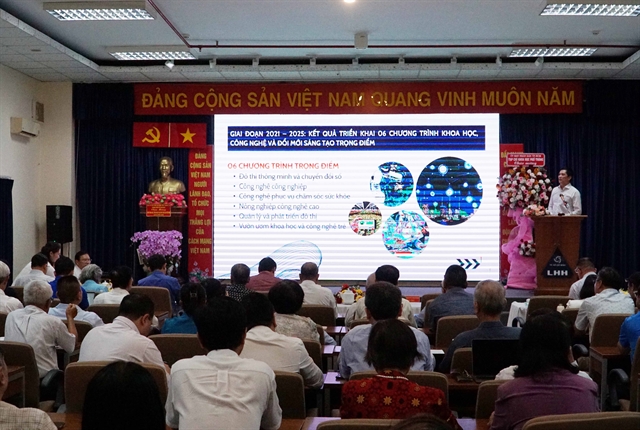 |
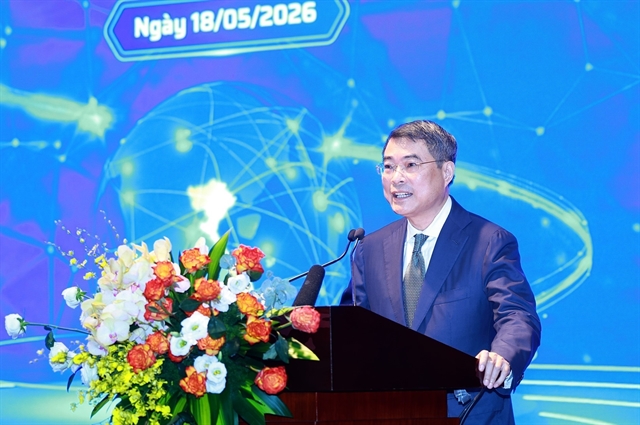
| An overview of the workshop in HCM City on May 18 on enhancing science and technology potential. — VNA/VNS Photos Thu Hoài |
HCM CITY — Southern metropolis HCM City must narrow down its technological priorities to avoid spreading resources too thinly, experts said at a workshop held on May 18.
This was the core message from scientists and experts at the workshop regarding the city’s science and technology potential for the 2026-30 period, with a vision towards 2050.
The event was co-organised by the HCM City Union of Science and Technology Associations and the municipal Science Council.
The city is entering a new developmental phase as a modern megacity, aligning itself with global mega-trends such as the digital, green, and circular economies, smart manufacturing, clean energy, and smart urban development.
This transition requires an urgent restructuring of its growth model, shifting from traditional drivers to a knowledge- and innovation-based economy.
Professor Nguyễn Văn Phước, chairman of the city Union of Science and Technology Associations, said the city's core strategy is to cultivate an "innovative megacity - smart industry - digital seaport - green economy" model.
Powered by digital technology, Artificial Intelligence (AI), big data, and smart governance, this model aims to optimise resources and boost socio-economic efficiency.
"A key task ahead is building an inter-regional digital infrastructure and developing a shared database that integrates data on population, land, transport, logistics, water supply, energy, environment, and investment into a unified digital governance platform," Phước said.
Technologies such as AI, the Internet of Things (IoT), GIS, Digital Twin, and cloud computing are considered the backbone of the city's future urban management.
Experts urged the city to accelerate its growth model transition to reduce its current reliance on real estate, resource exploitation, and low-cost labour.
In the long run, the city aims to become a smart, green, climate-resilient megacity with high international competitiveness.
To meet these goals, a framework programme has been proposed featuring eight key schemes linked under the model: "digital infrastructure - innovation - applied technology - smart governance - sustainable development."
These schemes will focus on regional data infrastructure, AI for smart cities, intelligent logistics, digital ports, environmental technology, high-quality human resources, and a robust innovation ecosystem.
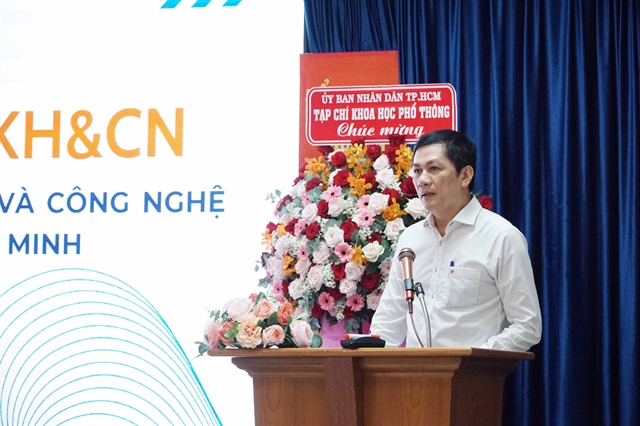 |
| Lê Thanh Minh, deputy director of the HCM City Department of Science and Technology, presents the 2026-30 Science and Technology Programme at the workshop in HCM City on May 18. |
A specialised 'Robotics Task Force'
Associate Professor Lê Hoài Quốc, chairman of the city Automation Association, said the rise of robotics and drones is no longer just a trend, but a profound economic restructuring that blurs the lines between the digital and physical worlds.
“Developing a robotics ecosystem should be viewed as a foundational strategy linked directly to the city's economic competitiveness and autonomy.”
Quốc proposed that the city establish a "Robotics Task Force" — a specialised municipal-level coordinating body with the authority to select and oversee key projects.
He also recommended implementing a "regulatory sandbox" to test robotics and drone solutions in controlled yet flexible environments.
Furthermore, administrative and financial mechanisms should follow a "fast-disbursal, fast-track" approach to shorten the deployment time of new technologies.
Regarding human resources, Lê Như Hùng, chairman of the city Association for Human Resources and Talent Development, said despite various policies to attract talent, the results have not yet met expectations.
“Top talents do not just require financial incentives; they need to be trusted with major responsibilities, given conducive environments to maximise their capabilities, and provided with adequate social welfare.”
He suggested that local organisations and businesses restructure their operating models to better utilise a high-quality workforce, while the city must clearly define its technological priorities to avoid diluting investment. — VNS
Sci-Tech
 Sci-Tech
 Sci-Tech
 Sci-Tech
 Sci-Tech
 Sci-Tech
 Sci-Tech
 Sci-Tech
 Sci-Tech
 Sci-Tech
 Sci-Tech
 Sci-Tech
 Sci-Tech
 Sci-Tech
 Sci-Tech