 Society
Technology vital for deep-sea journey
1.
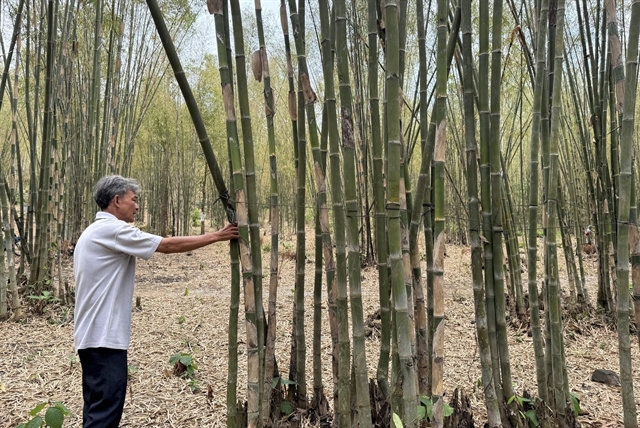 |
| Farmers in An Giang Province’s Núi Cấm Commune tend to their bamboo plantations. — VNA/VNS Photo |
AN GIANG — Once known for its parched hills and unstable livelihoods, the area at the foot of Cấm Mountain in An Giang Province is undergoing a quiet transformation, as farmers turn to bamboo cultivation to secure a more sustainable future.
In Tà Lọt Hamlet, Núi Cấm Commune, land that was long considered unsuitable for farming is now covered in lush green bamboo groves.
For years, local farmers struggled with fruit trees that failed to thrive due to prolonged drought and erratic weather.
Many households faced repeated crop losses, leaving incomes uncertain and daily life difficult.
A shift began when farmers decided to replace ineffective crops with tầm vông (Thyrsostachys siamensis), a hardy bamboo species well suited to the harsh conditions of the Bảy Núi region.
Unlike fruit trees, bamboo requires little water, is resistant to drought, and involves relatively low investment costs.
More importantly, it offers stable demand for construction, fencing, and handicraft production.
The resilience of the plant has gradually reshaped agricultural practices in the area.
Hillsides once left barren are now covered in thriving bamboo, marking a significant change in both landscape and livelihoods.
Among the pioneers of this transition is farmer Đặng Ngọc Bình, who had previously faced years of failure cultivating fruit trees due to a lack of irrigation water.
After converting three hectares of hillside land to bamboo, he has seen consistent growth with minimal pest issues and reduced labour requirements.
After several years, his bamboo plantation now generates an annual income of over VNĐ150,000,000 (US$6,000).
He said that unlike before, when farming depended heavily on rainfall, bamboo cultivation provides a more stable and predictable income, helping his family move away from financial uncertainty.
Similarly, Huỳnh Văn Tần, another resident of Tà Lọt Hamlet, has reported encouraging results after switching from low yield crops to bamboo.
Each hectare of bamboo now brings in profits of around VNĐ70 million ($2,800) per year after expenses, a relatively high income for farmers in such dry conditions.
He noted that improving farming methods and adapting to market demand have been keys to success.
With stable prices and reliable buyers, farmers feel more confident in expanding their plantations and investing in long-term production.
The transition has also encouraged greater cooperation among local farmers.
In 2024, a professional farmers’ group specialising in bamboo and ornamental bamboo species was established in Núi Cấm Commune.
Initially consisting of 34 members cultivating over 58ha, the group has since expanded to 52 members with more than 80.5ha under cultivation.
The group has helped farmers access technical guidance, financial support, and market information.
Members coordinate planting schedules, share cultivation techniques, and work together to manage pests and improve product quality.
Financial institutions have also played a role in supporting the transition, disbursing loans totalling over VNĐ1.6 billion ($64,000) to help farmers purchase seedlings and expand their plantations.
As a result, bamboo cultivation is increasingly forming a concentrated production area.
Beyond economic benefits, bamboo farming is contributing to environmental protection.
Dense bamboo groves help reduce soil erosion, retain moisture, and improve local ecosystems.
In the context of increasingly evident climate change, the adoption of drought tolerant crops such as bamboo represents a practical and forward looking solution.
However, challenges remain. Most bamboo is currently sold in raw form, limiting its market value.
Farmers are often dependent on traders and vulnerable to price fluctuations.
The lack of local processing facilities means that much of the plant’s potential remains untapped.
There are also concerns during the dry season, when fallen bamboo leaves can increase the risk of fire, requiring additional preventive measures.
To address these issues, local authorities are promoting strategies to enhance the value of bamboo products.
Plans are underway to attract investment in processing facilities that can produce handicrafts and other value added goods locally.
Lý Thanh Tùng, chairman of the Núi Cấm Commune Farmers’ Association, said the area is seeking to develop products such as household items, decorative pieces, and souvenirs made from bamboo.
These products could be linked to the growing tourism sector around Cấm Mountain, a well known destination attracting both domestic and international visitors.
Efforts are also being made to build a brand for Núi Cấm bamboo, standardise production processes, and ensure consistent product quality.
The long-term goal is to establish a complete value chain from cultivation and harvesting to processing and consumption, enabling farmers to participate more fully in value creation.
From once barren hills, bamboo is steadily bringing new life to the land and stability to local communities.
With the right investment and strategic direction, this modest crop could become a key driver of economic and social development in the mountainous areas of An Giang Province. — VNS
Society
 Society
 Society
 Society
 Society
 Society
 Society
 Society
 Society
 Society
 Society
 Society
 Society
 Society
 Society