 Society
Technology vital for deep-sea journey
1.
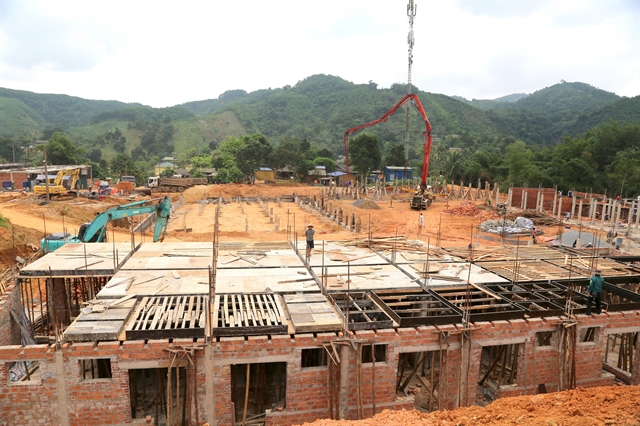 |
| The boarding school under construction in Quảng Trị's Đakrông Commune, Apri 15. — VNA/VNS Photo |
QUẢNG TRỊ — In the rugged mountains of central Việt Nam, construction crews are working extended shifts to finish a chain of boarding schools that officials hope will transform education for thousands of ethnic children living along the country's border with Laos.
The central province of Quảng Trị is building 15 new multi-grade boarding schools – one in each of its 15 land-border communes – at a combined cost of nearly VNĐ3.34 trillion (US$127 million).
Officials describe the effort as more than a construction programme, calling it a strategic investment in human development, poverty reduction and national security in one of the country's most isolated regions.
"These are projects of strategic significance," said Lê Hồng Vinh, chairman of the Provincial People's Committee, who recently visited the construction sites to check on progress.
Two of those projects – in the communes of Đakrông and Hướng Phùng – illustrate both the scale of the challenge and the urgency driving the effort.
In Đakrông – about 360sq.km of mountainous terrain where the Pa Cô and Vân Kiều ethnic communities make up more than 98 per cent of the population – nearly half of all households are classified as poor or near-poor.
For children in remote villages, getting to class can mean hours of trekking through forest, crossing streams and navigating roads prone to landslides during the rainy season.
A new boarding school under construction aims to change that.
The Đakrông Primary and Secondary Boarding School, which broke ground in November 2025, will sit on 6.46ha and accommodate 1,021 students.
The total investment is roughly VNĐ221 billion ($8.4 million) and the project is on track for a July 2026 handover.
Contractors say the job has not been easy.
The remote location makes delivering materials difficult, and the site requires deep foundation excavation and sand bedding – demanding technical work under tight conditions.
So far, though, the crew has managed to keep up.
"The main items are still proceeding on schedule," said Phan Tuấn Anh, the leader of the contractor consortium handling the project.
As of mid-April, the site is roughly 30 per cent complete. Workers are pushing to finish two single-story building blocks before moving on to upper floors and roofing on the remaining structures.
About 60km to the northwest, a larger project is taking shape in Hướng Phùng, where ethnic groups account for more than 70 per cent of the population.
That school – also a combined primary and secondary boarding facility – will serve around 1,500 students on a 13-hectare site, with a total investment of VNĐ360 billion ($13.7 million). Construction began in November 2025, and officials expect it to be ready before August 2026.
The principal of the existing semi-boarding school in the commune, Nguyễn Văn Tý, said the need for the new facility was pressing.
"The sooner this is finished, the better," he said.
"Right now, students are still hacking through the forest and crossing streams to get here, with landslides always a threat along the way."
A permanent boarding school, he said, would ease the burden on teachers who spend considerable time just coaxing students to attend, and give parents the confidence to send their children to school regularly. At last count, the Hướng Phùng project is about 35 per cent complete.
Each of the 15 new schools is being built to the same comprehensive standard: classrooms, administrative buildings, student dormitories, teacher housing, playgrounds and sports grounds.
"When completed, these schools will give thousands of students a fully equipped, modern learning environment," said Lê Thị Hương, director of Quảng Trị's Department of Education and Training.
Her department, she said, is committed to ensuring the new facilities are put to full use starting with the next academic year, and for many years to come. — VNS
Society
 Society
 Society
 Society
 Society
 Society
 Society
 Society
 Society
 Society
 Society
 Society
 Society
 Society
 Society