 Society

ZOOD Real Estate launches Élevée, a $667 million project in north Riyadh
1.
|
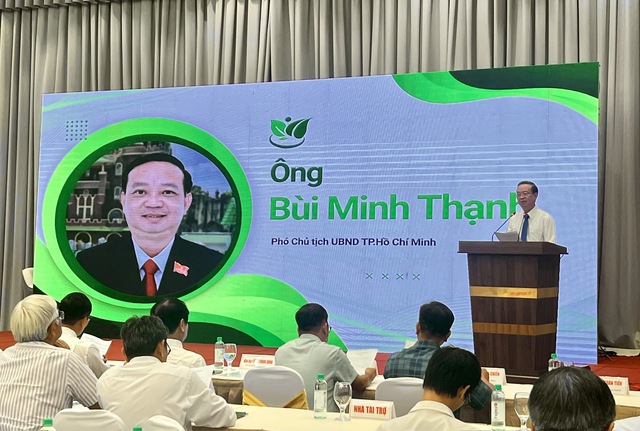
| Bùi Minh Thạnh, Deputy Chairman of the HCM City People’s Committee, speaks at the “Smart Agriculture” conference held in HCM City on April 17. — Photo chinhphu.vn |
HCM CITY — Việt Nam’s agriculture sector must accelerate the adoption of technology, data and large-scale production to stay competitive amid climate change and tightening global standards, experts said at a conference in HCM City.
The “Smart Agriculture” conference, held by the Việt Nam Association for Science and Technology Information (VASTI) and Một Thế Giới magazine on Friday, aimed to provide a science and technology-driven vision while updating the latest technological trends reshaping Việt Nam’s agricultural sector.
Doãn Văn Chiến, deputy director in charge of the National Agricultural Extension Centre for the Mekong Delta, said digital transformation and smart farming are an inevitable trend and even a requirement for Việt Nam’s agriculture sector.
The application of science and technology in agriculture remains uneven due to limits in institutions, resources and farmers’ access to new tools, he said.
To address this, the National Agricultural Extension Centre is rolling out a programme to promote smart production in 2026-27. It focuses on applying technologies such as the Internet of Things (IoT), Artificial Intelligence (AI) and big data across the entire value chain.
At the same time, the agricultural extension system is shifting to a “digital extension” model, using data platforms and applications to connect directly with farmers.
Agriculture in Việt Nam is at a turning point as it shifts from traditional practices to industrialisation and digitalisation, participants said at the conference.
The wider use of AI and robots in the fields could not only reduce labour needs but also standardise processes and reduce errors, they added.
They also called for the digitalisation of the entire value chain, from farm to table.
They stressed the need for transparent traceability and modern management tools to reduce risks from global market fluctuations.
Đỗ Văn Hùng, deputy chairman of VASTI, proposed building an “agricultural data bank” model, as data is emerging as a core resource.
Developing smart agriculture requires “clean” and connected data to forecast yields, detect pests and optimise farming practices, he said.
Việt Nam’s agriculture is expected to move beyond simply producing more crops, he added, noting that its new goal is to export knowledge, management models and higher added value.
From a business perspective, Võ Quan Huy, director of Huy Long An - Mỹ Bình Limited Liability Company in Tây Ninh Province, who has spent more than half a century working in the fields and is known as the “banana king”, pointed out that fragmented small-scale production remains the biggest bottleneck.
He said that when land is divided into small plots, it is difficult to build synchronised infrastructure or apply large-scale mechanisation.
Land consolidation is a necessary condition for businesses to invest systematically in irrigation, automation and cost optimisation, he said.
Some high-tech farming models have already shown clear results.
Lê Mai Tùng, founder of Seamorny Vietnam Company Limited in HCM City, shared his company’s soft-shell crab farming model that uses a closed recirculating system combined with AI.
While the traditional method achieves a survival rate of only about 10 per cent, the use of a closed system integrated with robots, AI and IoT raises the rate to more than 90 per cent, while significantly cutting operating costs, he said.
Đặng Duy Hiển, deputy director of the Digital Transformation Department under the Ministry of Agriculture and Environment, said the agriculture sector remained a key pillar in 2025, with export turnover reaching US$70 billion.
As Việt Nam seeks to expand international markets, the sector is reinforcing its strategic role, he said.
He said three priorities are needed for effective smart agriculture. People are the most important factor, followed by a synchronised digital transformation software system, and stable digital infrastructure and data systems for use and sharing.
At the same time, communication efforts on smart agriculture should be strengthened to raise public awareness, he said.
Bùi Minh Thạnh, deputy chairman of the HCM City People’s Committee, said the city is not only an economic hub but also a centre for science, technology and innovation, playing an important role in research, application and transfer of agricultural technologies.
The city has set key directions, including becoming a centre for agricultural technology research and transfer, promoting regional linkages, improving mechanisms to attract businesses, and building a co-operative ecosystem among the State, scientists and enterprises.
He also affirmed the city’s commitment to supporting businesses, piloting new models and promoting the application of science and technology. — VNS
Society
 Society
 Society
 Society
 Society
 Society
 Society
 Society
 Society
 Society
 Society
 Society
 Society
 Society
 Society