 Society
Vietnamese Prime Minister meets Cambodian National Assembly President
1.
|
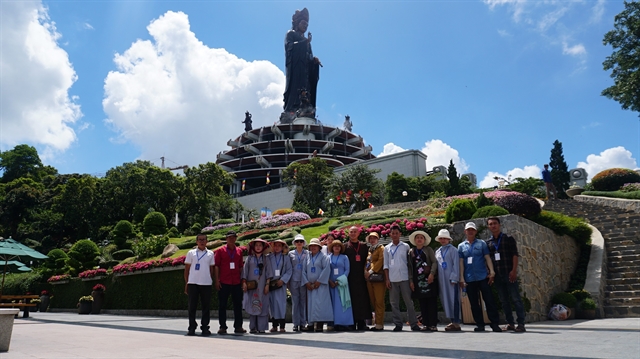
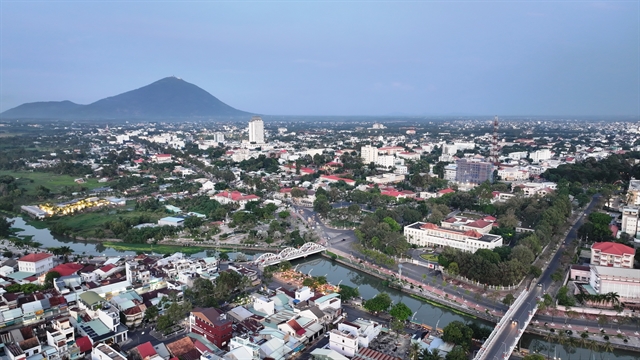
| Visitors gather at Bà Đen Mountain in Tây Ninh Province, one of southern Việt Nam’s most popular spiritual and tourism destinations, attracting both domestic and international travellers for sightseeing and pilgrimage. — VNA/VNS Photo |
TÂY NINH — With strong growth recorded in the first quarter of this year, Tây Ninh Province is shedding its long standing image as a remote border locality and emerging as a strategic trading gateway and a dynamic growth pole in the southeastern region.
By placing economic data at the centre of policymaking and prioritising business satisfaction, the province is accelerating a comprehensive push in infrastructure and investment climate reform.
Economic indicators in the opening months of 2026 present an encouraging outlook.
The Index of Industrial Production (IIP) expanded by 15.5 per cent, with the processing and manufacturing sector, widely regarded as the backbone of the economy, rising by more than 16 per cent.
Total retail sales of goods and consumer service revenue reached over VNĐ55.5 trillion (US$2.2 billion), up 15.4 per cent year on year.
The province’s investment environment continues to gain traction, with more than 2,000 foreign direct investment projects and total registered capital exceeding $25.4 billion.
This growing confidence has been further reinforced by the interest of major investors, including Đại Tây Dương Construction Company, which is studying plans to invest between $2 billion and $5 billion in infrastructure, ports and industrial zones.
According to Lê Văn Hẳn, chairman of the provincial People’s Committee, transport infrastructure has been identified as a critical breakthrough area.
He noted that sustained economic expansion in recent years has enabled Tây Ninh to attract significant resources, and partnerships with large scale investors will enhance connectivity and unlock long-term development opportunities.
Beyond industry, agriculture is also undergoing a transformation driven by digitalisation and modern production models.
A notable example is the integrated value chain developed by De Heus and Hùng Nhơn Group.
With total planned investment rising to VNĐ13.1 trillion ($520 million), the project aims to produce 80 million breeding chickens and 25 million commercial chickens annually for export.
Vũ Mạnh Hùng, chairman of Hùng Nhơn Group, said the company is targeting international markets, including Halal segments.
With a closed and standardised production chain, the first export shipment of chicken products is expected to be delivered in early 2027, marking a significant milestone for the province’s high-tech agriculture sector.
Strategically located between HCM City and Cambodia, Tây Ninh holds a unique geo economic advantage.
The province aims to have the digital economy contribute 30 per cent of its GRDP by 2030, positioning itself as a regional hub for integrated services and logistics.
Trương Thanh Liêm, head of the provincial Economic Zone Authority, said Tây Ninh has strong potential to become a key connectivity centre driving regional growth.
Following administrative restructuring, the province is focusing on maximising its role as a gateway for trade, prioritising investment in border economic zones and underdeveloped areas in a green and sustainable manner.
The province has set an ambitious target of achieving annual GRDP growth of 10 to 10.5 per cent between 2026 and 2030, with per capita income projected to reach $8,000 to $8,500.
|
| Tourism infrastructure surrounding Bà Đen Mountain has been developed in a well coordinated and integrated manner, effectively meeting the diverse needs of visitors travelling to Tây Ninh Province. — VNA/VNS Photo |
Bottlenecks and solutions
Despite positive momentum, several bottlenecks remain. A notable paradox is that while State budget revenue has surged, public investment disbursement has yet to meet expectations.
Trương Văn Liếp, director of the Department of Finance, reported that budget revenue exceeded VNĐ14 trillion ($550 million) in the first quarter, up nearly 48 per cent year on year, reflecting a clear recovery among businesses.
However, slow disbursement of public investment capital, land clearance challenges and price fluctuations continue to pose risks to key projects.
Meanwhile, the foreign invested business community, a major contributor to the local economy, has raised concerns over policy changes.
At a recent dialogue with provincial leaders, FDI enterprises highlighted difficulties stemming from new tax regulations, particularly the removal of zero per cent tax incentives for goods exported via bonded warehouses, which has affected cash flow and VAT refunds.
Labour shortages also remain a pressing issue. Despite improved wages and benefits, the supply of unskilled workers continues to fall short of demand, constraining production expansion.
Transport infrastructure, although being upgraded, still faces operational constraints such as time restrictions on truck movements along key routes, slowing logistics and goods circulation.
To address these challenges and move closer to becoming a destination that is both attractive and liveable, Tây Ninh is prioritising administrative reform and synchronised infrastructure development.
Public investment disbursement has been identified as a top priority. Nguyễn Văn Quyết, secretary of the provincial Party Committee, has called for stronger coordination between government agencies and investors to turn memoranda of understanding into viable projects, emphasising the need for tangible actions that contribute to real economic outcomes.
The province is focusing resources on major transport projects, including the HCM City–Mộc Bài expressway, the Gò Dầu–Xa Mát route and Ring Road No.4.
At the same time, digital infrastructure is being advanced, with a goal of providing 5G coverage across all industrial parks, economic zones and urban areas by 2030.
Tây Ninh is also striving to rank among the top 10 provinces nationwide in the Provincial Competitiveness Index.
Authorities have pledged a shift from administrative control to a service oriented approach, placing business satisfaction at the centre of governance.
In the long term, workforce development will be key. The province plans to expand training in high-tech industries, logistics and modern agriculture, while encouraging major educational institutions to establish local campuses to ensure a stable supply of skilled labour.
Tây Ninh’s growth strategy is no longer confined to projections. It is being realised through billion dollar projects and strong commitments from local authorities.
While challenges related to taxation, labour and land clearance persist, the province remains confident that with the guiding principle that business success is provincial success, it will solidify its position as a strategic connectivity hub contributing to the prosperity of southern Việt Nam. — VNS
Society
 Society
 Society
 Society
 Society
 Society
 Society
 Society
 Society
 Society
 Society
 Society
 Society
 Society
 Society