 Society

Việt Nam, China seek stronger substantive parliamentary cooperation
1.
|
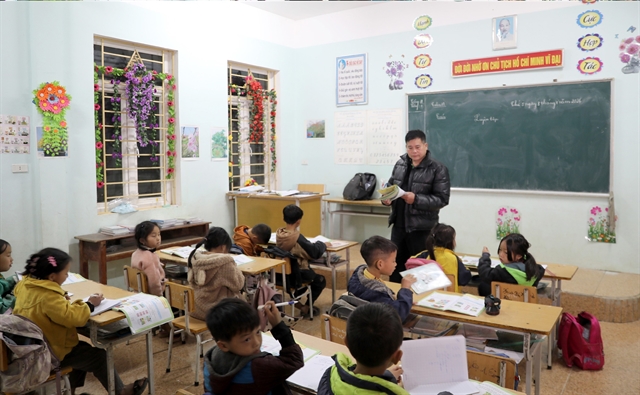
| Teacher Lương Thanh Hưng teaches the evening class in Mỹ Lý Commune, Nghệ An Province. — VNA/VNS Photo Văn Tý |
NGHỆ AN — As darkness falls over Piêng Vai Peak in Nghệ An Province, a single classroom glows in the mountains, where a devoted teacher quietly nurtures learning within remote ethnic communities.
Piêng Vai, a border village about 10km from the centre of Mỹ Lý Commune, sits in rugged terrain. During the rainy season, roads become slippery, while thick winter fog often isolates the village from the outside world.
The community is home to 73 H’Mông households, all classified as poor. Many working-age adults leave to earn a living elsewhere, leaving children in the care of grandparents. Without close supervision, students can easily forget lessons and fall behind.
In response, teacher Lương Thanh Hưng volunteered to help reinforce their knowledge. Working at Mỹ Lý 1 Semi-Boarding Primary School for Ethnic Students, he teaches classes during the day and offers free evening tutoring.
For more than three decades, Hưng has devoted his life to this remote border area.
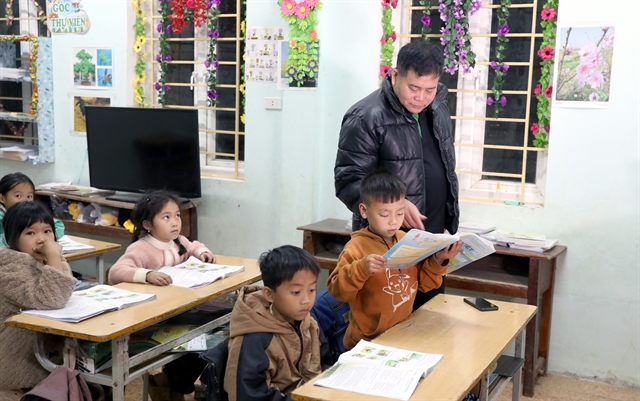
In the evening class, students review lessons, practise writing and gradually improve their results. Beyond academics, it also provides emotional support for the children.
Cự Bá Lạ, a second-grade student at the school’s Piêng Vai campus, said: “I really like going to the evening class. There are only my grandparents at home, and sometimes I don’t know who to ask about my homework. In this class, the teacher explains it again, so I understand better and do math faster.
“I also learned to write neatly and read good books. It’s fun because many friends study and play together. I hope to study well in the future to help my family and my village.”
The students’ guardians have also noticed positive changes.
Già Y Máy, a senior resident in Piêng Vai, said: “In the past, few people in the village could read or write and life was difficult. Now, seeing our children go to school, we are very happy.
“With teachers helping them in the evenings, they make clear progress, they remember lessons longer and write more neatly.”
|
| The evening class is where ethnic students, who often live far away from their parents, can receive help with their learning. — VNA/VNS Photo Văn Tý |
For Hưng, teaching goes far beyond formal class hours. Wherever he works, he and his colleagues continue to support students after school. From teaching lessons to providing daily care, he looks after them as if they were his own children.
“Students in mountainous areas face greater disadvantages than those in the delta regions,” he said.
Their parents often work far from home, and many grandparents, who belong to ethnic groups, do not speak the national language, so they cannot help with homework, Hưng explained.
“That’s why we offer free evening classes, hoping to help them consolidate their knowledge and improve. Even on rainy, slippery days, the students still come. Seeing the eagerness in their eyes makes me try even harder,” he added.
As the evening class ends and the students leave, Hưng often stays behind to prepare the next day’s lessons. In the quiet of the mountains at night, his perseverance helps keep the light of learning alive in this remote village.
Lương Văn Bảy, chairman of Mỹ Lý Commune People’s Committee, said the area remains underdeveloped, with 12 school sites far from the centre, but dedicated teachers like Hưng continue their work despite the hardship.
“Local authorities recognise their efforts and are seeking ways to provide additional resources to sustain these classes,” he said.
Amid the vast forests at the border, the small classroom remains lit each night. There, not only is literacy nurtured but also hope is also fostered for children living far from their parents on their journey toward the future. — VNS
Society
 Society
 Society
 Society
 Society
 Society
 Society
 Society
 Society
 Society
 Society
 Society
 Society
 Society
 Society