 Society
Vietnamese Prime Minister meets Cambodian National Assembly President
1.
|
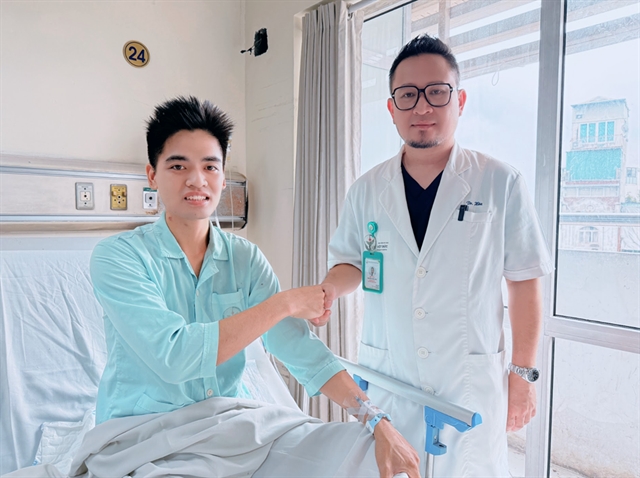
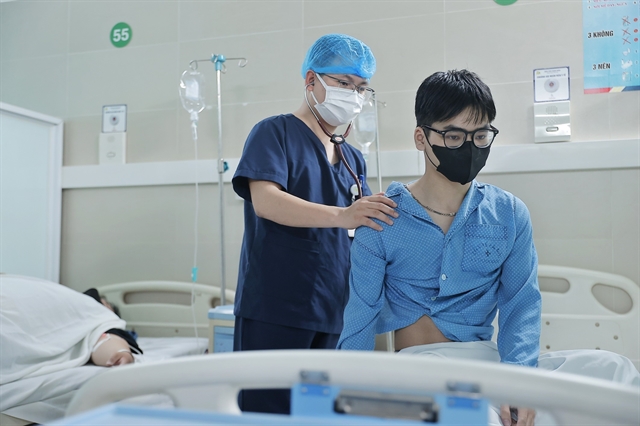
| Dr. Nguyễn Xuân Hòa, Deputy Head of the Department of Gastrointestinal Surgery, visits the patient after the surgery. — Photo courtesy of the hospital |
HÀ NỘI — Surgeons at Hà Nội-based Việt Đức Friendship Hospital have successfully carried out a rare autologous kidney transplant, saving a young man with severe multi-organ injuries following a traffic accident.
The 27-year-old patient was admitted in critical condition with extensive damage to both the urinary and digestive systems. Doctors found the kidney had sustained grade V trauma, with a completely severed renal pedicle, crushed blood vessels, shortened veins and a long segment of the ureter missing.
He also suffered serious gastrointestinal injuries, including a ruptured duodenum at segment D2, necrotic damage to segments D3–D4 and injury to the pancreatic tissue.
Given the complexity of the case, the hospital’s transplant and urology team opted for an autologous kidney transplant to try to preserve organ function.
The kidney was removed, cleaned, blood clots were cleared and damaged tissue excised before reconstruction.
Doctors used homografts, blood vessels from a brain-dead donor stored at the hospital’s tissue bank, to rebuild and extend the renal pedicle before transplanting the kidney back into the patient.
Associate Professor Dr Lê Nguyên Vũ, deputy director of the Organ Transplant Centre, said the risk of kidney removal is typically high in such cases.
"However, if the patient has access to specialised facilities within the golden time of six to eight hours, along with synchronised and close coordination between specialities, there is still a chance to preserve the kidney using autologous transplantation techniques."
At the same time, the gastrointestinal surgery team treated the digestive injuries by removing the damaged D3–D4 segments and restoring continuity by connecting the jejunal loop to the D2 segment.
Dr Nguyễn Xuân Hòa, deputy head of the Department of Gastrointestinal Surgery, emphasised: “If the gastrointestinal injury is not thoroughly treated, digestive fluids leaking into the abdominal cavity can cause peritonitis, severe infection, and directly affect the outcome of the kidney transplant.”
Following the surgery, the patient’s condition improved steadily. Kidney function was preserved and he was able to resume eating and drinking.
Việt Đức Friendship Hospital is among the country’s leading centres for complex organ transplants, where autologous kidney transplantation has become a routine technique in specialised cases.
The procedure is typically indicated for severe renal artery damage, vascular malformations or extensive ureteral loss. Because it uses the patient’s own organ, it removes the need for immunosuppressive drugs after surgery. — VNS
Society
 Society
 Society
 Society
 Society
 Society
 Society
 Society
 Society
 Society
 Society
 Society
 Society
 Society
 Society