 Society
Top leader hails friendship association's role in nurturing Việt Nam–Denmark ties
1.
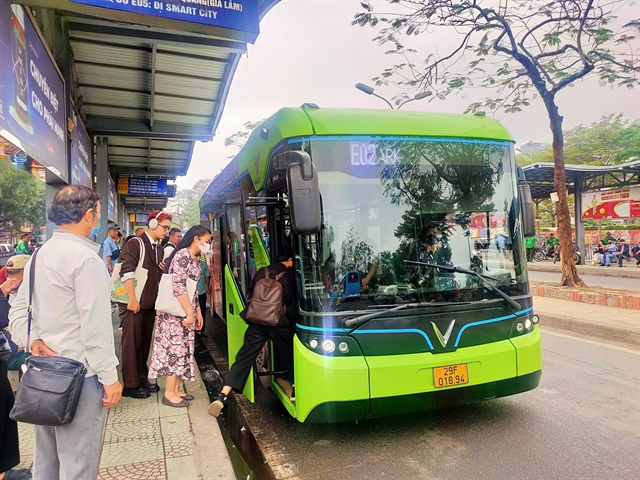 |
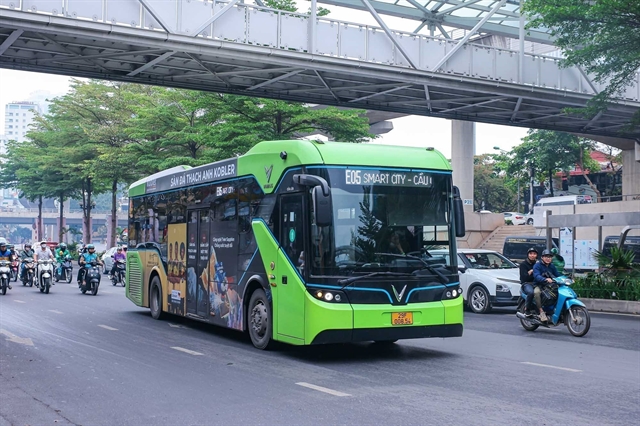
| An electric bus picks up passengers in Hà Nội. Green public transport helps promote a sustainable lifestyle and minimise environmental pollution. — VNS Photo Đoàn Tùng |
Thu Trang
HÀ NỘI — Amid the oil crisis, green transport has emerged not only as an environmental trend, but as a vital solution to reduce Việt Nam's dependence on fossil fuels and protect the health of its cities and the competitiveness of its economy.
As the oil shipments through the Strait of Hormuz have been repeatedly interrupted due to the conflict in the Middle East, global oil prices are rising, leading to higher petrol prices in Việt Nam and other economies.
The crisis has caused numerous energy security problems, with the Government focusing on strategies and solutions and residents worrying at every petrol station and for every trip.
At 7am at a petrol station on Thái Thịnh Street in Hà Nội's Đống Đa Ward, motorbikes and cars queue up tail-to-tail waiting to refuel.
Nguyễn Phong, a ride-hailing driver, calculates that he consumes up to five litres of petrol a day, meaning that every month he has to spend an extra VNĐ1 million (around US$38) compared to last year.
“Every time I hear news of petrol price hikes, I feel like my salary is being cut a little more,” he said.
The petrol price shock also pushes up transport, logistics and production costs. But the clearest impact lies on congested streets, where thousands of engines idle during peak hours, emitting large amounts of toxic gases and fine particles, often causing poor air quality in major cities like Hà Nội and HCM City.
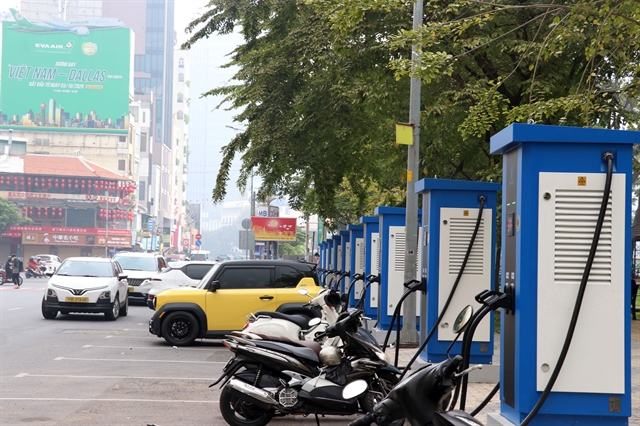 |
| Charging stations for electric vehicles in HCM City. — VNA/VNS Photo Tiến Lực |
Deputy Chairman of the Hà Nội Public Passenger Transport Association Nguyễn Hoàng Hải commented: “Public transport enterprises have recognised the problem very early on and participated in the green transition in line with directives from the city and the transport sector.”
Public transport companies are currently facing challenges including replacing vehicles, maintaining passenger numbers and improving service quality. The cost of clean-energy vehicles is also often more than twice that of traditional vehicles.
“This raises the issue of funding sources for vehicles to meet the city's transition roadmap,” Hải said.
Green policies
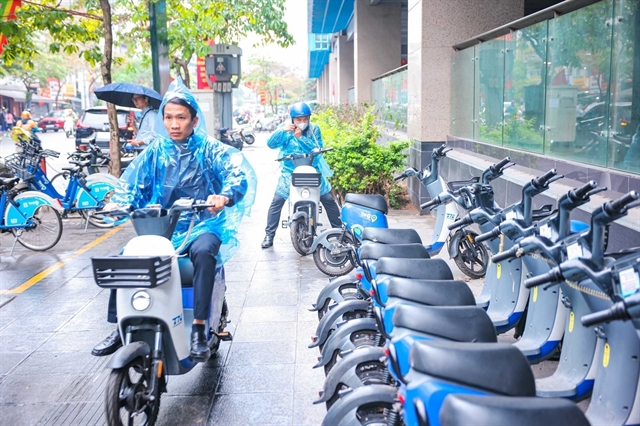 |
| An electric motorbike rental system is growing, allowing residents to easily access a flexible and convenient means of transport. — VNA/VNS Photo Hoàng Hiếu |
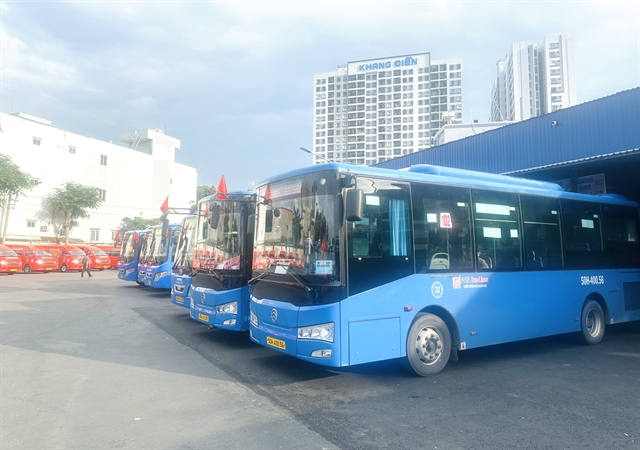
Việt Nam has set several green energy transition goals for transport. Since last year, all new or replacement buses must run on electricity or other forms of green energy, and all new taxis must use clean energy by 2030, with the ultimate goal of rapidly increasing the proportion of urban electric vehicles.
These targets reflect a clear shift. Transport is seen as a key sector in emissions reduction strategies, environmental protection and ensuring energy security.
“At present, the whole country is seeing a green transition in public transport. In the capital city, this transition is also one of the most important goals," Hải said.
“I completely agree with this shift. The green transition is part of the Party's policies of developing a green and circular economy and sustainable development in transport."
Public transport firms are seeing this shift as an opportunity.
“It's an opportunity for enterprises to transform themselves, improve the image of the capital's public transport and enhance service quality, encouraging more people to use public transport, thus reducing the use of private vehicles and helping to reduce traffic congestion and environmental pollution,” the deputy chairman said.
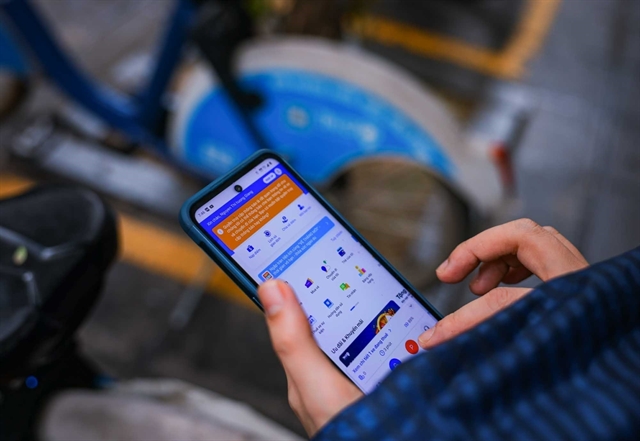 |
| A self-driving electric car rental app can be used for travel. — VNA/VNS Photo Hoàng Hiếu |
Office worker Phạm Thanh Tú said: “Initially, I switched to buses because it was convenient, with no need to queue at petrol stations. But after a few petrol price hikes due to conflicts, I realised I'm saving a good amount of money each month.
"At that point, ‘going green’ is no longer a campaign matter, but a way to protect one's own wallet.”
Meanwhile, shared bicycle and electric motorbikes rented through mobile apps have started appearing in central zones, creating more short-distance travel options and reducing pressure on streets already overloaded by private vehicles.
Infrastructure upgrades
The growth of green vehicles brings a difficult infrastructure problem, however. New owners of electric vehicles need to figure out where to plug them in to charge them.
Many old apartment buildings in dense residential areas do not have fixed parking spaces, let alone suitable charging stations.
Electric vehicle owners mainly rely on charging stations from major manufacturers concentrated around shopping centres, large car parks or national highways, while inner city areas still do not have them.
Experts note that the purchase price of electric cars and motorbikes is still a barrier for low-income residents, while the impact of petrol prices also hits this group the hardest, as they tend to use old vehicles that consume more fuel.
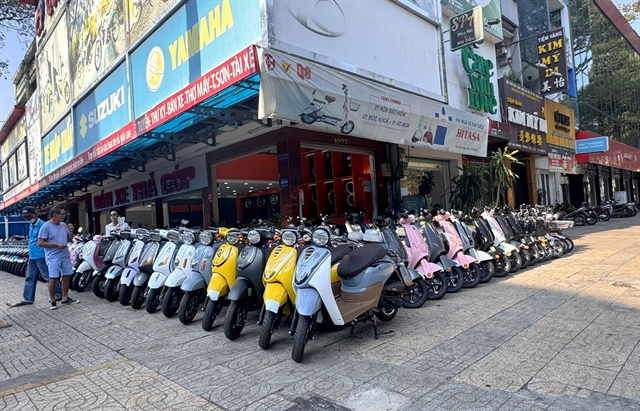 |
| Customers look at electric motorbikes at a store in HCM City. — VNA/VNS Photo Thanh Vũ |
Lê Thị Minh, a State agency employee living in the suburbs, said: “My motorbike is old. Every time petrol prices rise it's very tiring, but to switch to an electric one costing over VNĐ20 million ($760) is too much. With options to pay in installments or low interest rates, more people would surely consider switching.”
Hải said: “Companies also want financial support so that changing vehicles is easier and more convenient. Currently, enterprises often depend on bank loan packages. Although Hà Nội has also provided interest rate support at very high rates, the procedures to apply for loans and support take a lot of time.”
Recent policies issued by Hà Nội authorities to remove loan obstacles and provide administrative support have helped enterprises with their green vehicle transition.
“Green transport must be considered as part of social welfare policy,” Hải said.
For companies, greener transport is not just environmental responsibility; it's also a condition to join global supply chains.
Some logistics enterprises have started trialling electric trucks for inner city transport, combined with warehouses using rooftop solar power. Initial investment costs are high, but return lower operating costs, less dependence on oil price fluctuations and advantages when negotiating with foreign partners, who are increasingly focused on green criteria.
Nguyễn Đăng Hưng, director of a private logistics company in Hà Nội, said: “If we're slow to transition, we not only lose on costs but also risk being excluded from the supplier lists of major customers. This oil crisis is a reminder that we cannot continue relying on oil forever.”
Opportunities
 |
| Electric vehicles increasingly contribute to transforming the urban landscape in a modern and environmentally friendly direction. — VNA/VNS Photo Hoàng Hiếu |
The conflict in the Middle East has once again shown the fragility of dependence on oil-based energy. For Việt Nam, the recent petrol price shock can be seen as a rare opportunity to accelerate the process of shifting to green transport, which had long been planned.
Hải said: “With the plans already set, accompanied by feasible policies and enterprise support, we believe that a multimodal, green and sustainable public transport network is being realised. This is not only the Government's wish, but also the people's wish.
"When people see public transport greening hour by hour, day by day, it will inevitably receive more attention and greater participation. Green transport is an unchangeable trend. And let us have optimistic views on the growth in service quality and ridership of this mode of transport."
He added: “If we know how to turn pressure into motivation, Việt Nam can get through this oil crisis with a more modern, cleaner transport system that is less vulnerable to unpredictable future geopolitical fluctuations." — VNS
Society
 Society
 Society
 Society
 Society
 Society
 Society
 Society
 Society
 Society
 Society
 Society
 Society
 Society
 Society