 Society
Liechtenstein Prime Minister concludes official visit to Việt Nam
1.
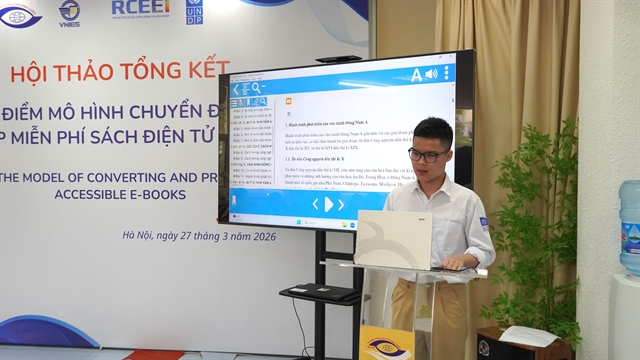 |
| Visually impaired student Lê Đức Minh demonstrates how he accesses e-books using a laptop. — Photo courtesy of UNDP |
Khánh Dương
HÀ NỘI — For Lê Đức Minh, a visually impaired 10th grader in Hà Nội, the shift from bulky Braille books to accessible digital textbooks has transformed the way he learns, opening the door to greater independence and confidence in the classroom.
Instead of relying on traditional Braille, a tactile reading system for the blind, Minh now listens to textbooks online through accessible e-books. By accessing website sachtiepcan.vn, searching for titles and downloading them, he can follow lessons easily using assistive applications.
With synchronised text and audio features, the e-books allow him to study independently, prepare lessons in advance, and participate more actively in class.
Minh is among the first visually impaired students at Nguyễn Đình Chiểu Primary and Secondary School to access the e-book library. The school is considered a pioneering model of inclusive education in Việt Nam, where visually impaired students study alongside sighted peers in an equal and supportive environment.
The accessible e-book pilot initiative has been implemented by the United Nations Development Programme in partnership with the National Institute of Educational Sciences and other organisations.
Launched in the 2024-25 academic year, the project provided accessible textbooks across five core subjects: Maths, Literature, English, Natural Sciences and History-Geography, for 30 seventh and ninth grade students with visual impairments, enabling them to study via mobile and laptop applications.
Unlike traditional Braille books, which are often bulky and limited in availability, accessible e-books can be stored on digital devices, allowing students to study anytime and anywhere.
In the 2025-26 academic year, Nguyễn Đình Chiểu School has expanded the programme to 64 visually impaired students from grades 6 to 9.
Minh first used the e-books in the 2024-25 academic year when he was in Grade 9. Now studying at Bắc Thăng Long High School, he continues to rely on them.
“Since using digital textbooks, I have become more proactive and confident in learning. My academic performance has improved. In the first semester, I achieved good student status and ranked among the top five in my class,” Minh said.
“If technological tools are fully accessible and learning materials are properly designed, people with disabilities in general and visually impaired individuals in particular can study proactively, confidently and effectively like other students.”
He added that the tools have also made him more independent.
“Previously, without textbooks, I had to search for materials online, which were scattered, inconsistent and lacking detail. Now, the materials are comprehensive and well structured, helping me expand my thinking instead of piecing together information from the internet,” he said.
Nguyễn Thị Diệu Linh, a former student of Nguyễn Đình Chiểu School, said she is particularly interested in the image descriptions in the geography textbooks, describing them as accurate and highly useful.
Using the materials most frequently for English, Linh has achieved strong results in the subject.
Nguyễn Thị Tuyết Mai, the school’s principal, said students are enthusiastic about using digital books.
“E-books enhance accessibility and support inclusive, independent learning for visually impaired students, while also helping improve their listening skills,” she said.
She added that the school places strong emphasis on IT training, as students need to be proficient in using computers and personal mobile devices to access learning materials.
Additional specialised IT classes are organised, while students also support one another through Zalo groups to share tips and experiences.
Federica Dispenza, assistant resident representative of the United Nations Development Programme in Việt Nam and head of the Governance and Participation Unit, said globally fewer than 10 per cent of published materials are accessible to people with disabilities, with the figure dropping to as low as 1 per cent in developing countries.
“This is what many people call a ‘book famine’. It remains a major barrier to learning and participation,” she said.
She described the pilot as a concrete step beyond technical innovation.
“It shows that students have gained greater autonomy. They can read, review and learn independently. Teachers and parents spend far less time reading materials aloud and students participate more confidently in class because they finally have the same content as everyone else.”
“Access to textbooks should be a foundation, never a privilege. Accessible digital textbooks are a practical way to make inclusive education a reality in Việt Nam,” she said.
Trần Thị Văng, head of the National Centre for Special Education under the National Institute of Educational Sciences, said the accessible e-books could benefit not only visually impaired students but also those who have lost reading ability or have physical disabilities that make it difficult to use printed books.
The centre plans to organise training on e-book applications for teachers nationwide, with a view to expanding the model across Việt Nam in the coming years, she said. — VNS
Society
 Society
 Society
 Society
 Society
 Society
 Society
 Society
 Society
 Society
 Society
 Society
 Society
 Society
 Society