 Society

Vietnamese Prime Minister meets Cambodian National Assembly President
1.
 |
| Naval soldiers on the Trường Sa (Spratly) Archipelago. VNA/VNS Photo |
HÀ NỘI - Việt Nam’s development journey has not only been marked by economic growth figures but also clearly reflected in achievements in education, healthcare, social welfare, and improvements in people’s quality of life.
With a consistent orientation that places people at the centre of development, numerous policies have been implemented to ensure development opportunities for all people, helping realise the goal of leaving no one behind.
For several decades, Việt Nam’s development mindset has evolved, shifting from the goal of meeting essential needs in the post-war period to improving the quality of life and fostering comprehensive human development. The Party’s guidelines and resolutions adopted at successive National Party Congresses have consistently affirmed that economic growth must go hand in hand with social progress and equity, towards sustainable development.
This is clearly reflected in the prioritisation of resources for education, healthcare, and the social welfare system — areas that directly affect the lives of every citizen.
Human development is not only about increasing income but also encompasses knowledge, health, culture, and opportunities to participate in social life. For this reason, Việt Nam has gradually built an inclusive policy system, moving beyond a purely assistance-based approach to one that enables individuals to maximise their potential and improve their livelihoods.
 |
| Kids are learning whilst playing at the Trung Chải Kindergarten in Pa Tần Commune, Lai Châu Province. In Việt Nam, human development encompasses knowledge, health, culture and opportunities to participate in social life. VNA/VNS Photo Quý Trung |
This approach reflects the humanistic nature of Việt Nam’s development model and aligns with global trends that view high-quality human resources as a decisive factor in national competitiveness.
From ensuring basic needs, Việt Nam is now entering a stage focused on improving the quality of life and promoting comprehensive human development.
Educational vision
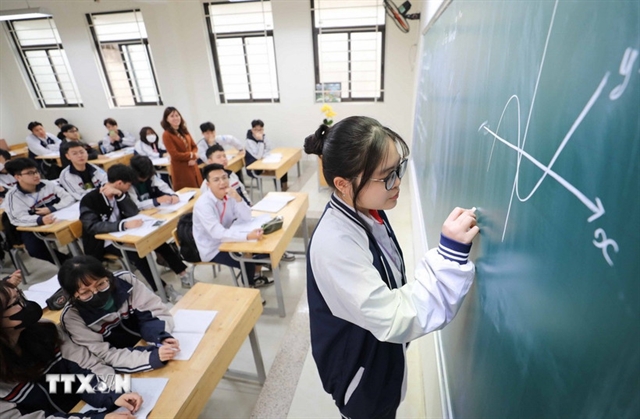
In recent years, Việt Nam’s education sector has recorded notable progress in both scale and quality, becoming one of the key pillars of the country’s human development strategy.
The network of schools has continued to expand, ensuring that the vast majority of school-age children can attend school. The nationwide literacy rate remains high and relatively stable. Priority investment in remote, mountainous, and ethnic minority areas has helped narrow disparities in access to education between regions, laying a foundation for social equity through equal learning opportunities.
The quality of general education has gradually improved through curriculum reform, new teaching methods, and the promotion of digital transformation.
Alongside general education, vocational education has been increasingly emphasised to meet labour market demands. The system of vocational schools has expanded enrolment, strengthened links with businesses, and promoted order-based training programmes, thereby enhancing practical skills for learners and increasing their opportunities for sustainable employment.
 |
| The opening ceremony for a new year at Phan Huy Chú High School in Hà Nội. In recent years, Việt Nam’s education sector has recorded notable progress in both scale and quality. VNA/VNS Photo |
Education-related social welfare policies also play a key role in ensuring that no one is left behind. Plans to build nearly 250 inter-level boarding schools in border communes, tuition exemption and reduction policies, support for disadvantaged students, student credit programmes, and numerous scholarship initiatives have helped millions of students continue their education despite difficult circumstances.
Overall, the achievements of Việt Nam’s education sector reflect a shift from expanding learning opportunities to improving quality and promoting comprehensive human development.
Public health boost
Alongside education, the healthcare sector has made significant progress, becoming a pillar in ensuring quality of life and human development.
The network of medical facilities has been expanded, with nearly 13,000 healthcare establishments providing health insurance-covered medical services nationwide. This allows people to receive healthcare services locally, reducing pressure on higher-level facilities and saving travel costs.
Việt Nam’s healthcare system is increasingly being refined through a balanced combination of preventive medicine and curative care, with disease prevention as the foundation and comprehensive healthcare as the overarching goal.
The role of preventive medicine has become increasingly evident through enhanced epidemiological surveillance, effective control of infectious diseases, particularly during the COVID-19 pandemic, and the implementation of expanded immunisation programmes with high coverage rates.
 |
| Joy is shared between a doctor and patient as she begins a strong recovery following late-stage lung surgery. VNA/VNS Photo |
At the same time, the system of medical examination and treatment has received robust investment. Việt Nam has mastered many modern medical technologies and developed specialised healthcare services, enabling people to access high-quality medical care within the country.
Health insurance coverage reached 95 per cent of the population by the end of 2025, moving closer to the goal of universal healthcare while reducing financial burdens on patients. The average life expectancy of Vietnamese people has also increased, reaching around 74.8 years.
These developments show that the healthcare sector not only ensures social welfare but also improves the quality of human resources and enhances the country’s resilience to emerging challenges.
Social welfare goals
One of Việt Nam’s most notable achievements in recent years has been the development of an increasingly comprehensive social welfare system that is inclusive, multi-layered, and sustainable.
The poverty rate has continued to decline sharply across different periods, falling to around 1.3 per cent by 2025 under the multidimensional poverty standard, reflecting the effectiveness of the country’s poverty reduction strategy. In many disadvantaged areas, national target programmes have significantly improved living conditions, gradually narrowing development gaps between regions.
The social protection system has also expanded, helping safeguard vulnerable groups from socio-economic fluctuations, natural disasters, and epidemics. Policies on social insurance, unemployment insurance, and employment support have continued to be improved, providing workers with greater security amid changes in the labour market.
In addition, programmes to develop social housing and eliminate temporary and dilapidated houses have been implemented widely across many localities, helping hundreds of thousands of households improve their living conditions and stabilise their lives in the long term.
Policies for ethnic minorities, people with disabilities, women, children, and the elderly have been implemented in a coordinated manner, not only providing material support but also expanding access to education, healthcare, and employment, thereby promoting comprehensive human development.
Documents of the 14th National Party Congress reaffirm the consistent viewpoint of placing people at the centre of development, in which social welfare is not merely a policy for addressing risks but also a foundation for ensuring social stability and sustainable development.
Looking back, the achievements in education, healthcare, and social welfare reflect not only economic progress but also the country’s humanistic values. This is a solid foundation for Việt Nam to move forward confidently on its development path, ensuring that every citizen has the opportunity to pursue a brighter future. VNA/VNS
Society
 Society
 Society
 Society
 Society
 Society
 Society
 Society
 Society
 Society
 Society
 Society
 Society
 Society
 Society