 Society

Vietnamese Prime Minister meets Cambodian National Assembly President
1.
|
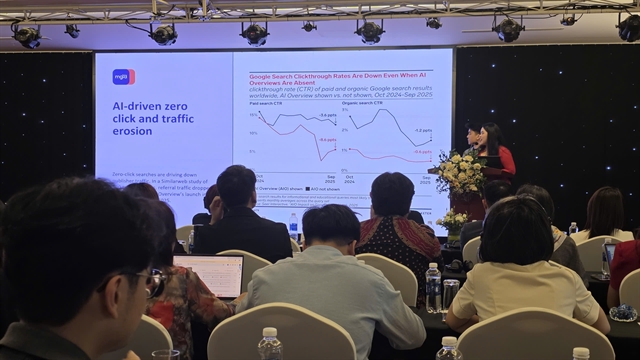
| Participants at the event in the afternoon on March 25. — VNS Photo Ly Ly Cao |
By Ly Ly Cao
HÀ NỘI — As artificial intelligence (AI) rapidly reshapes the global media landscape, questions of trust and audience attention are emerging as critical challenges for newsrooms, industry experts said at a conference held in Hà Nội on March 25.
The conference Journalism in the Whirlwind of Trust and Attention in the AI Era brought together media leaders and industry representatives to address mounting challenges facing news organisations amid rapid advances in AI.
Amid concerns over declining public trust and the disruptive impact of AI on information flows, Lê Quốc Minh, chairman of the Vietnam Journalists Association and Editor-in-Chief of Nhân Dân Newspaper, stressed the enduring role of journalistic principles.
"Reliability and objectivity are the guiding principles for press agencies to produce high-quality content that adheres to professional and ethical standards, earns public trust and fulfils the mission of Việt Nam's revolutionary press in the whirlwind of information in the AI era," he said.
Given the ongoing evolution of AI, news organisations are being forced to rethink not only how content is produced but also how it is distributed, consumed and monetised.
The interplay between trust, attention and technology emerged as a central theme, with participants pointing to the need for innovation grounded in journalistic integrity.
According to Aliefah Fikri, Asia Pacific Head of Success at MGID, publishers are increasingly grappling with declining traffic and fragmented audiences, driven in part by the rise of AI-powered zero-click discovery, which reduces the need for users to visit news websites directly.
The representative from MGID said that referral traffic to 100 leading news sites dropped by 17 per cent between May 2024 and May 2025 following the rollout of AI-generated search overviews, highlighting the scale of disruption.
"AI is not just changing search. It is reducing visit opportunities," Aliefah said, pointing to a broader shift away from traditional referral models towards distributed content ecosystems dominated by social platforms, aggregators and creator-led channels.
This shift has compounded longstanding issues of audience fragmentation and declining trust. Video and social formats are gaining traction, particularly among younger users, while text-based news sites face growing difficulty in maintaining engagement and loyalty, the conference heard.
Aliefah emphasised that sustainable growth in this environment requires a return to core principles.
"Acquire audiences and engage users multiplied by precise analytics equals strong monetisation," she said, outlining a framework that prioritises diversified traffic sources, deeper engagement metrics and balanced user experience in advertising strategies.
On the editorial side, a representative from Reuters shared insights into how AI is being integrated into newsroom workflows while maintaining strict editorial standards.
"Reuters regards AI as a breakthrough that offers the potential to enhance our journalism and empower our journalists," said Francesco Guarascio, Vietnam Bureau Chief at Reuters.
He outlined a framework built on four pillars: responsibility, transparency, oversight and accountability.
Human editors remain central to all editorial output, with AI tools used to reduce repetitive tasks, augment reporting capabilities and explore new forms of storytelling.
Francesco also stressed that trust remains the cornerstone of journalism in the AI age. Reuters commits to clear disclosure when AI tools are used, rigorous human oversight and prompt correction of any errors.
"Reporters and editors are always responsible for what they publish," he said, adding that any AI-generated content without human input must meet strict internal standards and is clearly labelled. — BIZHUB/VNS
Society
 Society
 Society
 Society
 Society
 Society
 Society
 Society
 Society
 Society
 Society
 Society
 Society
 Society
 Society