 Economy


Tighter controls on livestream sales
1.
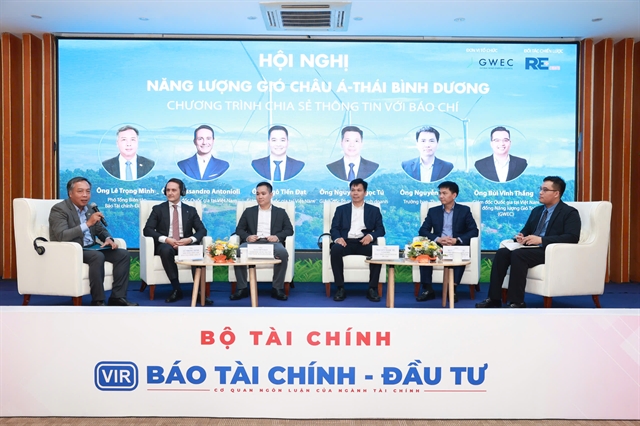 |
| Experts shared at the press meeting ahead of the Asia-Pacific Wind Energy Summit 2026. Photo courtesy of the organiser |
HÀ NỘI — Việt Nam is among the regional leaders in wind power development targets. However, major bottlenecks remain, including power purchase agreements (PPAs), grid transmission capacity and policy coordination from licensing to project implementation, experts said.
The information was released at a press meeting held in Hà Nội on Tuesday ahead of the Asia-Pacific Wind Energy Summit 2026.
Under the revised National Power Development Plan VIII (PDP VIII), Việt Nam aims to develop 26,066-38,029MW of onshore and nearshore wind power capacity by 2030, along with 6,000-17,032MW of offshore wind power expected to come online during 2030-35.
Bùi Vĩnh Thắng, the Global Wind Energy Council (GWEC)’s country director for Việt Nam, said that excluding China and India, Việt Nam could be considered a regional frontrunner in both onshore and offshore wind development.
Sharing the same view, Alessandro Antonioli, country director for Việt Nam at Copenhagen Infrastructure Partners (CIP), highlighted Việt Nam’s strong competitive advantages, including its long coastline and favourable wind conditions with consistently high wind speeds.
He said another major driver was domestic demand. As a rapidly developing economy, Việt Nam requires a stable and affordable energy supply to sustain growth. At the same time, the ongoing shift of manufacturing supply chains from Europe and the US to Việt Nam is increasing demand for greener energy sources that meet international sustainability standards.
“This is both a challenge and an opportunity if supportive policies, a clear commercial framework and stronger local supply chains are put in place,” Antonioli said.
Nguyễn Ngọc Tú, business development director at IPC E&C, said electricity demand in Việt Nam remained extremely high, requiring the power sector to stay ahead of economic and population growth.
“Việt Nam already has much of the necessary ecosystem to support the expansion of renewable energy and is moving in the right direction as global economies accelerate their transition to green energy,” he added.
Key bottlenecks remain unresolved
Despite strong potential and ambitious targets, Antonioli said delays in policy planning over the past three years had weakened investor confidence, particularly because of delayed payments to some renewable energy producers due to approval issues affecting 173 projects.
He added that Việt Nam was in a favourable position to accelerate renewable energy development, but clearer regulations were needed regarding project licensing procedures and electricity pricing frameworks.
Most importantly, he said that the current PPA template lacked key provisions required for international project financing.
He said investors could not commit additional capital if they did not know the terms under which electricity would be sold.
Nguyễn Tuấn, head of commercial at PetroVietnam Technical Services Corporation (PTSC), shared similar concerns, saying that the current PPA framework made it difficult to secure international financing because it lacked core provisions such as foreign currency convertibility.
“These offshore wind projects are billion-dollar developments. Without bankable policies, implementation will not be possible. This is one of the biggest policy bottlenecks,” Tuấn said.
He also pointed to transmission infrastructure constraints as another major challenge, not only for wind power but for the wider electricity sector.
Electricity demand continues to rise sharply, while localised power shortages still occur in northern Việt Nam. Although the Government has outlined plans for major north-south transmission lines through 2030, with a vision to 2045, Tuấn said implementation must be faster and better coordinated.
“Otherwise, the market will continue facing the paradox of power congestion in some areas while shortages persist in others,” he said.
Signs of policy progress
GWEC’s Thắng said that although the policy framework remained incomplete, recent measures have begun creating conditions for projects to move forward.
He noted that even in offshore wind, the Ministry of Agriculture and Environment had already allocated sea areas for survey activities for several projects.
Thắng said investors closely following the market had recognised emerging opportunities as a series of new policies were introduced in 2025, including the revised PDP VIII, Decrees 56, 57 and 58 guiding the implementation of the Electricity Law and direct power purchase mechanisms, as well as National Assembly Resolution 253 on national energy development policies for 2026-30.
“GWEC sees this as the beginning of a new development cycle. It is also the right time for investors and financial institutions to return to the market,” Thắng said.
He added that equipment manufacturers, contractors and service providers had already begun positioning themselves early after identifying the market’s long-term demand potential.
Against the backdrop of Việt Nam’s ambition to achieve double-digit economic growth, electricity demand is forecast to rise sharply in the coming years, increasing the importance of wind power in the country’s energy mix.
APAC Wind Energy Summit 2026 to open opportunities for Vietnamese firms
The APAC Wind Energy Summit 2026 will take place in Hà Nội from June 9-11 under the theme: Wind Powering Prosperity in the Asia-Pacific: Building an Electrified Economy through Scaled Wind Energy and Supply Chains.
The event is expected to attract more than 600 regional and international delegates and will feature high-level discussions, technology exhibitions, business networking activities and policy dialogues.
Lê Trọng Minh, deputy editor-in-chief of Vietnam Invesment Review, said the conference would provide practical insights and valuable information for businesses, investors and readers, while clarifying the role of wind energy in Việt Nam’s economic growth.
He added that the event would also create opportunities for cooperation between domestic and international companies, contributing to the development of green energy and the achievement ofViệt Nam’s net-zero emissions target by 2050.
Discussions at the summit will focus on green finance, energy security, energy storage, industrial electricity demand, floating offshore wind, grid integration, digitalisation and supply chain development.
Organisers said the programme was designed to balance strategic vision with practical implementation solutions, offering clearer perspectives on scaling up wind energy across the Asia-Pacific region while strengthening energy security, economic resilience and industrial competitiveness. — VNS
Economy
 Economy
 Economy
 Economy
 Economy
 Economy
 Economy
 Economy
 Economy
 Economy
 Economy
 Economy
 Economy
 Economy
 Economy