 Economy



Việt Nam, China seek stronger substantive parliamentary cooperation
1.
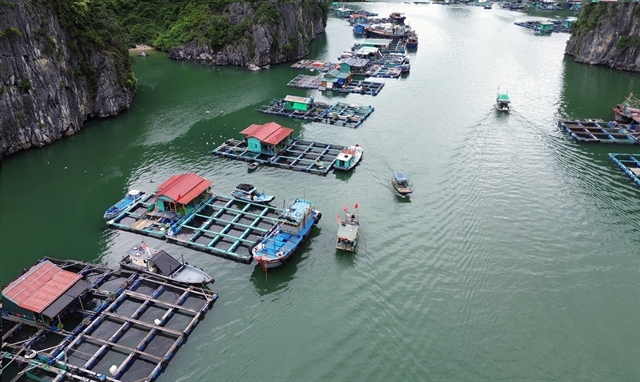 |
| Floating fish farming cages in Hải Phòng. Việt Nam aims to have at least 300,000 small and medium-sized enterprises (SMEs) with outstanding loans at credit institutions by 2030. — VNA/VNS Photo Trần Việt |
HÀ NỘI — Deputy Prime Minister Nguyễn Văn Thắng has signed Decision No. 928/QD-TTg approving the national financial inclusion strategy for the 2026-30 period, aiming to build a modern and safe inclusive financial ecosystem in Việt Nam.
The strategy targets all citizens and businesses, with priority given to people in rural, remote, border and island areas, low-income households, students, small- and medium-sized enterprises (SMEs), cooperatives, household businesses and vulnerable groups.
Under the strategy, Việt nam aims for 95 per cent of the population aged 15 and above to have transaction accounts at banks or other authorised institutions by 2030.
The value of non-cash payments is expected to reach 30 times the country’s GDP, while at least 30 per cent of adults are targeted to have savings deposits at credit institutions and foreign bank branches.
The strategy also aims for at least 300,000 SMEs to have outstanding loans at credit institutions or foreign bank branches by 2030.
Outstanding loans serving agriculture and rural development are expected to account for around 25 per cent of total credit in the economy, while insurance sector revenue is projected to reach 3.3-3.5 per cent of GDP.
The Government's strategy seeks to ensure equal access to financial products and services, helping improve living standards and ensuring that no one is left behind in the development process.
To achieve the targets, the strategy proposes a series of measures, including improving the legal framework, diversifying financial service providers and developing modern digital distribution channels at reasonable costs.
The plan also focuses on expanding access points for financial services in rural, remote and disadvantaged areas, enabling residents and businesses to access financial products more conveniently.
Authorities will promote cashless payments across the economy while encouraging the development of financial products tailored to agriculture, rural production, SMEs, cooperatives and household businesses.
The strategy also encourages cooperation between credit institutions, foreign bank branches and fintech firms to develop digital financial service models for priority groups.
A nationwide financial education programme and digital citizen programme will also be implemented to improve financial literacy and digital skills.
The Government stressed the importance of consumer protection, cybersecurity and personal data protection as financial services become increasingly digitalised.
Notably, the strategy prioritises sustainable finance and green finance development.
Credit institutions and financial service providers are encouraged to prioritise loans for green and circular economy projects and apply environmental, social and governance (ESG) standards.
The Government also plans to diversify green financial products and green credit schemes to improve access to financing for businesses and individuals pursuing green transition initiatives.
In addition, insurers are encouraged to expand microinsurance and supplementary pension products, while fintech applications are expected to help widen financial inclusion for vulnerable groups and underserved communities.
There are currently more than one million active enterprises in Việt Nam, of which around 98 per cent are SMEs, while micro and small firms account for nearly 70 per cent.— VNS
Economy
 Economy
 Economy
 Economy
 Economy
 Economy
 Economy
 Economy
.jpg) Economy
Economy
 Economy
 Economy
 Economy
 Economy
 Economy
 Economy