 Society

Vietnamese Prime Minister meets Cambodian National Assembly President
1.
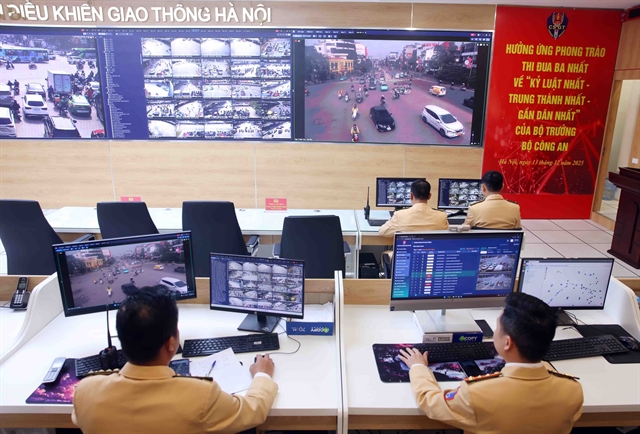 |
| Police officers at the Hà Nội traffic control centre. — VNA/VNS Photos |
HÀ NỘI — At busy intersections, traffic is flowing more smoothly, signals appear better timed and enforcement less arbitrary, pointing to a broader shift in how Hà Nội manages its rapidly expanding urban transport network.
Since December 13, 2025, the intelligent traffic control centre operated by the Traffic Police Division under Hà Nội Police has processed more than 19,300 traffic violations using an artificial intelligence (AI)-enabled camera system.
Beyond the headline figure, officials say the technology is reshaping urban management, not merely identifying breaches.
For years, traffic control in the capital relied heavily on manpower and on-the-spot judgement, often reacting to congestion rather than anticipating it. The new system marks a move away from that model.
With 1,837 AI cameras integrated into traffic signals at 195 key intersections, Hà Nội now operates a citywide network capable of monitoring and regulating traffic in real time. Authorities say this allows data to be shared continuously, supporting faster and more consistent decision-making.
The approach represents a shift towards more proactive management. Instead of waiting for congestion to build, the system enables earlier intervention by adjusting signal cycles, coordinating traffic flows and maintaining stability across multiple routes simultaneously.
A similar transition is underway in enforcement procedures.
From January 1, Hà Nội Police began piloting a fully digital sanctioning process via the iHanoi application, with 7,810 cases already processed through the system. The initiative replaces traditional administrative procedures with a streamlined digital process.
Residents can check violations, confirm details and pay fines online without visiting police offices, while authorities say the system helps reduce administrative workload, improve transparency and limit direct contact.
Public response has been broadly positive, although some say adaptation will take time.
“The system makes enforcement feel more consistent, but people still need time to get used to it,” said Lê Văn Hùng, a motorbike driver in Vĩnh Hưng Ward.
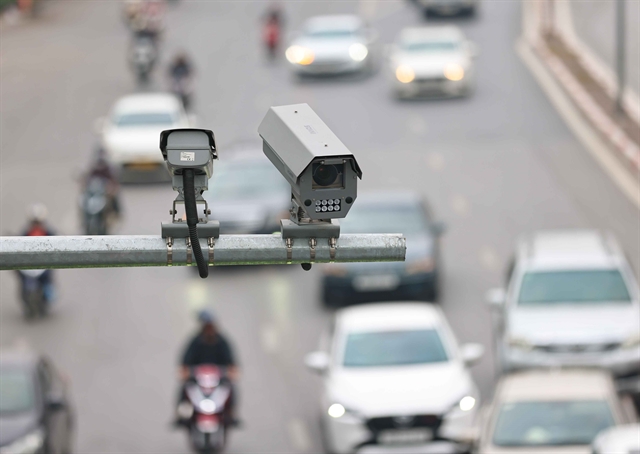 |
| The AI camera system has detected thousands of violations, underscoring its effectiveness. |
Others have raised concerns about awareness and the pace of adaptation.
“Not everyone is familiar with using apps to handle fines yet, especially older people,” said Nguyễn Thị Yến, a retiree. “There should be more guidance to help people adapt.”
At a broader level, the shift reflects a governance approach that prioritises efficiency and accessibility.
One of its most significant aspects is the focus on behaviour. Congestion in Hà Nội has long been linked not only to infrastructure constraints but also to inconsistent compliance with traffic rules.
The system automatically detects and fines common offences such as running red lights, illegal stopping or parking and encroaching on pavements, allowing authorities to address violations at their source. Enforcement becomes more consistent and visible, encouraging behavioural change rather than serving as an occasional response.
At the same time, data generated by the system is being used to refine traffic organisation.
Authorities have adjusted operations at 188 intersections and established 22 green wave corridors along key routes such as Phố Huế–Hàng Bài, Trần Hưng Đạo and Võ Chí Công. Hundreds of signal recalibrations and technical interventions have helped ensure stable and continuous operation.
Initial results suggest the approach is having an impact. Traffic flow through intersections has improved by between 4 per cent and more than 18 per cent, including at some of the capital’s most congested junctions. While incremental, these gains point to the cumulative effect of a more coordinated and data-driven system.
Hà Nội is moving away from a model defined by manual control and fragmented processes towards one built on integration, real-time data and digital platforms.
The intelligent traffic control centre, in this sense, represents more than an operational upgrade. It forms part of a broader effort to build digital government and a smarter urban environment, where technology underpins not only infrastructure but also decision-making.
More consistent enforcement is also influencing behaviour on the streets.
“People are more careful now, especially at red lights and no-parking zones. You know the cameras are always there,” Hùng said.
However, some caution that lasting change will depend on public awareness.
“Technology helps, but improving traffic culture still requires long-term education,” Yến said.
A new model of urban management is taking shape, more proactive, better connected and increasingly aligned with the demands of a growing city. — VNS
Society
 Society
 Society
 Society
 Society
 Society
 Society
 Society
 Society
 Society
 Society
 Society
 Society
 Society
 Society