 Society

Vietnamese PM pays courtesy visits to Cambodian King, Queen Mother
1.
|
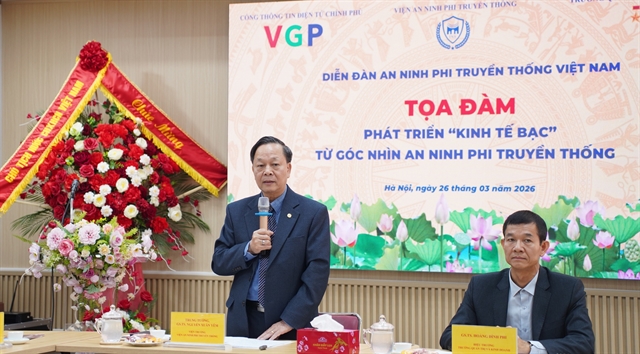
| Nguyễn Xuân Yêm, director of the Institute for Non-Traditional Security under the University of Economics and Business (VNU) speaks at the seminar in Hà Nội on Thursday. — Photo baochinhphu.vn |
HÀ NỘI — A shift in approach to population ageing is needed, including more effective use of older workers, to turn the 'silver economy' into a key growth driver, experts told a seminar in Hà Nội on Thursday.
The discussion, titled ‘Developing the silver economy from a non-traditional security perspective’, was jointly organised by the Institute for Non-Traditional Security under the University of Economics and Business (VNU) and the Government Portal.
Speaking at the seminar, Nguyễn Xuân Yêm, director of the institute, said Việt Nam is facing three major policy challenges. He noted that the country must find ways to more effectively mobilise its rapidly growing elderly population, which now stands at around 16.1 million people, many of whom remain willing and able to work.
He added that older people should be placed at the centre of social security policies, particularly in healthcare, and that policies must ensure they can fully benefit from socio-economic development in both material and spiritual terms.
Trương Xuân Cừ, vice chairman of the Việt Nam Association of the Elderly, emphasised that the ageing population represents not only a social responsibility but also a valuable intellectual resource.
He said Việt Nam currently has about 25,000 senior intellectuals, including 1,250 professors and 5,500 associate professors, who could make significant contributions if properly engaged.
“This is an invaluable knowledge resource if it is effectively utilised,” he said.
However, he also pointed out that the silver economy in Việt Nam remains underdeveloped. He noted that the country lacks a comprehensive and coordinated policy framework, and that social resources have not yet been mobilised effectively, preventing the sector from reaching its full potential.
Experts at the seminar noted that, globally, the silver economy has already become an important engine of growth. China, for instance, has more than 310 million elderly citizens, whose economic contribution currently accounts for about 6 per cent of GDP and is expected to rise to 10 per cent. In Japan, the silver economy contributes roughly 20 per cent of GDP, while Singapore is actively leveraging population ageing to drive innovation and create new business opportunities.
In light of these trends, participants stressed that Việt Nam must accelerate institutional reforms and develop markets tailored to an ageing society.
Hoàng Đình Phi, rector of the University of Economics and Business, said that the Politburo’s Resolution 72 on a number of breakthrough solutions to strengthen the protection, care and improvement of public health should clearly define the responsibilities of ministries and local authorities, particularly the Ministry of Health, in developing a modern healthcare market.
He explained that such a market should not be limited to healthcare services alone but should also encompass pharmaceuticals, including both Western and traditional medicine. Despite its long-standing heritage, Việt Nam’s traditional medicine sector has yet to realise its full potential.
He warned that the country’s heavy reliance on imported Western medicines not only increases foreign currency expenditures but also undermines the autonomy of the national healthcare system and weakens domestic production capacity, especially in the field of traditional medicine.
“In contrast, countries such as China, South Korea and Japan have successfully developed strong traditional medicine industries,” Phi said, adding that reviving and modernising Việt Nam’s traditional medicine sector should be considered a strategic priority.
Experts also highlighted difficulties in attracting private investment to elderly care services. They noted that service models such as day-care, short-term and long-term nursing care remain underdeveloped due to the lack of clear incentives related to land use, taxation and administrative procedures.
They added that the high cost of investment, combined with limited policy support, has discouraged businesses from entering the sector.
From a workforce perspective, Lê Ngọc Thành, rector of the VNU University of Medicine and Pharmacy, said Việt Nam needs to rethink its approach to ageing. He stressed that older people should not only be seen as beneficiaries of care but also as a valuable source of experience and expertise.
He noted that in countries such as Japan, older workers continue to contribute actively across many sectors, while in Việt Nam their potential remains underutilised.
Thành also pointed to ongoing efforts to develop the health sciences sector, including the gradual expansion of training units within his university. He said experienced lecturers and senior experts play a critical role in this process.
He added that many leading academics continue to teach and contribute out of a sense of responsibility rather than financial motivation, providing a strong foundation for improving training quality and maintaining academic stability. — VNS
Society
 Society
 Society
 Society
 Society
 Society
 Society
 Society
 Society
 Society
 Society
 Society
 Society
 Society
 Society