 Society
Artisan family keeps Đông Hồ folk painting alive
1.
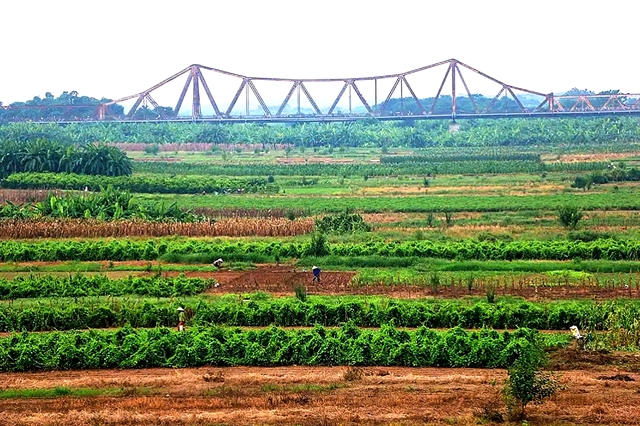 |
| An agricultural land area at the Hồng River in Hà Nội. One notable aspect of the amended Capital Law is regulations on the exploitation and use of agricultural land funds along rivers with embankments. — VNS Photo Đoàn Tùng |
HÀ NỘI — Hà Nội is moving to unlock new space for eco-friendly agriculture under a draft amended Capital Law, as policymakers seek to balance innovation with tighter safeguards against misuse of land.
The proposed changes centre on improving land use efficiency through high technology and sustainable practices, while strengthening environmental protection and climate change adaptation.
A notable feature of the draft law is the authority it would grant to the Hà Nội People's Council to regulate the exploitation and use of agricultural land along riverbanks and on floating islets in embanked river sections.
These areas are not clearly governed under the current Law on Dyke and Land Law, which largely restrict construction to ensure flood prevention safety.
Under the draft, such land could be organised for ecological farming using advanced technologies, combined with experiential tourism and education. Any construction will still have to comply with dyke planning and disaster prevention regulations.
Compared with the 2013 Land Law, which is under revision, the proposal offers greater flexibility in the use of riverbank farmland. However, it also raises the need for strict oversight to prevent encroachment on flood drainage corridors.
The draft law will also allow the city to issue detailed rules on licensing facilities that directly support agricultural production, including processing areas, storage, product display spaces and experiential zones.
This marks a shift from current practice, where many high-tech farming models face legal obstacles in building supporting infrastructure.
Preferential policies are also proposed to attract investment into high-tech agriculture and environmental protection. Projects focused on waste and wastewater treatment, climate resilience or the development of high-tech farming zones will be eligible for incentives related to land, science and technology and investment.
The direction aligns with the Communist Party of Việt Nam Central Committee’s resolution on green agriculture and the circular economy.
High-tech models show promise
In practice, Hà Nội has already seen encouraging results from high-tech agricultural models.
According to the Agricultural Extension Centre under the Hà Nội Department of Agriculture and Environment, 14 models were implemented last year across four categories tailored to local conditions, applying advanced technologies and climate adaptation measures.
In production linkages, the Vietnamese Good Agricultural Practices rice model delivers economic efficiency about 20 per cent higher than conventional methods. A processed potato model yielded profits of VNĐ110 million (US$4,100) per hectare, while ginger output reached about 13 tonnes per hectare.
In vegetables, flowers and fruit, substrate-grown melons generated VNĐ260–330 million ($9,800–12,500) per hectare per crop, often paired with experiential tourism through dozens of tours. Industrial mushroom production brought profits of up to VNĐ286 million ($10,800) per cycle.
Climate adaptation models have also shown results. New lotus varieties yield revenues exceeding VNĐ210 million ($7,900) per hectare, while improved rice and soybean varieties are helping to restructure crops and raise land value.
These outcomes align with the city’s 2021–2025 urban agriculture development programme, which prioritises value chain integration, high-tech application and emissions reduction.
Calls for safeguards
Experts caution that expanding construction rights on agricultural land must be tightly controlled to avoid abuse, particularly where farming is used as a pretext for commercial or tourism development.
Without clear standards, they warn, policy goals could be distorted, placing pressure on infrastructure, the environment and land management systems.
Some localities have already seen rapid growth in agriculture-tourism models without adequate oversight of planning and land use, offering lessons for Hà Nội as it designs new mechanisms.
Residents have also voiced cautious support.
Nguyễn Văn Hòa in Ba Vì Commune said, "Residents hope for mechanisms to invest more systematically, like building greenhouses and storage warehouses, but if not clearly regulated, indiscriminate construction could occur."
Phạm Thị Thu from Sóc Sơn Commune said that while combined production and tourism models could be effective, clearer distinctions would be needed to prevent them from becoming purely service-based businesses on agricultural land.
Residents in Sơn Tây Ward, Kim Anh and Trung Giã communes said the key issue would not be whether to open up mechanisms but how to design effective controls.
They called on authorities to set clear criteria for construction ratios, permitted facility types, and monitoring and enforcement measures, while ensuring consistency with the Land Law, Law on Dyke and related planning frameworks to avoid overlaps or legal gaps.
As Hà Nội pursues a greener, more modern agricultural model, striking the right balance between openness and control will be crucial to ensuring the policy delivers real-world results. — VNS
Society
 Society
 Society
 Society
 Society
 Society
 Society
 Society
 Society
 Society
 Society
 Society
 Society
 Society
 Society