 Society
Bringing fallen heroes home: Keeping Việt Nam’s tradition of gratitude alive
1.
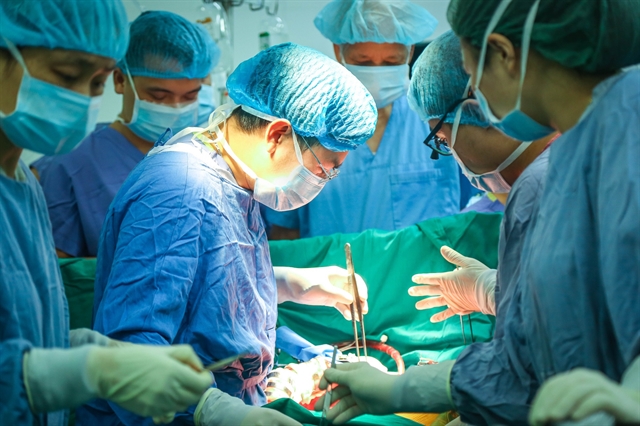 |
| Medical team performs a multi-organ transplant at the Việt Đức Friendship Hospital. —Photo courtesy of the hospital |
HÀ NỘI — Việt Đức Friendship Hospital has successfully carried out a series of organ transplants from brain-dead donors, including the country’s first domino liver transplants, marking a major advance in complex transplant procedures.
In this unique multi-organ operation, the heart and liver of a brain-dead donor were transplanted into a male patient with the rare disease amyloidosis, while the patient’s own healthy liver was then used for transplantation into another patient suffering liver cancer on a background of cirrhosis.
The organ donor was a 42-year-old woman with no prior medical history or significant underlying conditions. She lost consciousness following a motorcycle accident on March 11 and was admitted to Vĩnh Phúc General Hospital.
Upon arrival at Việt Đức Hospital, the woman was in a deep coma, with a Glasgow Coma Scale (GCS) score of 3, dilated pupils of 4mm and loss of light reflex. After her family consented to organ donation, doctors determined that the heart, liver, both kidneys and certain tissues could be donated.
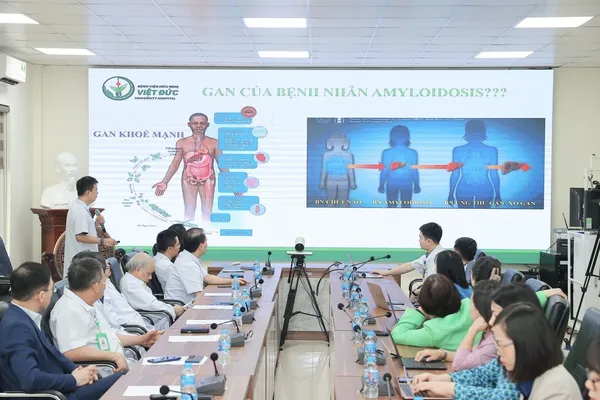
The recipient of the heart and liver transplant is a 53-year-old man diagnosed with hereditary amyloidosis caused by a mutation in the transthyretin (TTR) gene. Amyloidosis is a rare condition in which abnormal protein deposits, known as amyloid fibrils, accumulate in organs and tissues, including the heart, kidneys, liver and nerves, impairing their function.
Because the patient’s inherited amyloidosis caused multi-organ damage, particularly progressive infiltrative cardiomyopathy, a combined heart-liver transplant was necessary to replace the amyloid-infiltrated heart muscle and remove the source of mutated TTR protein from the liver. Health experts noted that his liver remained healthy and suitable for transplantation to another patient.
Associate Professor Dr Nguyễn Quang Nghĩa, Director of the hospital’s Organ Transplant Centre, explained that despite producing abnormal proteins, a liver from a patient with amyloidosis can function effectively for many years in a new body.
“People with end-stage liver cancer, instead of only living for another 6–12 months, now have their lifespan extended to 7–10 years,” he said.
The second liver recipient was a 64-year-old man with a history of intermittently treated hepatitis B, diagnosed with liver cancer on a background of cirrhosis and portal vein thrombosis. He had received one course of combination immunotherapy with tremelimumab and durvalumab but was no longer eligible for surgery and was transferred to Việt Đức Hospital for transplantation.
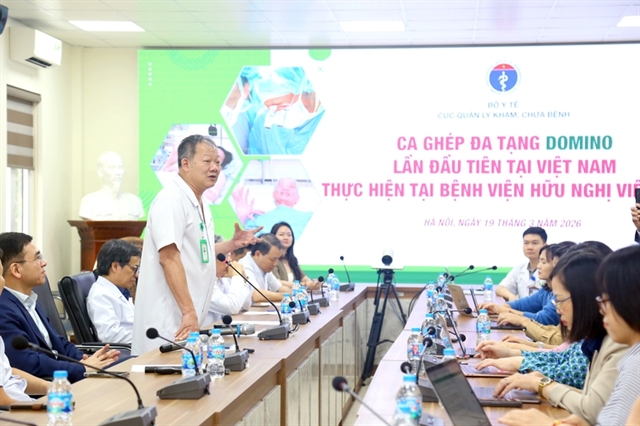 |
| Associate Professor Dr. Dương Đức Hùng, Director of Việt Đức Friendship Hospital, speaks at a press conference on March 19. — Photo courtesy of the hospital |
This is the first-ever domino liver transplant in Việt Nam and in Asia, in which the liver from a patient with amyloidosis was not discarded but used to transplant into another patient with liver cancer on a background of cirrhosis.
The multi-organ procedure, involving both heart and liver transplants for a patient with the rare disease amyloidosis, is also only the second such case in Việt Nam.
“We have performed a remarkable multi-organ transplant, marking the first time Việt Nam has successfully implemented the domino liver transplant technique, a method that optimises the supply of donated organs, which is still scarce,” Associate Professor Dr Dương Đức Hùng, Director of Việt Đức Friendship Hospital, said on March 19, a week after the historic procedure.
Following the transplant, both patients had their endotracheal tubes removed after 12 hours, with the transplanted organs recovering rapidly. Within 72 hours, both were alert, able to sit up and eat and drink.
Five days after surgery, the patients can move and eat normally. If recovery continues smoothly, they are expected to be discharged within the next week.
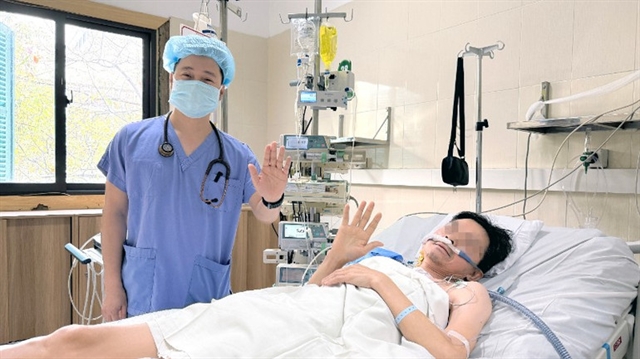 |
| The heart and liver transplant recipient is currently in stable condition. — Photo courtesy of the hospital |
Dr Hà Anh Đức, Director of the Medical Services Administration at the Ministry of Health, praised Việt Đức Friendship Hospital for successfully carrying out the domino organ transplant.
“The domino liver transplant technique has profound humanitarian significance as it optimises the supply of donated organs from a brain-dead donor, thereby providing a chance of survival for many patients with end-stage organ failure,” Dr Đức said.
He added that the successful procedure not only demonstrates the high level of expertise and mastery of complex organ transplantation by Vietnamese surgeons, but also reflects the strong development of Vietnamese medicine in organ transplantation in recent years.
Globally, domino liver transplantation has been performed since 1995, with more than 1,200 cases at 66 medical facilities across 21 countries. The method is considered relatively safe, with a one-year survival rate of approximately 86.7 per cent. In Southeast Asia, Việt Nam is the first country to successfully perform a combined domino heart-liver transplant, further enhancing its position on the international organ transplantation map. — VNS
Society
 Society
 Society
 Society
 Society
 Society
 Society
 Society
 Society
 Society
.jpg) Society
Society
 Society
 Society
 Society
 Society