 Society
European business confidence remains at historic high in Q3
1.
.jpg) |
| Doctors from Chợ Rẫy Hospital in HCM City and Vĩnh Long General Hospital in Vĩnh Long Province watch a trial run of a linear‑accelerator radiotherapy system for cancer treatment. — VNA/VNS Photos |
HÀ NỘI — Deputy Prime Minister Nguyễn Chí Dũng has approved a national strategy on the development and application of atomic energy for peaceful purposes through 2035.
The strategy sets out a comprehensive framework to develop atomic energy in a safe, secure and effective manner, supporting socio-economic growth, enhancing living standards, protecting the environment, and strengthening national energy security. It also aligns with Việt Nam’s commitment to achieving net-zero emissions by 2050.
A key pillar of the strategy is the development of nuclear power.
By 2035, Việt Nam aims to complete and safely operate the Ninh Thuận 1 and Ninh Thuận 2 nuclear power plants. Domestic firms are expected to undertake about 30 per cent of the construction and installation workload for auxiliary components.
The Government also plans to deploy at least one small modular reactor project, marking a step toward more flexible and scalable nuclear energy solutions.
Alongside project implementation, Việt Nam will continue to build out nuclear power infrastructure and define a long-term project pipeline grounded in safety, sustainability and efficiency, contributing to national energy security and the net-zero roadmap.
The strategy also aims for significant expansion in the use of radiation and radioactive isotopes, with the projected annual growth of 10-15 per cent through 2035.
In health care, Việt Nam plans to reach advanced regional standards, including increasing the availability of CT scanners, MRI systems, nuclear imaging equipment and radiotherapy accelerators, while achieving full digitalisation of X-ray services.
As for industry, nuclear and radiation technologies will be used to improve quality control, optimise production processes and enhance material processing. Domestic manufacturing of radiation-related equipment to reduce dependence on imports also remains a priority.
Agriculture is another area of focus, with plans to apply nuclear techniques in crop breeding, plant protection, livestock, aquaculture and food preservation, helping to improve productivity and product quality.
The strategy places a major emphasis on strengthening Việt Nam’s nuclear science and technology.
By 2035, the country plans to establish two key national laboratories in nuclear power and strategic minerals, along with three to five advanced laboratories.
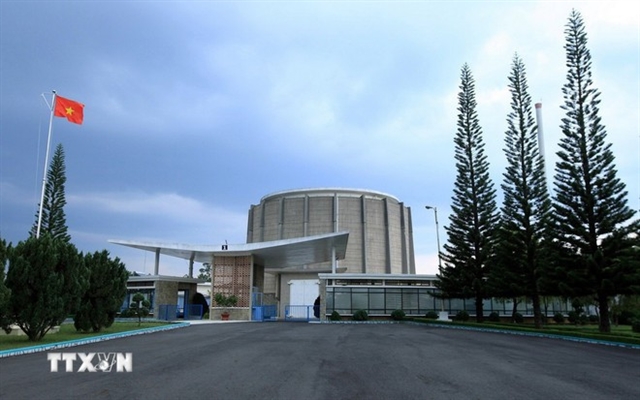 |
| The Đà Lạt nuclear reactor. |
In addition, four to five high-level research groups are expected to develop capabilities in core nuclear technologies, supporting both nuclear power projects and research reactors.
Investment will also be directed toward higher education, with a target of three to five universities achieving internationally competitive standards in nuclear engineering and related fields.
Vision to 2050
Nuclear power is expected to contribute around 6-8 per cent of total electricity generation, with the addition of approximately four large reactors and 10-15 small modular reactors. This share may be adjusted depending on technological and economic conditions.
Việt Nam also aims to master key nuclear technologies and foster leading domestic enterprises capable of design, construction, manufacturing and equipment supply for the nuclear sector.
Advanced nuclear applications are expected to expand across health care, industry, agriculture and natural resources and environmental management. A large accelerator centre is also planned as part of the country’s long-term scientific infrastructure.
The strategy underscores the need for a robust regulatory framework aligned with international standards, ensuring radiation safety, nuclear safety and nuclear security.
Plans include developing a modern national radiation monitoring and early warning system, as well as investing in a highly skilled workforce of engineers, scientists and technical specialists to support the sector’s growth.
By 2050, Việt Nam aims to reach the average level of developed countries in nuclear science and technology, positioning itself as a regional hub for nuclear research, training and application in Southeast Asia. — VNS
Society
 Society
 Society
 Society
 Society
 Society
 Society
 Society
 Society
 Society
 Society
 Society
 Society
 Society
 Society