 Society

Ping An Digital Bank Completes HKMA’s Second GenA.I. Sandbox Cohort
1.
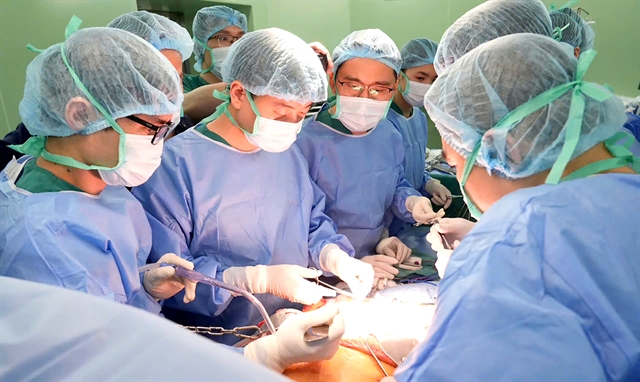 |
| The doctors strain every nerve during the organ retrieval and transplant operation. — VNA/VNS Photo Tạ Nguyên |
HÀ NỘI — As much of the country paused for Tết celebrations, doctors set aside the holiday and entered a race measured not in minutes but in heartbeats, carrying out an extraordinary organ donation and transplant operation in the opening days of the Lunar New Year.
On the sixth day of Tết, while streets remained bright with spring colours, medical staff at Hà Nội’s Bạch Mai Hospital began an urgently activated special shift.
It was not prompted by a traffic accident or routine emergency but by the first multi-organ donation and transplant effort of the new year, involving a patient who had suffered a cerebral stroke and ultimately helped save eight lives.
Upon receiving information from Bạch Mai Hospital, Cao Đằng Khang, head of the Cardiovascular Surgery Ward at HCM City University of Medicine and Pharmacy Hospital, boarded an emergency flight from HCM City to Hà Nội to join the heart retrieval team.
"Organ retrieval and transplantation requires the coordination of about 20–30 members in the entire team. During the Tết holiday period, calling for that full force demands tremendous unity among the doctors," said Khang.
It became a sleepless night for doctors and nurses. Behind operating theatre doors, every heartbeat, every breath and every stitch carried responsibility, pressure and hope.
Doctors still recall that spring shift with emotion. Bạch Mai Hospital had admitted a young man suffering a severe cerebral stroke with heavy haemorrhage, deep coma and signs of brain death. Despite the application of all available resources and the most advanced treatments, the patient could not be saved.
Once the risk of brain death was confirmed, the hospital notified the National Organ Transplant Coordination Centre and held frank discussions with the patient's family about his condition.
Amid profound grief, the family made a decision that moved the entire medical team. They agreed to donate the tissues and organs of their only son, who was nearing death, so that others might live.
From that moment, a race against time formally began.
Bạch Mai Hospital’s board of directors directly oversaw the process. Resuscitation, anaesthesia and surgical teams were urgently mobilised, even as many staff remained on Tết holiday. No one asked about shifts or unfinished family meals. All attention focused on honouring the family’s humanitarian gesture.
At the same time, the National Organ Transplant Coordination Centre urgently matched recipients on the national waiting list, linking a network of public and private as well as military and civilian hospitals, including HCM City University of Medicine and Pharmacy Hospital, National Lung Hospital, National Children's Hospital, National Eye Hospital, Vinmec Hospital, Military Hospital 103 and Bạch Mai Hospital.
"Early in the spring, with traffic congestion and limited flights, the hospital's board of directors had to coordinate with airlines and city police to ensure the fastest, safest transport of tissues and organs. The logistics team prepared detailed transport plans, from routes, flight times, specialised vehicles, to preservation equipment," said Associate Professor Vũ Văn Giáp, deputy director of Bạch Mai Hospital and commander of the special donation-transplant operation.
After retrieval, organs were allocated to hospitals according to plan. The heart was transported urgently to HCM City for transplant into a 10-year-old child suffering from dilated cardiomyopathy.
From Vũng Tàu, amid severe post-Tết congestion, an ambulance brought the child to hospital in time as the southern medical team prepared the operating theatre and waited minute by minute.
About six hours after retrieval, the healthy heart was beating steadily in the child’s chest. At the southern end, the announcement "the heart has revived" rang out, drawing emotion from doctors in both regions.
That same night, two liver lobes were transplanted into a 23-month-old child with congenital biliary atresia and a 45-year-old patient with decompensated cirrhosis. Two kidneys were transplanted at Bạch Mai Hospital into patients with end-stage renal failure. A lung was transplanted into a 64-year-old patient with severe chronic obstructive pulmonary disease, while two corneas restored sight to two others.
"In that urgency, everything was directed towards one common goal: saving hearts, saving lives when hope was nearly exhausted. That's why, upon receiving news of an organ donor, we immediately mobilised our team, rearranged personal work and remaining holiday time to fly to Hà Nội as soon as possible, in time to assess and join the retrieval team,” said Khang.
“After completing retrieval, we quickly arranged the earliest flight back to HCM City with that special cargo, the donor's heart, to perform the transplant for the patient waiting every second."
Eight fragile lives were extended during that sleepless spring night.
Continuing lives
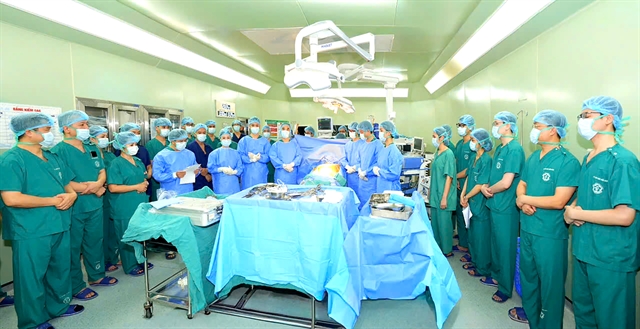 |
| Bạch Mai Hospital's medical staff are mobilised to the fullest for the organ retrieval and transplant operation. — VNA/VNS Photo Tạ Nguyên |
Behind that success lies the story of young Bùi Đức Quang, the family’s only son and their pride and joy. In 2022, he was commended for returning lost property to its owner, an act reflecting the kindness that defined him in life.
In a moment of profound grief, his mother shared that, upon learning her son’s tissues and organs could save many people, the family believed this was what he would have wanted. They chose to ensure his passing became not an end but the continuation of life for others.
That decision went beyond a medical act. It reflected the courage of parents facing the loss of an only child, love enduring through pain and an understanding that life may continue through compassion and generosity.
Throughout the process, doctors and nurses carried out not only their professional responsibilities but also supported the family at every stage, accompanying them through grief while providing detailed explanations and ensuring all procedures were conducted in accordance with legal and ethical requirements.
"We bow in gratitude to the donor and family, those who turned pain into the highest humanitarian act. Every revived heartbeat today is proof of compassion's value; and of the medical sector's efforts in transplant techniques," said Associate Professor Giáp.
The first multi-organ transplant of the spring was more than a medical achievement. It demonstrated close coordination among hospitals across the country, linking military and civilian as well as public and private institutions from north to south in a shared effort. It also marked further progress in Việt Nam’s strategy to develop advanced multi-organ transplant capabilities.
During those early days of the new year, doctors, nurses, technicians and logistics staff set aside personal commitments to carry out the operation. In doing so, they not only saved eight patients but also helped spread awareness of organ donation as a life-saving humanitarian act deserving broader public understanding and support.
This year’s spring at Bạch Mai Hospital stands as a testament to compassion and human values, affirming the dedication and expertise of medical professionals as lives continue onward. — VNS
Society
 Society
 Society
 Society
 Society
 Society
 Society
 Society
 Society
.jpg) Society
Society
 Society
 Society
 Society
 Society
 Society
.jpeg)