 Society

Việt Nam, Denmark issue joint statement on establishment of Comprehensive Strategic Partnership
1.
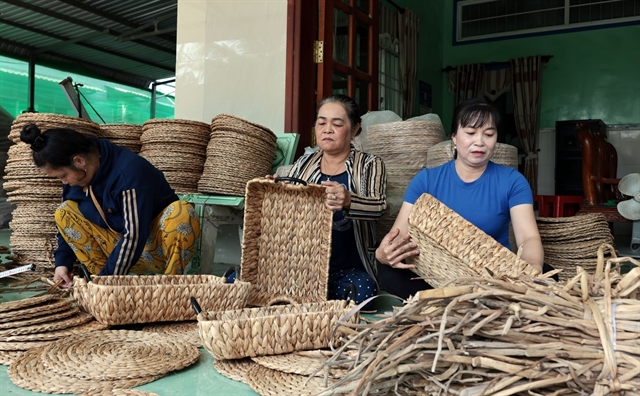 |
| A household business in An Giang Province manufactures woven products from water hyacinth with support from social policy credit, one of the measures under the national target programme for sustainable poverty reduction. — VNA/VNS Photo Trần Việt |
HÀ NỘI — The Ministry of Agriculture and Environment recently approved the 2026-30 plan for the national target programme on new rural development, sustainable poverty reduction and socio-economic development in ethnic and mountainous areas, with more than VNĐ1 quadrillion (US$40 billion) in estimated funding.
The central budget is expected to provide about 9.6 per cent of the funding, or VNĐ100 trillion ($3.9 billion), while local budgets will make up 28.7 per cent, or VNĐ300 trillion ($11.7 billion).
Other funding sources include VNĐ360 trillion ($13.9 billion) of integrated funding from other programmes and projects (34.6 per cent); VNĐ23 trillion ($885.7 million) of policy credit capital (2.2 per cent); and about VNĐ261 trillion ($10.1 billion) mobilised from businesses and communities (25 per cent).
The programme has set goals of building modern, culturally rich and sustainable new rural areas; promoting comprehensive development in ethnic and mountainous regions; and implementing inclusive, multidimensional poverty reduction while ensuring gender equality and social welfare.
At the same time, it seeks to promote a green, circular and ecological rural economy in line with agricultural restructuring to raise incomes and living standards, narrowing development gaps among regions.
By 2030, the programme aims to increase average rural incomes by 2.5 to three times compared to 2020, with incomes for ethnic people reaching about half of the national average.
Multidimensional poverty reduction is expected to be maintained at 1-1.5 per cent annually, bringing the multidimensional poverty rate in ethnic and mountainous areas to below 10 per cent, with virtually no communes or villages remaining in extremely disadvantaged conditions.
Nationwide, about 65 per cent of communes are expected to meet new rural standards, including 10 per cent achieving advanced criteria. At least five provinces or centrally-run cities must complete the new rural development process.
Among the new rural development criteria, planning will be digitally implemented and managed through a geographic information system, enabling updates to the National Planning Database and sharing with organisations and individuals.
In addition to economic development, rapid poverty reduction, sustainable income growth and narrowing living standard gaps, the national target programme also focuses on promoting gender equality and enhancing the role of women.
To develop a modern, ecological, multi-value rural economy that meets market demand, it aims for 80 per cent of ethnic farming households to participate in commodity-oriented agricultural and forestry production.
Priorities include restructuring agriculture and the rural economy, with emphasis on low-emissions production models, organic and circular agriculture, good agricultural practices (VietGAP and GlobalGAP standards), safe input use and product traceability.
At the same time, the programme underlines efforts to strengthen and develop the collective economy and cooperatives linked to value chains and sustainable livelihoods, support the establishment of concentrated raw material zones and large-scale commodity production, and promote strong links between production, processing and consumption.
A key measure is the development of high-quality, distinctive, multi-value and environmentally friendly local products under the One Commune–One Product (OCOP) programme, supported by the application of technology in processing, brand building and market expansion.
The national target programme also aims to promote diversified livelihood models and support production development that aligns with sustainable poverty reduction and the ecological and cultural conditions of each locality, especially in extremely disadvantaged or remote areas.
It encourages the application of science and technology and the development of a digital and green economy, innovative start-ups and market connectivity, in addition to piloting microfinance and climate-adaptive agricultural insurance. Workers from extremely disadvantaged areas will also get support to enrol in overseas employment programmes. — VNS
Society
 Society
 Society
 Society
 Society
 Society
 Society
 Society
 Society
 Society
 Society
 Society
 Society
 Society
 Society