 Society

Việt Nam, Denmark issue joint statement on establishment of Comprehensive Strategic Partnership
1.

|
| Many visitors explore, sample, and purchase regional specialties at the first Việt Nam Glorious Spring Fair 2026. VNA/VNS Photo |
HÀ NỘI — Many businesses who bring their products to the Việt Nam Glorious Spring Fair 2026 have proactively invested in technology, making science and tech a foundation for enhancing traditional product value, productivity and quality – driven by a spirit of entrepreneurship and innovation.
In the context of the Politburo’s Resolution No 57-NQ/TW issued last year on breakthroughs in science and technology development, innovation, and national digital transformation, alongside Resolution No 68-NQ/TW on private economic development currently being vigorously implemented, the application of science and technology in producing essential goods for daily life has been identified as a key driver, forming an important foundation for increasing product value and better responding to market needs.
When science and technology meet craftsmanship
At the event, many businesses have directly introduced to consumers products that meet quality and safety standards.
For many years, handicraft production in traditional craft villages has relied largely on manual labour, heavily dependent on the skills of artisans. While this model preserves refined craftsmanship and cultural identity, it has also revealed limitations in productivity and scalability.
Facing increasingly stringent market demands, the application of science and technology has become an inevitable direction for many production facilities and enterprises in this sector.
Bold technological investment has brought about clear transformation at the Asian Craft Co, Ltd in Thường Tín Commune in Hà Nội.
|
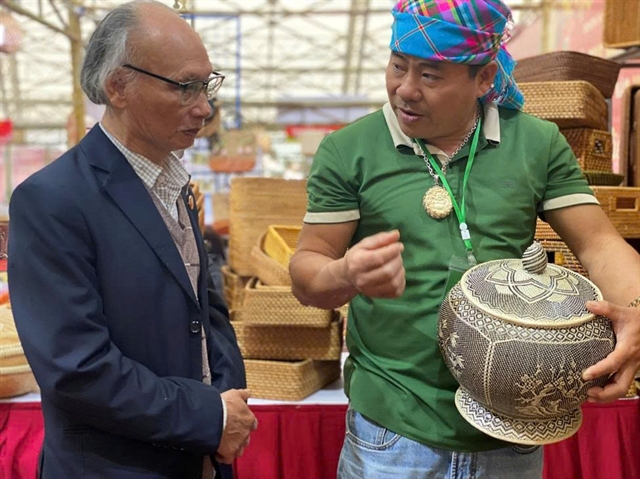
| Nguyễn Văn Hoa, a representative of Thu Linh Production Facility from the Phú Vinh bamboo and rattan craft village in Chương Mỹ Commune in Hà Nội, introduces products to customers.— VNA/VNS Photo |
From design and mould-making to processing and finishing high-end handicraft products made from kaolin stone, buffalo horn, decorative shells and mother-of-pearl, and carved wood, the company has introduced modern machinery and equipment. This has significantly increased labour productivity, reduced manual workload and ensured greater precision, consistency, and overall product quality.
Lê Thị Thuận, Deputy Director of Asian Craft Co, Ltd, said that previously, when cutting was done entirely by hand, each worker could process only around 30 kilogrammes of horn per day.
“Now, with machinery introduced into production, output can reach several hundred kilogrammes a day, saving time while improving efficiency and product quality,” she said.
The application of science and technology has not only strengthened the company’s competitiveness but also opened up sustainable development pathways for traditional handicraft products in the context of economic integration.
At the Spring Fair, the company showcased and supplied a wide range of products made from buffalo and cow horn, shells and sea pearls, including jewellery, health-care items and household goods. With diverse designs and assured quality, the booth attracted a large number of visitors.
Phan Mỹ Hạnh, a visitor from Dịch Vọng Ward in Hà Nội, said she highly appreciated the quality and credibility of products featured at the Spring Fair 2026.
The booths were carefully selected, offering diverse products with clear origins and demonstrating strong investment in design, quality and brand value, in Hạnh's view.
Technology shaping new production models
Alongside handicraft products, essential food items directly linked to consumer health are also witnessing significant transformation thanks to the application of science and technology.
As consumers increasingly focus on food safety, traceability and product quality, high-tech agriculture is seen as a crucial pathway to meeting market requirements.
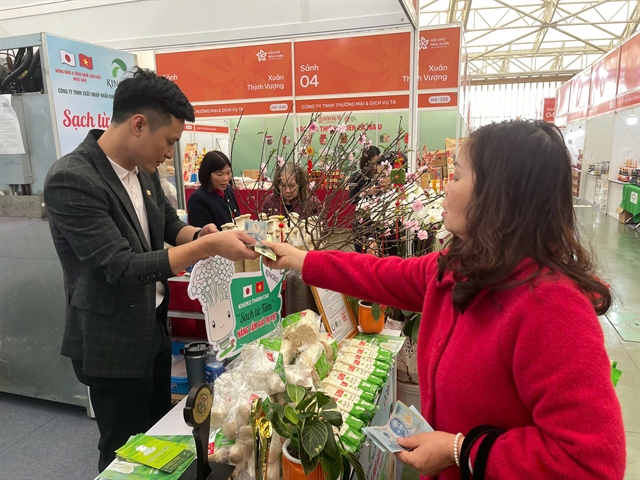
|
| The mushroom products attract strong interest from visitors. VNA/VNS Photo |
In Hương Sơn Commune, Hà Nội, Thanh Cao Kinoko Import-Export Co, Ltd has invested in building a high-tech mushroom production facility operating under a closed-loop model with modern cultivation rooms.
Environmental factors such as temperature, humidity, lighting, and airflow are tightly controlled throughout the mushroom growth cycle to ensure consistent quality and food safety.
The factory is comprehensively equipped, with many stages automated from substrate mixing and cultivation to harvesting and packaging. The application of technology minimises direct human contact, enhancing hygiene standards and reducing production risks.
Nguyễn Hữu Tĩnh, Director of Thanh Cao Kinoko Import-Export Co, Ltd, said the factory operates on a large scale with 30 modern cultivation rooms, a cooling system and standardised harvesting and packaging areas.
Each mushroom is grown under ideal conditions, with temperature, humidity, lighting and airflow precisely monitored around the clock. Many stages are automated to optimise quality and preserve the mushrooms’ natural purity. The entire cultivation process inherits the essence of Japanese mushroom-growing technology.
“We use original Japanese mushroom strains, smart cold-room systems, and continuous monitoring of factors such as temperature, humidity, light, enabling mushrooms to grow evenly, naturally and retain their distinctive pure flavour,” Tĩnh said.
“All stages, from inoculation and cultivation to harvesting and packaging, are standardised, minimising direct contact and absolutely avoiding chemicals or preservatives. Our plastic containers can be reused for up to 15 years, optimising resources and moving toward green, environmentally friendly production.”
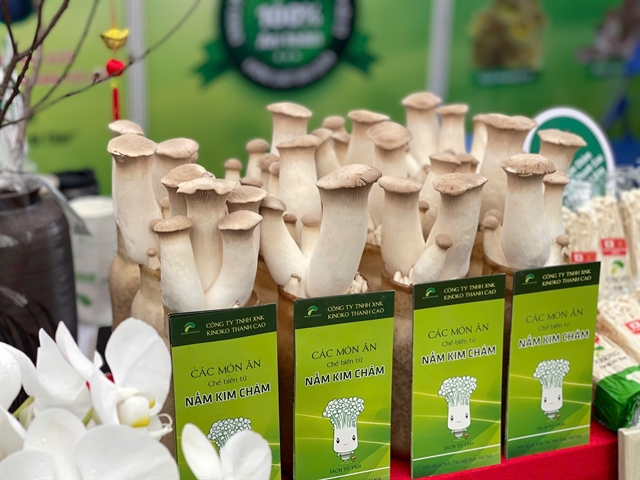
|
| Mushroom products from Thanh Cao Kinoko Import-Export Co., Ltd. on display at the fair. VNA/VNS Photo |
Tĩnh also said that the company’s high-tech agricultural approach stems from a desire to produce clean and safe food products that meet rising domestic demand, while pursuing sustainable development by efficiently using resources and reducing environmental impact through substrate reuse after production.
The company places strong emphasis on product transparency through traceability systems, allowing consumers to easily access information about production processes and thereby building market trust, he said.
Dương Công Thành, Head of Marketing at Thanh Cao Kinoko Import-Export Co, Ltd, said the company brought two main products to the fair: enoki mushrooms and king oyster mushrooms.
“Although the products have been on the market since 2017, their reach among consumers remains limited, Thành said.
"Through the fair, the company hopes to better introduce and promote its mushrooms, allowing customers to experience the difference between Kinoko mushrooms and other products, and to gain a more comprehensive view of the quality of Vietnamese-grown, clean mushrooms.”
He added that more than 200 kilogrammes of mushrooms were sold after just two days of the fair.
The practical experiences of the two enterprises demonstrate that proactive technological innovation and investment in modern production reflect the spirit of innovation encouraged by major Party and State policies.
When science and technology are properly positioned, closely linked to production realities and daily needs, 'Made in Việt Nam' products can not only meet domestic market demands but also gain greater opportunities to reach international markets, contributing to improved living standards and enhanced economic competitiveness. — VNS
Society
 Society
 Society
 Society
 Society
 Society
 Society
 Society
 Society
 Society
 Society
 Society
 Society
 Society
 Society