 Society
Lawmakers stress importance of removing bottlenecks to develop digital economy
1.
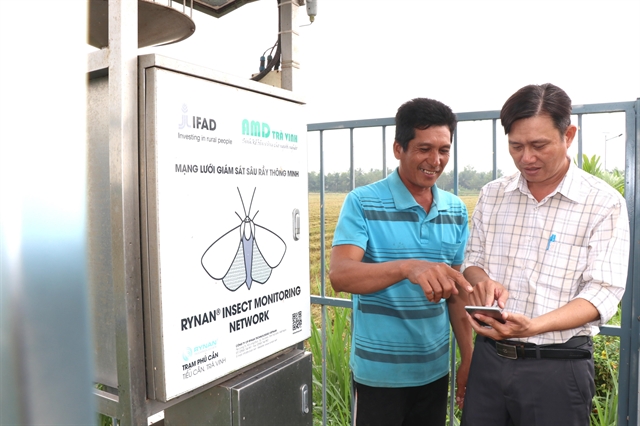 |
| Farmers in Vĩnh Long Province’s Tiểu Cần Commune monitor rice pests using smartphones. — VNA/VNS Photo Thanh Hòa |
VĨNH LONG — Vĩnh Long Province’s agriculture is shifting towards green and modern development, as high-tech, circular and low-emission farming drive sustainable restructuring in line with Politburo's Resolution 57.
The implementation of the Resolution issued on December 22, 2024, on breakthroughs in science, technology, innovation, and national digital transformation, has opened up a new approach by using them as the foundation for restructuring the locality’s agricultural production.
The Mekong Delta province has implemented agricultural models that are reshaping production, including high-quality and low-emission rice and organic coconut farming, delivering higher profits for farmers while cutting greenhouse gas emissions.
Many farmers and co-operatives have proactively adopted science, technology and digital tools to reorganise production in a more efficient and sustainable way, and to develop smart agriculture.
The Phát Tài Agricultural Co-operative in Châu Thành Commune and the Phước Hảo Agricultural Co-operative in Hưng Mỹ Commune are among seven co-operatives in the delta chosen by the central Government to develop pilot models under the project “Sustainable development of one million hectares of high-quality, low-emission rice associated with green growth in the Mekong Delta by 2030”.
Trần Văn Chung, director of the former, said his co-operative has identified the application of technology as a fundamental solution to maintain stable production and achieve sustainable development.
It has invested in mechanisation and digital management systems, including three-tier grain separation and cluster sowing machines and automatic drying and milling systems, helping reduce labour costs and ensure the quality of rice.
Lê Văn Dũng, deputy director of the Provincial Department of Agriculture and Environment, said farmers have more than 5,088ha of rice paddies in the project in the 2025 autumn–winter crop, compared to just 98.4ha in the 2024 summer–autumn crop.
Yields reached 6.4–6.8 tonnes per hectare, with profits being VNĐ4.3–5.6 million (US$164–213) higher than for other farmers.
The model reduces carbon dioxide emissions by 20–22 per cent per crop compared with traditional cultivation, aligning with green growth goals.
Organic coconuts
Vĩnh Long, the country’s largest coconut producer, is developing organic coconut growing areas linked to science and technology.
With more than 120,000ha of coconuts, accounting for 65 per cent of the country’s total, the province has identified organic nuts as an important way to raise added value and meet export market requirements.
It had some 36,000ha of coconuts meeting the organic standards of the US, EU and China and Japanese Agricultural Standards as of the end of last year.
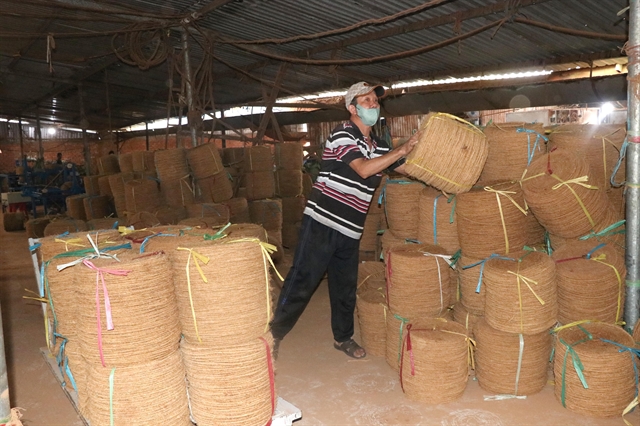 |
| Coconut husk is used to produce fibre for thread and carpets in Vĩnh Long Province’s Nhị Long Commune, part of a coconut-based circular economy. — VNA/VNS Photo Thanh Hòa |
It has 183 enterprises making a range of coconut products like juice, oil, desiccated meat, cosmetics, coir, and coal.
Many have invested in modern technologies to meet the stringent standards of markets such as the US, the EU, Japan, and China.
Sok Farm Co. Ltd in Tiểu Cần Commune invests in modern technology and a circular economy, and linked up with more than 50 households with 20ha of organic coconuts.
Besides the nuts, it also harvests coconut flower nectar for high-value products.
Phạm Đình Ngãi, its executive director, said these products were exported to eight countries last year.
According to the Provincial Department of Agriculture and Environment, coconut trees planted for more than 10 years can absorb 70–75 tonnes of carbon dioxide per hectare each year, opening up potential for a carbon economy based on the province’s coconut industry.
Châu Văn Hòa, deputy chairman of the Provincial People’s Committee, said: “Developing green, circular agriculture linked with science and technology and digital transformation is an inevitable requirement in the context of climate change and increasingly deep international economic integration.”
The province will refine mechanisms and policies to encourage enterprises, co-operatives and farmers to apply science and technology, digital transformation and environmentally friendly production models, while implementing the digital transformation project for the agriculture and environment sector to 2030.
It targets 15–20 per cent of farming areas using digital technologies by 2030, developing smart farms with full data connectivity and traceability.
It already has more than 81,400ha under high-tech organic farming, accounting for about 10.5 per cent of total farmlands.
It has nearly 900 growing area codes covering more than 33,320ha, with 696 meeting requirements for exports of items such as durian, rambutan, longan, grapefruit, coconut, and sweet potato to markets like China, the US, the EU, and New Zealand.
It also has 67 export-standard packing facilities granted the codes.
Digital transformation has also been implemented in a coordinated manner across livestock, aquaculture, forestry, and natural resources management.
Many farming areas use sensors, automatic monitoring systems and livestock management software, helping reduce disease risks and improve production efficiency. — VNS
Society
 Society
 Society
 Society
 Society
 Society
 Society
 Society
 Society
 Society
 Society
 Society
 Society
 Society
 Society