 Society

Another 58 sets of martyrs’ remains recovered at Lê Thị Riêng Park
1.
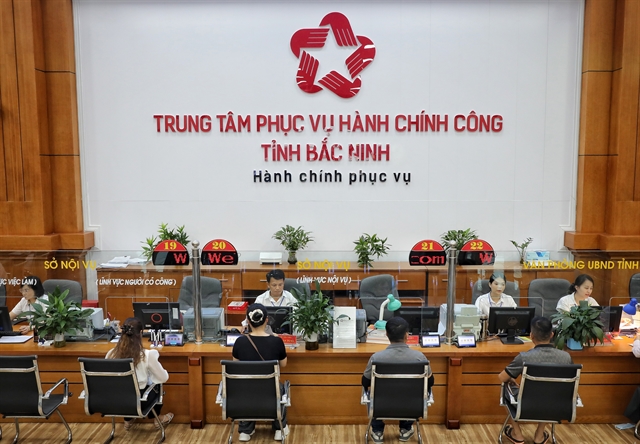 |
| Local residents at the provincial Public Administration Service Centre in the northern province of Bắc Ninh.— Photos courtesy the provincial People's Committee |
BẮC NINH — The northern province of Bắc Ninh has emerged as the national leader in the index measuring services provided to citizens and businesses in the handling of administrative procedures.
The most notable achievement recorded in 2025 has been the sweeping reduction, standardisation and simplification of administrative procedures related to business activities.
Of the 51 sector-specific procedures currently under review, the province has proposed reforms for 44 that directly serve production and business operations.
In particular, the introduction of the “24-hour Green Lane” and the “60 per cent Green Lane” mechanisms for key projects has marked a breakthrough, significantly shortening appraisal and approval timelines and making an important contribution to improving the investment climate.
Built on a strong digital foundation, the province continues to rank among the country’s leading localities in the provision of online public services.
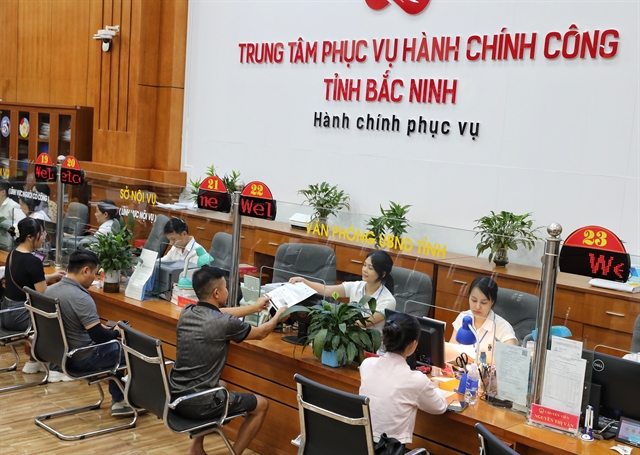 |
| Staff supports local residents to do administrative procedures at the provincial Public Administration Service Centre in the northern province of Bắc Ninh. |
Across the province, 1,049 procedures are now delivered in a fully online format, accounting for nearly half of the total number of administrative procedures.
All procedures serving businesses are conducted online; almost 100 per cent of applications receive electronic results; and more than 93 per cent of administrative dossiers have been digitised.
The application of a zero-fee policy for 42 online procedures has helped change public habits, accelerating the shift from paper-based submissions to the digital environment.
Another notable highlight is the province’s near-complete rollout of administrative services that are no longer bound by geographical boundaries.
Residents can submit applications at any Public Administration Service Centre or reception point across the province.
Since the second reception point was put into operation in Kinh Bắc Ward, the number of “cross-boundary” applications has risen rapidly, reflecting the public’s readiness to adopt the new model.
The province has also achieved substantial progress in implementing Project 06 and in data digitisation.
More than 2.87 million civil status records, nearly 3 million land records, and over 15,000 judicial records have been digitised, cleaned and synchronised with the National Population Database.
Major databases, including those for social and health insurance, have been interconnected, minimising repetitive paperwork.
As a result, 85 per cent of the data used in handling administrative procedures is now automatically extracted from digital platforms, helping to shorten processing times and reduce social costs.
Communications and public outreach have been strengthened as well.
With more than 450,000 users following its Zalo channel and tens of thousands reached via social media each month, the provincial Public Administration Service Centre has become a familiar support channel.
It provides guidance on using online public services, helps citizens avoid illegal brokerage services, and promotes positive stories of administrative reform.
 |
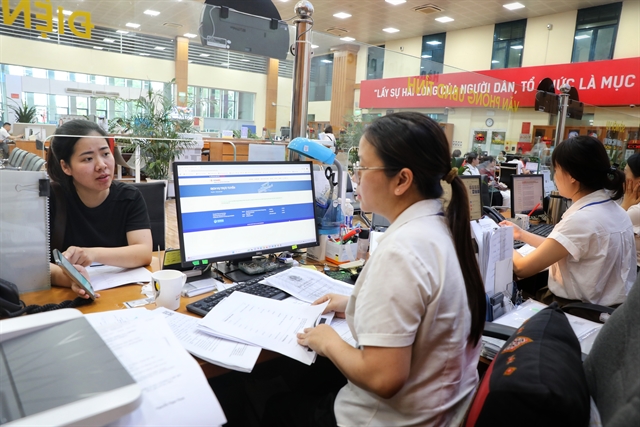
| Photo shows the provincial Public Administration Service Centre in the northern province of Bắc Ninh. |
More convenient
Nguyễn Văn Thìn, a resident in Việt Yên Ward, said the changes have made procedures far more convenient for the public.
“When we have requests or difficulties, we no longer have to travel a long distance or make repeated visits. The procedures are becoming simpler, and people are much less burdened,” he said.
Sharing a similar view, Nguyễn Văn Diệu from Mỹ Thái Commune described electronic records and digital procedures as “extremely impressive”, calling them a modern step in the right direction.
Nguyễn Ngọc Nam, Deputy Chief of the provincial People’s Committee Office and Director of the provincial Public Administration Service Centre, said administrative reform is “a continuous journey”.
He said the province will continue to improve weaker indicators to ensure public service quality remains at the highest level.
Looking further ahead, the province views digital transformation as a core solution to enhancing competitiveness and moving towards a digital society.
The province is prioritising investment in technology, developing mobile applications for citizens, and working with technology enterprises to train a high-quality workforce capable of operating digital government systems.
 |
| A local resident at the Public Administration Service Centre in Hợp Thịnh Commune, in the northern province of Bắc Ninh. |
Mai Sơn, Standing Vice Chairman of the provincial People’s Committee, said the province will focus on delivering online public services that are as fast and convenient as possible, while supporting small and medium-sized enterprises in their transition to the digital environment to improve production and business efficiency.
The province is also studying the introduction of a star-rating system for public administration centres, based on hard criteria such as on-time processing rates, the proportion of online processing and levels of citizen satisfaction.
This is expected to become an important benchmark in efforts to further improve service quality.
The province aims to maintain its leading position nationwide in administrative reform, move towards 100 per cent online public services, and universalise digital skills for all citizens through the “Digital Literacy for All” platform.— VNS
Society
Society
 Society
 Society
 Society
 Society
 Society
 Society
 Society
 Society
 Society
 Society
 Society
 Society
 Society