 Society
Công hopes to lift medal at Asian Para Games
1.
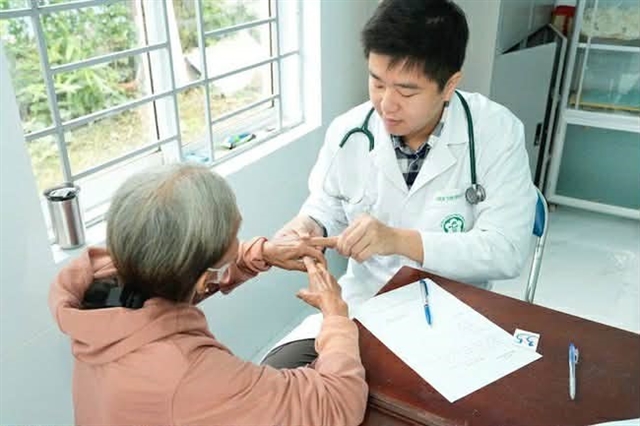 |
| Dr Đỗ Doãn Bách administers a health examination to a resident in Đắk Lắk Province. — Photo courtesy of Đỗ Doãn Bách |
HÀ NỘI — Medical volunteering is one of the most meaningful values of the health care profession, but for it to be truly meaningful, it must aim for sustainability.
That was the message from Dr Đỗ Doãn Bách, speaking at the fifth National Congress of the Việt Nam Young Doctors' Association, term 2025-2030, which was held recently in Hà Nội.
Bách, from the Việt Nam National Heart Institute at the Bạch Mai Hospital, spoke about practical, in-depth perspectives drawn directly from his professional experiences and grassroots volunteering activities.
The doctor recounted his work trip at the end of last month to support residents in the flood epicentre of the Đắk Lắk Province.
He said the most haunting aspect during those days of direct examinations was not just the shortages of equipment and medicines, but the feeling of 'if only we had arrived sooner and advised earlier'.
In reality, some cases could have been avoided if risks had been identified quickly and hospitalisation initiated early.
Yet it was there that he learned an even harder lesson: Treating according to the latest guidelines is not always the 'most appropriate treatment' if not placed in the specific context of the patient.
Some patients cannot afford the treatment regimen; others do not need additional medication right then, but rather a doctor who sits down and listens to their life story.
Patients include war veterans who endured the conflict, or families with children bearing the effects of Agent Orange.
These experiences convinced him that, to protect community health sustainably, young doctors' volunteering programmes must integrate with a system featuring interconnected stages: proper screening, effective follow-up, context-appropriate treatment and ongoing contact so no one is left behind.
"It was during those encounters with people in the flood epicentre that I gained a deeper understanding of the public's trust in doctors, especially frontline ones,” said Bách.
“Young Doctors Pioneering Volunteering for Community Health will be the mission of young doctors, helping to narrow professional gaps between healthcare levels, facilitating exchanges and promoting digital transformation and building big data to create a system that provides treatment recommendations closest to Vietnamese people."
Systematic action
As a cardiologist, Bách noted that cardiovascular diseases and strokes are currently the leading disease burdens, yet they can be much better prevented and controlled with early intervention.
According to the World Health Organization data, there are about 19.8 million cardiovascular deaths annually, accounting for nearly 32 per cent of total deaths, with 85 per cent due to heart attacks and strokes, mainly in low- and middle-income countries where primary care and prevention remain limited.
This reality demands clear action. Volunteering for community health cannot stop at examinations and medicine distribution. It must focus on specific topics, especially early detection, risk stratification, continuous management, and timely intervention to minimise cardiovascular events for the public.
Highly evaluating the existing foundation of the young doctors' movement, Bách cited results from the 'Young Doctors Following Uncle Hồ's Words, Volunteering for Community Health 2024' journey, with over 21,000 young doctors carrying out nearly 2,700 procedures serving more than 1.13 million people.
For the next term, he believes that a fundamental shift from 'campaigns' to 'systematic approaches' is needed.
After each volunteering stint, people must clearly understand their condition and risks. Primary healthcare levels need more data, tools, and specialist connection channels to enhance screening and initial management capabilities.
Health care processes must be interconnected and uninterrupted. Only then will volunteering create lasting value for the community.
Three pillars
From practical clinical experience, Bách proposed a medical volunteering model to deliver a 'systemic boost', focusing on three pillars: screening – risk stratification – initial management for people; strengthening connections and remote consultations between levels; and standardising data for the national electronic health record platform.
Another major concern he raised was the lack of large-scale, standardised Vietnamese cardiovascular disease data.
While international treatment guidelines are vital foundations, to answer 'what is most suitable for Vietnamese people in Việt Nam's practice conditions' needs sufficiently large, interconnected and reliable data infrastructure.
This will form the basis for professional associations to develop practical recommendations and improve treatment efficacy.
"Medical volunteering is one of the most beautiful values of the medical profession, but for it to be truly meaningful, it must aim for sustainability," Bách said.
"In cardiology, that sustainability lies in risk management, improving patients' quality of life, using digital transformation as leverage and data as infrastructure,"
The doctor expressed hope that community health volunteering will evolve towards standardisation, digitalisation and continuity to build a national disease database, so more people receive early detection, early advice and early follow-up. — VNS
Society
 Society
 Society
 Society
 Society
 Society
 Society
 Society
 Society
 Society
 Society
 Society
 Society
 Society
 Society