 Society

Ping An Digital Bank Completes HKMA’s Second GenA.I. Sandbox Cohort
1.
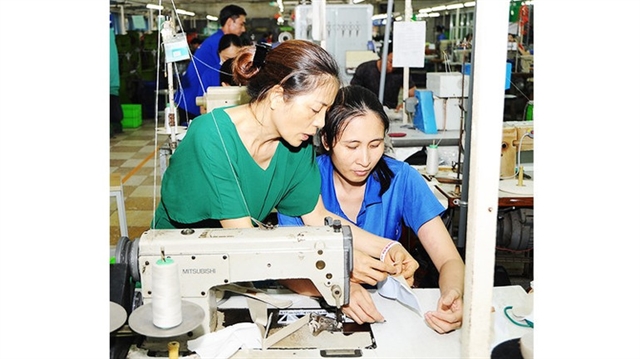 |
| Older but highly skilled workers can still find jobs. Photo nhandan.vn |
HÀ NỘI — Nguyễn Thị Cúc, a 50-year-old resident of Phúc Thịnh Commune in the outskirts of Hà Nội, had to hide her children to participate in a job fair in Đông Anh Commune last month.
Cúc was a surplus employee after the reorganisation of administrative units. With years of experience as an accountant and still in good health, she felt restless after being at home for more than three months.
“My children and grandchildren are all grown up and either working or studying all day. So staying at home all the time makes me feel sad, lonely and useless,” Cúc told nhandan.vn.
“My family is living in the suburbs, but we do not have much land for cultivation to supplement our income. Therefore, I feel I still need to work,” she said.
She thought it was difficult to find a job at her age. But while participating in the job fair, Cúc and other middle-aged people found satisfactory jobs.
Cúc was recruited as an accountant by an F&B company in Hà Nội’s Tây Hồ Ward with a starting salary of VNĐ8 million (US$320) per month.
Similarly, Vũ Văn Quang, 52, was employed by Đông Anh Sprocket Company as a skilled mechanic with a starting salary of VNĐ10 million per month.
Amid rapid population growth and ongoing restructuring and streamlining of the Government apparatus, older workers are becoming an important resource in the labour market.
Vũ Quang Thành, vice director of the Hà Nội Job Service Centre under the Department of Internal Affairs, said that the labour market is more open to older workers.
In particular, many businesses participating in job fairs have advertised for workers over 50 years old, especially in sectors like services, trade, garments, footwear, mechanics and warehousing, said Thành.
"Older workers with experience, skills and good work attitudes always have job opportunities," Thành added.
More than half of the workers at Quang Minh Garment Company's two production workshops in Phú Thượng Ward are over 50 years old.
Nguyễn Thị Hậu, a 62-year-old resident of Xuân Đỉnh Ward, has been working at the company’s workshop for more than seven years.
Hậu said: “Previously, I worked as garment worker at a military establishment. Right after retiring, I started working here, with a salary of VNĐ6 million per month. The job is suitable for me and the workshop is near my home.
“Being able to work and earn extra income in addition to my pension means I can manage my finances independently, avoid burdening my children and feel more refreshed."
Nguyễn Phan Nghĩa, a 56-year-old retiree who has been recruited for a year, said: “I started out knowing nothing about the machines at the workshop, but after receiving training here, I now work with two heat sealing machines. I am proficient at the job, and my income is VNĐ8 million per month.”
“Previously, I was a civil servant, but I retired early. Unexpectedly, my current technical job suits me perfectly,” Nghĩa added.
Quang Minh Company Director Mai Thị Thanh said that many older people came to the firm with ideas of doing simple jobs, like being housekeepers or janitors. But after training, they can take on more complex jobs, with high responsibilities and skills.
“Thanks to them, we have reduced the pressure of labour shortages and increased revenue,” said Thanh.
The examples of Cúc, Hậu and Quang show that older workers, even those who have retired or been laid off after mergers, can completely adapt to new jobs if they receive appropriate training.
This is currently a solution to help businesses supplement their workforce, while also providing job opportunities for older workers.
Legal corridor
In practice, with rapid population ageing and the ongoing restructuring of employment within State agencies, older workers are an abundant resource. However, they require appropriate employment policies, including retraining, flexible work arrangements and support for occupational transitions.
The Law on Employment 2025, which will take effect from January 2026, for the first time links employment policy with the reality of population ageing in Việt Nam, providing specific regulations on support for older workers in the labour market.
Policies to support employment for older workers include loans to maintain and expand employment, support for skills training and upgrading, and assistance for retraining and career transitions.
The law also designates older people as one of the priority groups for participation in public employment programmes, and integrates older workers into the system for supporting vocational skills development.
In the Law on Vocational Education, several policies are linked to older workers, such as expanding vocational education into a flexible, lifelong learning system that creates opportunities for vocational training and skills upgrading regardless of age.
The law also recognises accumulated vocational competencies, as well as pathways for articulation and career transition that enable older people to use their accumulated experience and skills to continue upgrading their qualifications.
Việt Nam currently has more than 16 million older people, accounting for around 17 per cent of the population.
Nguyễn Thanh Bình, chairman of the Việt Nam Association of the Elderly, said: “In the context of population ageing, encouraging older people to work not only helps them increase income, maintain health and strengthen community engagement, but also serves as a sustainable poverty reduction solution.”
“Allowing older people to access loans for production and business in line with the Party’s new policy orientation of entrepreneurship helps create jobs for older people. Only then can older people continue to contribute their intellect, effort and capabilities,” Bình added.
Nguyễn Thu Hồng is a 53-year-old worker at Hưng Vũ Garment Corporation in Hưng Yên Province, where nearly one quarter of the total 700 workers are older employees.
Hồng suggested: “If properly assigned, trained and protected, older workers can continue to make effective contributions to enterprises and society.” VNS
Society
 Society
 Society
 Society
 Society
 Society
 Society
 Society
 Society
 Society
 Society
 Society
 Society
.jpeg) Society
Society
 Society
.jpeg)