 Society

Việt Nam sets four priorities for APEC Finance Ministers’ Meeting in 2027
1.
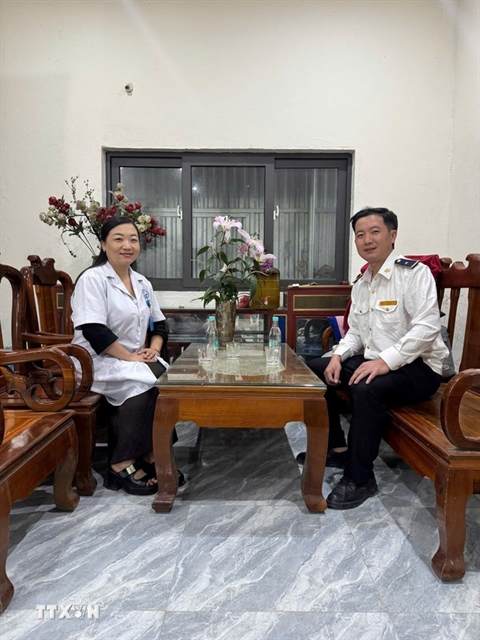 |
| The doctor couple of Lầu Bá Hùa and Hờ Y Chùa in their humble house. VNA/VNS Photo |
NGHỆ AN — In a remote border commune of Nghệ An Province where mist and cloud blanket the mountains year-round, a Mông ethnic doctor couple have overcome entrenched customs and harsh terrain to devote their careers to safeguarding community health.
They are Lầu Bá Hùa, a health worker at the provincial Centre for Disease Control, and Hờ Y Chùa, who works at the healthcare centre in Kỳ Sơn Commune.
Rather than pursuing careers in major cities, they chose to remain in one of the country’s most disadvantaged areas, viewing the wellbeing of their compatriots as their life’s purpose and serving as what colleagues describe as a protective shield for residents along the border gateway.
Overcoming outdated customs
To earn their medical degrees and return to serve their homeland, both endured a journey through the jungle in both literal and figurative terms.
Hùa recalls being a frail Mông boy leaning on a walking stick, carrying rice balls over his shoulder and walking more than 20 kilometres through forest to reach boarding school.
Born into a poor family with 10 siblings in Trường Sơn Hamlet of Bậm Cắn Commune, where poverty and illiteracy were widespread, he refused to accept what many saw as a fixed destiny.
"The hardships were not just about climbing mountains and crossing streams, and scrimping on food every day, but also about the intense struggle with my family and myself to be able to go to school," Hùa said.
In 2004, he left his hamlet for Vinh City to study at a medical college and in 2009 moved to Hải Phòng to pursue a university medical degree, saving scholarship funds to sustain his ambition of becoming a doctor for his village.
Studying alongside him was Hờ Y Chùa, then one of the few Mông students in Nghệ An to obtain a medical degree.
For Chùa, the path was even more challenging because of gender barriers and long-standing customs. In her final year of secondary school, she was required to marry under family arrangements. With support from her husband’s family and her determination to continue studying, she was able to pursue her education.
Their relationship grew from shared ideals and a common commitment to serve their community.
After graduation, instead of seeking posts in large urban hospitals, both returned to their hometown of Nậm Cắn Commune, a border area adjacent to Laos.
Around-the-clock work
Hùa now serves as deputy head of International Health Quarantine at Nậm Cắn International Border Gate, a key control point for monitoring cross-border health risks.
He and six colleagues work in shifts without regard to day or night, holidays or festivals, as large volumes of goods and travellers move between Việt Nam and Laos, increasing the risk of infectious disease transmission.
Quarantine officers follow strict procedures, including temperature checks, collection of health declarations, verification of epidemiological documents, screening of vehicles from affected areas and handling of suspected cases at the point of entry.
They remain on standby at all hours, prepared to don protective equipment and respond to potential cases in the early hours of the morning.
"Working here, only a small mistake or negligence may bring big risk for community,” said Hùa. “We clearly define that our role is a health guard for people.”
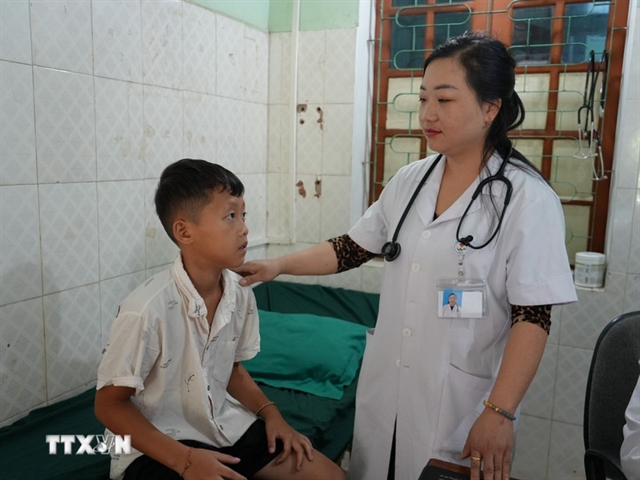 |
| Doctor Hờ Y Chùa is giving a medical check for an minority ethnic patient. VNA/VNS Photo |
While her husband works at the border gate, Hờ Y Chùa quietly dedicates herself to the examination department of the Healthcare Centre in Kỳ Sơn Commune.
With solid professional expertise, a calm manner and a composed approach, Chùa has become a trusted source of support for ethnic minority patients in the area.
Many people do not realise she is Mông because of her fluent Vietnamese and confident communication skills.
Her closeness to the community and understanding of local culture have helped bridge the gap between doctor and patient.
After demanding frontline duties or long shifts, her greatest reward is the trust and affection of local residents.
Doctor Moong Thị Thắm, Vice Director of the Kỳ Sơn Healthcare Centre, said: “Chùa is a devoted doctor. She not only has a solid expertise but is also helpful to her colleagues.”
The couple’s daily life consists of hurried meals together, sleepless night shifts and brief conversations through protective masks.
Challenges remain, including inadequate infrastructure in the border area and the constant risk of infection, but they have never regretted their decision.
When asked about the sacrifices of pursuing such demanding work in a remote region, Hùa said: “The job takes from us nothing but gives many things. Every morning when we get up, we feel useful. We can help someone be less in pain. That makes our life meaningful.”
Doctors Lầu Bá Hùa and Hờ Y Chùa are not only skilled physicians but also examples of professional dedication in the mountains.
Their story stands as proof that when commitment runs deep and aspiration is strong, difficulties can be overcome in service of the community. — VNS
Society
 Society
 Society
 Society
 Society
 Society
 Society
 Society
 Society
 Society
 Society
 Society
 Society
 Society
 Society