 Society
SBV to curb property price inflation, enforce lending rate rules
1.
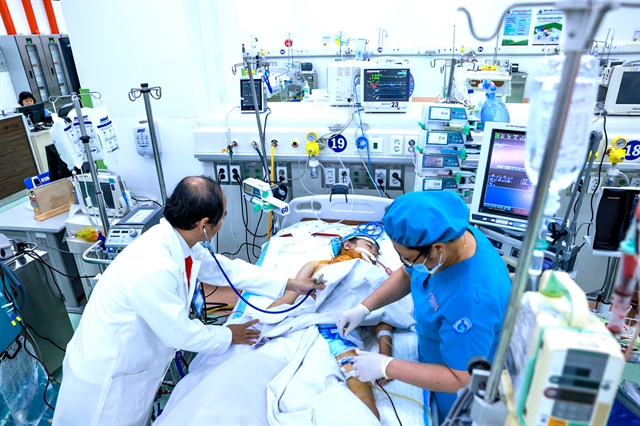 |
| A child with severe dengue complications under special treatment in the Intensive Care and Toxicology Department at Children's Hospital 1 in HCM City. — Photo: baochinhphu.vn |
HÀ NỘI — While Tết (Lunar New Year) lingered in bursts of colour and celebration, a different rhythm took hold behind the doors of dengue wards. There, the festive hum of the city gave way to the steady drone of ventilators and the hurried footsteps of medical teams who did not stop moving.
There were no fireworks there, no New Year’s greetings. Instead, there was a relentless succession of decisions: intubate or wait, adjust the ventilator, increase fluids, initiate continuous renal replacement therapy. Every intervention was measured against the clock. Every passing minute could tip the balance between survival and loss.
Lives were sustained not by skill alone, but by unwavering vigilance. Behind the medical teams' tired eyes and sleepless nights lay a quiet determination: not to yield, not while a heartbeat could still be saved.
No holiday at the ICU
The sound of ventilators is a familiar presence at the Hospital for Tropical Diseases in HCM City, even during Tết.
On the 26th day of the Lunar New Year, inside the hospital’s Intensive Care Unit (ICU), doctors and nurses barely left their posts. On one of the beds lay Hùng, 34, who was admitted with plummeting blood pressure and critically low haematological indices before rapidly slipping into shock. His vital signs were monitored hour by hour. The weight of responsibility was immense: to keep him from crossing the fragile line between life and death.
Dr Nguyễn Thanh Phong, deputy director of the Hospital for Tropical Diseases, told the Government's online newspaper that dengue circulates year-round, peaking during the rainy season. Although the early months of the year are often considered a low-transmission period, the hospital continued to record severe cases marked by profound shock, recurrent shock and serious liver damage.
What troubled him most, Phong noted, was not only the disease’s severity but its unpredictability.
Many still dismiss dengue as an ordinary fever, which can deteriorate with alarming speed.
Once a patient falls into shock or develops massive bleeding or multi-organ failure, every passing minute carries a cost. Each treatment decision becomes a delicate balancing act where clinical experience and professional composure serve as the patient’s last line of defence.
Some patients appear alert on the outside, yet their blood pressure has already dropped dangerously low, their pulse rapid. These are silent signs of severe shock they themselves cannot perceive. In those critical moments, it is the quiet concentration of medical staff that steadies the patients’ faltering heartbeats.
A New Year’s Eve battle for life
At HCM City’s Children's Hospital 1, some Tết shifts have become unforgettable.
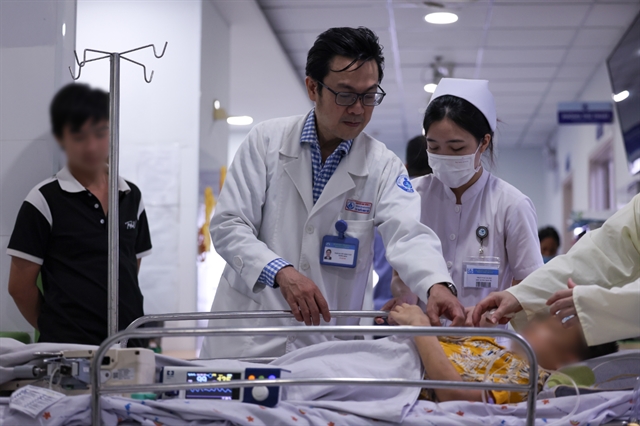 |
| Dr Nguyễn Minh Tuấn, head of the Dengue Department at HCM City’s Children's Hospital 1, treats a child with severe dengue complications. — Photo baochinhphu.vn |
Dr Nguyễn Minh Tuấn, head of the hospital’s Dengue Department, recalled one Lunar New Year’s Eve in 2024. As families across the country counted down to midnight, the hospital simultaneously admitted two severe dengue cases: one child in deep shock and another suffering from liver failure accompanied by gastrointestinal bleeding.
The on-duty team immediately entered a battle without gunfire. The children were monitored every 15 to 30 minutes, given anti-shock fluid resuscitation, transfusions of blood, platelets and plasma, and respiratory support when required. At the same time, doctors treated liver failure, corrected coagulation disorders and stabilised circulation.
There was no countdown. No celebratory toast.
“For the first 72 hours, hardly anyone had a full rest,” Tuấn recalled. “We ate quickly, drank quickly, just enough to keep going.”
In severe cases, treatment is not simply about following protocol. It is a chain of high-stakes decisions. Infuse fluids too slowly, and shock may worsen. Infuse too quickly, and the lungs may fail from fluid overload. Every number on the monitor is a matter of life and death.
Tuấn said it took nearly a week of intensive care over the holiday for the two children to pull through. There was a week without any sense of festivity, but only the steadfast belief of doctors that the patients must get better day after day.
As one year gave way to the next, the doctors quietly guarded the fragile rhythms of young lives, ensuring the New Year would not begin with loss.
There is still no specific antiviral treatment for dengue. Success depends on close monitoring of disease progression and timely intervention.
Tuấn believes dengue treatment is a collective effort, requiring seamless coordination among physicians, nurses, technicians and families to detect early warning signs.
Minh Xuân, whose child was treated at the hospital, said: “During my child’s treatment, the dedication and kindness of the doctors and nurses were our anchor. They helped us stay calm. I am truly grateful.”
Those simple words of thanks may be the most meaningful reward after long, sleepless shifts. And the doctors, for their part, have never allowed themselves to fall behind in the race to protect a patient’s life. — VNS
Society
 Society
 Society
 Society
 Society
 Society
 Society
 Society
 Society
 Society
 Society
 Society
 Society
 Society
 Society