 Society

HIIVE by fusion brings business and golf closer in Bình Dương
1.
|
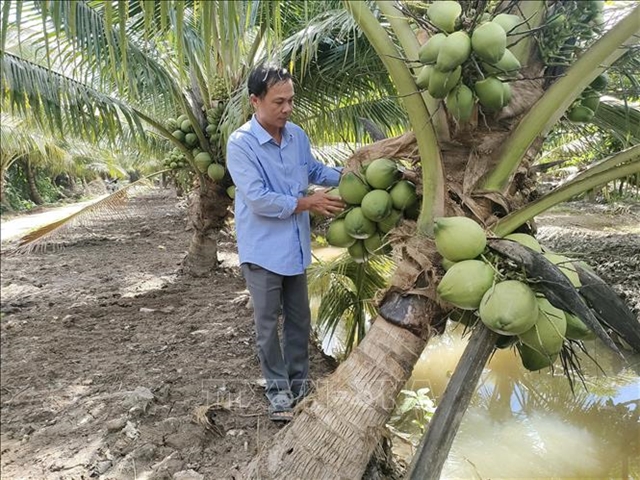
| Farmer Nguyễn Văn Dũng tends his organic coconut garden in Phú Thuận Commune in Vĩnh Long Province. — VNA/VNS Photo |
VĨNH LONG — Developing low-emission coconut farming is emerging as a strategic direction for the coconut sector in Vĩnh Long Province as green transformation and global integration accelerate.
As environmental standards tighten worldwide, agriculture is increasingly assessed not only by output but also by emission reductions, traceability and added value.
In this shift, Trà Vinh University has taken on a leading role in research, training and technology transfer, helping lay the groundwork for a more sustainable coconut industry.
A sector at crossroads
With more than 120,000 hectares under cultivation, accounting for about 65 per cent of the country’s total coconut area, Vĩnh Long Province is one of Việt Nam’s key coconut-growing localities.
The crop underpins the livelihoods of hundreds of thousands of households.
Yet the industry remains vulnerable to price swings and is heavily reliant on raw exports.
Dried coconut prices have fluctuated sharply, at times exceeding VNĐ200,000 (US$8) per dozen (12 fruits) before falling below VNĐ60,000 ($2.5), exposing structural weaknesses in market dependence.
Associate Professor Dr Diệp Thanh Tùng, vice rector of Trà Vinh University and director of the Mekong Delta Coconut Institute, said the sector must shift from expansion-driven growth to quality- and sustainability-based competitiveness.
He stressed the need to establish a “green passport” for coconuts, certifying environmentally responsible production, clear origin traceability and compliance with international regulations.
Việt Nam’s net-zero pledge at COP26, along with the EU’s Carbon Border Adjustment Mechanism (CBAM) and the European Union Deforestation Regulation scheduled for full enforcement in 2026, means exporters will have to meet stricter environmental benchmarks.
To adapt, the sector must build effective MRV (measurement, reporting and verification) systems, calculate carbon footprints and standardise traceability, Tùng said.
“The low-emission model should be built on three pillars: improved cultivation practices, stronger market access and higher farmer incomes,” he said.
Farmers are encouraged to adopt science-based methods, optimise fertiliser use, increase organic inputs, manage water efficiently and make better use of by-products under circular economy principles.
Properly managed coconut gardens can function as both productive farms and carbon-absorbing ecosystems.
However, fragmented production and the costs associated with technical expertise and digital systems pose significant challenges to implementing emission verification at scale.
Ultimately, raising farmers’ incomes remains central.
Participation in certified low-emission value chains could open access to premium markets and, in the future, carbon credit opportunities once regulatory frameworks are in place.
|
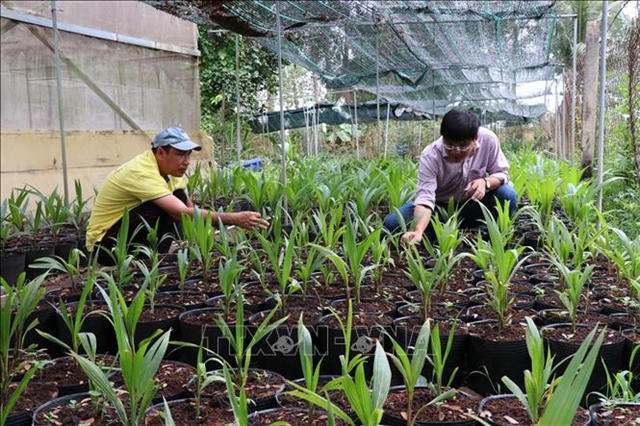
| Staff from the Centre for Applied Biology under the Faculty of Agriculture and Aquaculture at Trà Vinh University monitor growth and inspect the quality of wax coconut seedlings at the university’s experimental site. — VNA/VNS Photo |
Building a coordinated ecosystem
Trà Vinh University is leveraging its integrated training–research–transfer model to support this transition.
Through the Mekong Delta Coconut Institute, it is piloting low-emission farming models, developing digital maps of growing areas, guiding electronic farm record-keeping and training emission verification personnel.
Recently, VOS Holdings, based in HCM City, funded 50 scholarships for a “Coconut Carbon Footprint Lead Verifier” certification programme at the university.
The initiative aims to establish a locally trained team capable of independently measuring and verifying emissions to meet export market requirements.
At the local level, farming practices are gradually shifting towards sustainability.
In Tiểu Cần Commune, nearly 1,000 hectares are planted with coconuts, including 441 hectares cultivated organically by nearly 800 households under international standards.
The commune plans to convert all coconut areas to certified organic production by 2030.
While many farmers recognise the long-term benefits of greener production, concerns remain over technical procedures, record-keeping requirements and associated costs.
Local authorities note that clear guidance, training and stable purchasing commitments from businesses will be crucial to encouraging wider participation.
Experts emphasise that low-emission coconut development is a long-term restructuring process requiring coordinated action among government agencies, scientists, enterprises and farmers.
By strengthening scientific application, developing skilled human resources and enhancing transparency across the value chain, the province aims to build a resilient coconut industry capable of competing in an increasingly green global marketplace. — VNS
Society
 Society
 Society
 Society
 Society
 Society
 Society
 Society
 Society
 Society
 Society
 Society
 Society
 Society
 Society