 Society

Singapore Media Festival Returns for its 13th Edition with Refreshed Industry Focus and New Creator Summit
1.
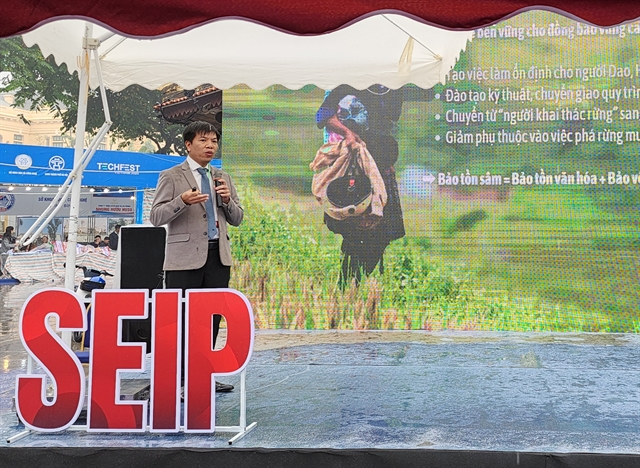 |
| The representative of the Lai Châu Mountain Ginseng cooperative pitches at Saturday’s event. — VNS Photo Lê Việt Dũng |
HÀ NỘI — Six early-stage enterprises working in areas from sustainable agriculture to green textiles took the stage on Saturday at the SEIP 2025 Demo Day, highlighting how impact-driven startups are seeking to turn conservation, inclusion and climate action into scalable business models.
The Demo Day marked the conclusion of the Social and Ecological Enterprise Innovation Programme (SEIP) 2025, an initiative to help small social and ecological enterprises professionalise their branding, strengthen market positioning and prepare for engagement with investors and commercial partners.
SEIP was launched in 2024 by the Việt Nam–Singapore Friendship Association (VSFA) and is co-implemented by the Research Institute for Innovation and Development (IID) under the patronage of the Ministry of Science and Technology.
SEIP 2025 focused on small, locally rooted enterprises, many of which operate in remote or rural areas.
Over six training sessions, 20 selected enterprises received coaching on brand strategy, communications, visual identity and market access – tools that organisers said remain largely inaccessible to early-stage impact businesses outside major cities.
From that cohort, six enterprises showing the strongest progress were selected for an additional three-month, one-to-one coaching phase, culminating in the Demo Day pitching round.
"Enterprises are operating in a new economic context, where social and environmental impact is increasingly a condition for competitiveness, not an optional responsibility," said Trần Xuân Đích, deputy director of the National Agency for Startups and Technology Entrepreneurship.
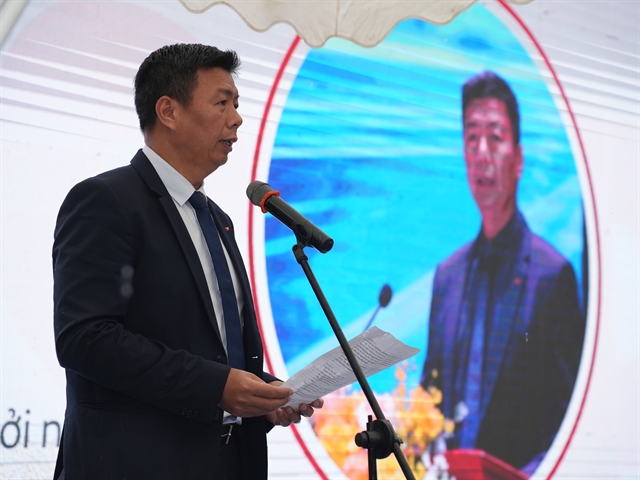 |
| Trần Xuân Đích, deputy director of the National Agency for Startups and Technology Entrepreneurship, speaks at the event. |
Đích cited the Vietnam Innovation Startup Ecosystem Report 2025, released this week during Techfest 2025, which found that Việt Nam now hosts nearly 4,000 startups, including two unicorns and dozens of high-growth firms.
While the ecosystem has expanded rapidly, the report notes a strategic shift toward depth and sustainability, structured around five pillars: policy, progress, capital, planet and people.
Pitching round
At the Demo Day, the six finalists pitched to a judging panel of investors, business association leaders and university-based experts, outlining business models that link commercial revenue with environmental protection and social inclusion.
One of the most prominent presentations came from the Cooperative for the Conservation and Development of Lai Châu Mountain Ginseng, which warned that Việt Nam’s rare native ginseng species could face extinction due to unregulated harvesting and widespread counterfeiting.
Việt Nam is one of the few countries that is home to multiple high-value ginseng varieties, including Lai Châu ginseng and Ngọc Linh ginseng, yet an estimated 80 per cent of ginseng products on the domestic market lack a clear origin, the cooperative said.
The cooperative's model focuses on scientific conservation and cultivation under GACP–WHO standards, combined with selective processing and controlled market access.
By shifting livelihoods away from wild harvesting, it has reduced pressure on about 150ha of natural forest annually, while creating income for ethnic minority communities in northern highland areas.
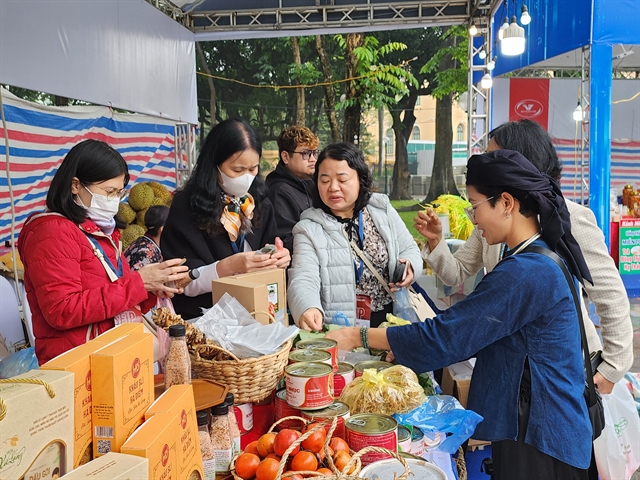 |
| Visitors sample products at an organic agriculture booth at the event. |
From the northern mountains, the pitches moved south to the mangrove forests of Cà Mau, where Tài Thịnh Phát Farm Cooperative presented a sustainable shrimp and crab farming model under mangrove canopies.
The cooperative positions itself as a link between urban demand for traceable, chemical-free seafood and coastal communities seeking stable livelihoods without destroying fragile ecosystems.
Its approach avoids industrial feed and antibiotics, relying instead on natural mangrove ecosystems.
According to the cooperative, the model has helped protect 60ha of mangrove forest, improved biodiversity and reduced post-harvest losses through standardised processing and storage.
Another finalist, Mộc Sa Farm Cooperative, addressed structural weaknesses in Việt Nam’s Arabica coffee sector, including poor seed quality, weak farmer-buyer linkages and ongoing deforestation linked to farm expansion.
Mộc Sa’s model integrates seed development, farmer contracts, semi-industrial processing and brand development into a single value chain.
The cooperative reported wastewater reductions of up to 95 per cent compared with traditional coffee processing methods and said its Arabica beans achieved speciality-grade cupping scores above 84 points.
The cooperative was awarded first prize at the event.
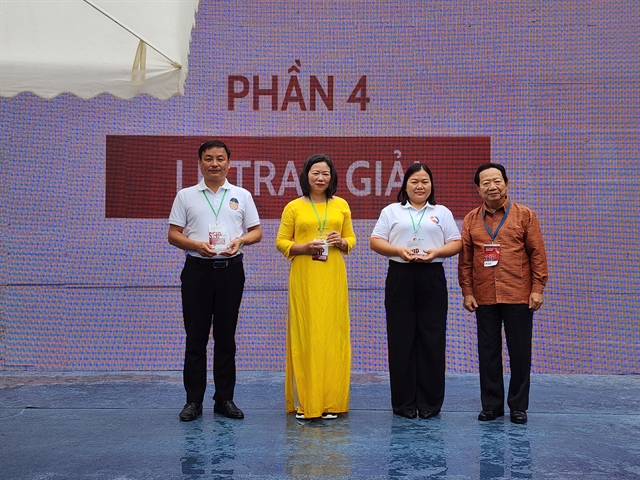 |
| Nguyễn Đức Hùng (right), former Vietnamese ambassador to Singapore, presents awards to the winners with the Mộc Sa Farm Cooperative representative at far left. |
In second place was Vietfiber, a green-textile startup seeking to reduce Việt Nam’s reliance on imported cotton fibre.
Việt Nam is the world’s second-largest garment exporter but imports 100 per cent of its cotton, leaving the industry exposed to supply-chain and environmental risks.
Vietfiber has developed a water- and chemical-free process to convert pineapple fibre – an agricultural by-product – into spinnable yarn compatible with existing textile machinery.
The company said its technology could significantly reduce water use, chemical waste and carbon emissions, while creating income for pineapple-growing communities, particularly women.
The third prize went to Tài Thịnh Phát Farm Cooperative.
Other finalists included Núi Tượng City, an eco-tourism and education enterprise near the Cát Tiên National Park, which reinvests tourism revenue into free classes for rural children, and the 18 April Vocational Training and Rehabilitation Cooperative, which employs people with disabilities to produce herbal products, primarily from mugwort, linking vocational training directly with production and healthcare demand.
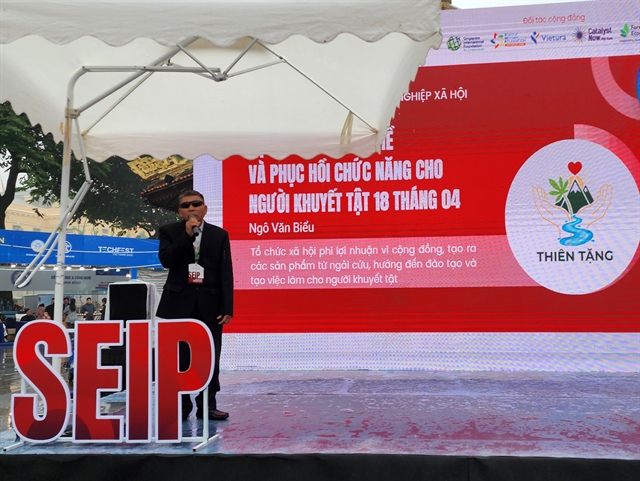 |
| A representative of the 18 April Vocational Training and Rehabilitation Cooperative, who is visually impaired, pitches at the event. |
Organisers said SEIP is designed to help early-stage enterprises become market-ready.
"The goal is to support small social and ecological enterprises by strengthening their branding and helping them prepare to engage with markets and investors," said Nguyễn Đức Hùng, former Vietnamese ambassador to Singapore and vice-chair and secretary-general of VSFA.
Participants received support to develop logos, packaging, digital platforms and pitch decks. Several enterprises said the process forced them to clarify pricing, customer segments and long-term strategy, rather than relying on grant funding or informal sales.
The event was attended by Singapore’s ambassador to Việt Nam, Rajpal Singh, who described SEIP as an example of growing people-to-people cooperation between the two countries, particularly in innovation and sustainability.
"Nurturing an innovation-driven economy is a shared priority," Singh said, adding that impact-focused enterprises represent an area with significant potential for deeper bilateral collaboration.
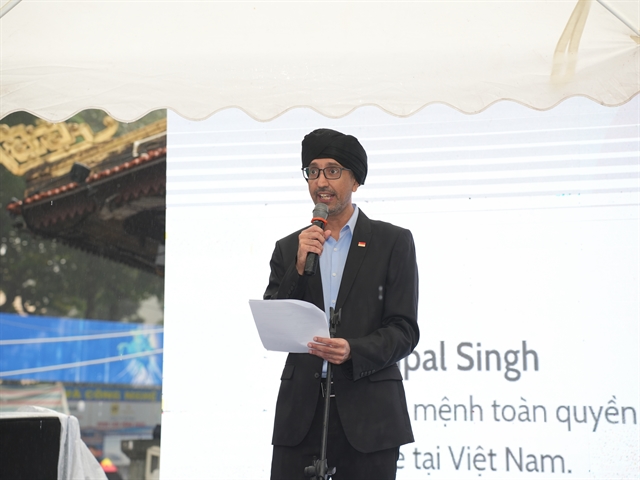 |
| Singapore’s ambassador to Việt Nam Rajpal Singh delivers his speech. |
With Demo Day concluded, the six enterprises will move into the next phase of market engagement, including connections with investors and partners linked to Techfest 2025 – Việt Nam’s flagship startup event. — VNS
Society
 Society
 Society
 Society
 Society
 Society
 Society
 Society
 Society
 Society
 Society
 Society
 Society
 Society
 Society


.jpg)