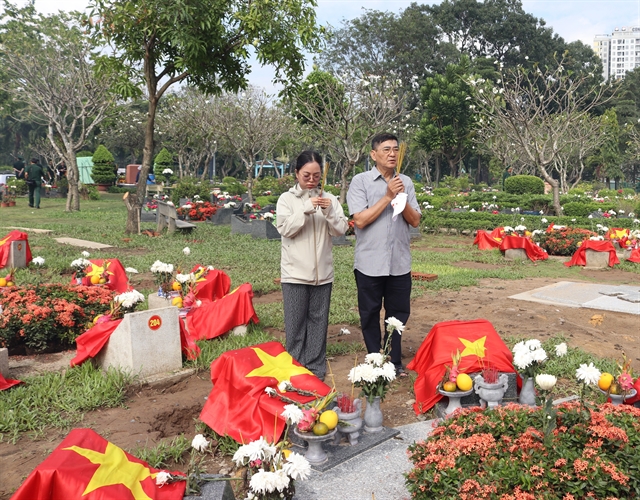
Incense for the fallen: Visitors honour fallen soldiers at the HCM City Martyrs’ Cemetery
1.
 |
| Chu Việt Nga, programme manager at HelpAge International in Việt Nam. Photo courtesy of HelpAge International |
Day-care centres are becoming a vital part of Việt Nam’s ageing landscape, offering safety, companionship and respite for caregivers. In a Q&A with Việt Nam News reporter Khánh Dương, Chu Việt Nga explains how community networks, flexible policies and smarter investment can turn elder day-care into accessible, compassionate services for families nationwide.
Day-care elderly services remain costly in Việt Nam. What solutions are needed to develop this model and make it more accessible for older persons, especially the poor and those in remote areas?
Day-care elderly services are gaining attention as part of the broader ecosystem of care for older persons in Việt Nam. However, accessibility remains limited due to high costs, uneven distribution and significant gaps between urban, rural and mountainous areas.
To develop this model in a way that fits Việt Nam's socio-economic conditions, I believe three groups of solutions are essential.
First, the regulatory framework, policies and State management roles for day-care services must be strengthened and completed. The regulation framework should ensure strict quality control while encouraging model innovation and avoiding administrative burdens for service providers.
This includes issuing service standards and professional requirements suitable for different scales of operation, offering flexible operational guidance and providing targeted support for poor and near-poor older persons as well as those in remote areas.
When policies are clear, transparent and enabling, both public and private actors will be more willing to invest in affordable models that better meet the diverse needs of older persons.
Second, Việt Nam should leverage and connect with existing community networks, particularly the Intergenerational Self-Help Clubs (ISHCs), a joint initiative of the Việt Nam Association of the Elderly and HelpAge International.
From the initial pilot in 2006, the model has been scaled up three times through decisions issued by the Prime Minister, with over 9,000 clubs nationwide and a goal of 21,000 clubs by 2035.
ISHCs can serve as satellites supporting day-care models by organising social activities within the community; mobilising volunteers for caregiving support, monitoring and escort; identifying care needs; and coordinating with day-care centres while facilitating connections to primary healthcare.
In remote areas where it is difficult to establish urban-standard day-care centres, the ISHC network and community volunteers are the most feasible solution.
Flexible day-care options can be adopted, such as using village cultural houses, community centres or commune health stations to host low-cost but safe and socially connected daytime activities.
Third, we must diversify service-delivery models and encourage partnerships across the public, private, social organisations, community, family and old persons themselves. Public-private cooperation should not only focus on financing but also on more flexible service arrangements.
In addition to stand-alone day-care centres, other models can be developed such as integrated day-care services at commune health stations, community activity venues and cultural houses; models that partner with businesses and social organisations to share costs, human resources, and facilities; and centres located on the ground floor or in common areas of apartment buildings, allowing older persons to access services right where they live, reducing travel costs and fitting the context of major urban areas.
A diverse range of service models from professional services to community-based care will help expand coverage and reduce costs for users. This approach is well suited to Việt Nam, where income levels and living conditions still vary significantly across regions.
The role of families and older persons themselves from co-designing services and participating in activities to contributing appropriate support is also essential to lowering costs, strengthening engagement, and ensuring the model truly reflects real needs.
Finally, the care system for older persons must be multi-tiered, including self-care, home-based care, community-based care, day-care services and long-term care when needed.
The development of day-care models should be situated within this overall system to ensure that every older person has an option suitable to their economic conditions, cultural context and individual needs.
What priorities should Việt Nam focus on in the next two to three years to pilot and scale up day-care elderly services?
I believe the top priority for piloting and expanding day-care models for older persons is to concretise the major policy directions set out by the State.
The country's updated vision to strengthen the protection, care and improvement of people’s health clearly identifies the development of care facilities for older persons, the improvement of rehabilitation services, stronger coordination between healthcare and care institutions, and the encouragement of private-sector participation.
In addition, Việt Nam’s Population Strategy to 2030 emphasises the need to develop a multi-tiered care network for older persons, including the expansion of residential care facilities.
Together, these two policy directions provide a favourable political and policy foundation for Việt Nam to develop day-care models in a systematic and well-regulated manner.
To translate these policy commitments into practice, it is essential in the next two to three years to issue detailed guiding documents and operational standards for residential care facilities, including day-care services.
A regulatory framework must be established that is strict enough to ensure safety and quality, yet flexible enough to allow for local innovation. This framework should define minimum professional standards, monitoring responsibilities, medical referral mechanisms, and also enable more flexible models such as day-care points located in village cultural houses, commune health stations, or the ground floors of urban apartment buildings to reduce travel time and improve access.
Another key issue is that Việt Nam currently lacks an official occupational code for elderly care workers, resulting in no standardised training pathway or mechanism for competency recognition.
Issuing an official occupational category, competency standards, and formal training curricula will help build a qualified workforce, provide peace of mind for families, and ensure safety for older persons using the services.
Alongside the legal framework, Việt Nam needs to conduct large-scale surveys to better understand the diverse needs of older persons and those approaching old age.
Information on functional decline, daytime support needs, ability to pay, levels of loneliness, rehabilitation requirements and preferences for community engagement will be essential for identifying which groups truly need day-care services, which groups are better suited to home-based care and which only require basic social support.
Such an evidence-based approach will help localities design models that match real needs and ensure efficient use of resources, rather than expanding a single type of service based on subjective expectations.
Another priority is assessing the current service ecosystem. Several private providers and social organisations already offer day-care services in major cities, indicating that there is real market demand. However, services are mostly concentrated in developed areas, costs remain high relative to average incomes, and there is a lack of models suitable for remote and rural areas.
Conducting a comprehensive review of existing providers including their strengths, challenges, operating costs, service standards, staffing models, and coordination with the healthcare system will help the Government determine appropriate support measures such as public-private partnerships, adjustments to licensing requirements, prioritisation of public land for social services, unified technical guidelines, or targeted incentives to encourage private-sector investment in this emerging field.
In the longer term, Việt Nam should begin laying the foundation for a national long-term care strategy and view the development of care services including day-care as part of the emerging “silver economy”.
What plans does HelpAge have to support Việt Nam in implementing eldercare models?
HelpAge International is committed to continuing its partnership with Việt Nam in developing care models for older persons at home, in the community and in care facilities including day-care models. In the coming period, HelpAge will focus on three main areas of work.
First, HelpAge will provide technical support to government agencies, local authorities and care service providers through research, assessments and the development of guidelines and standards related to elderly care. We will also advise both public and private facilities on designing and operating day-care models that are safe, high-quality, and appropriate for Việt Nam’s conditions.
Second, HelpAge will continue to develop, pilot and scale up effective care models, integrating them with existing resources and Việt Nam’s strengths such as the ISHC network and the increasingly strengthened grassroots health system.
At the same time, we will enhance training, capacity-building, provision of materials and peer learning among care providers to help improve service quality.
Third, HelpAge will strengthen connections with partners in Việt Nam and internationally, both to mobilise sustainable resources for developing care services for older persons and to promote two-way knowledge exchange, including learning from global experiences and sharing Việt Nam’s good practices with the world.
Through these efforts, HelpAge hopes to continue contributing to Việt Nam’s development and expansion of culturally appropriate, affordable and responsive day-care models that meet the growing needs of older persons in both urban areas and disadvantaged regions. VNS
Society
 Society
 Society
 Society
 Society
 Society
 Society
 Society
 Society
 Society
 Society
 Society
 Society
 Society