 Society

AIMCONNECT 2026 Held in Singapore, Bringing Global Automotive Leaders Together to Explore the Future of AI, Trust and Connected Mobility
1.
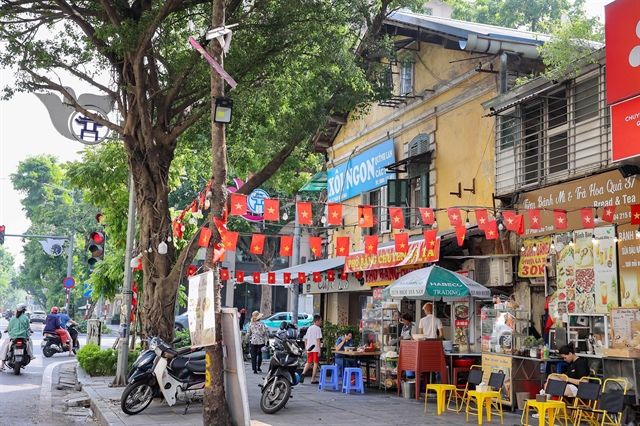 |
| Streetside stalls are set up on a sidewalk in Hà Nội. — VNA/VNS Photo Vũ Quang |
HÀ NỘI — Managing Hà Nội’s pavements has long been a major issue for authorities and urban planners, and experts now suggest that a smarter, more sensible approach is needed to balance order with livelihoods.
Pavements in the capital city are an unofficial place for small vendors to run their businesses, whether they are a grocery, a street food stall or a vehicle repair shop.
According to statistics from Hà Nội’s Department of Industry and Trade, the city currently has nearly 460 markets. However, traditional markets meet only about 40 per cent of shopping demand in inner city commnues and 70 per cent in suburban areas.
Many of these are deteriorating, which means residents are more inclined to go to informal yet more convenient stalls set up on sidewalks and alleyways.
Hà Nội People’s Committee Vice Chairman Nguyễn Mạnh Quyền told Tiền Phong (Vanguard) newspaper in November that eliminating these informal markets requires investing in replacement neighbourhood markets.
Meanwhile, the number of motorbikes and cars in Hà Nội has surged in recent years alongside rapid urbanisation, driving parking demand sharply upward.
According to a group of researchers from the University of Transport and Communications and the Hà Nội Architectural University, the total parking area in the city only meets 8-10 per cent of demand.
Most of the remaining need is patched together by repurposing office courtyards, residential buildings, schools, vacant land lots and pavements or sidewalks.
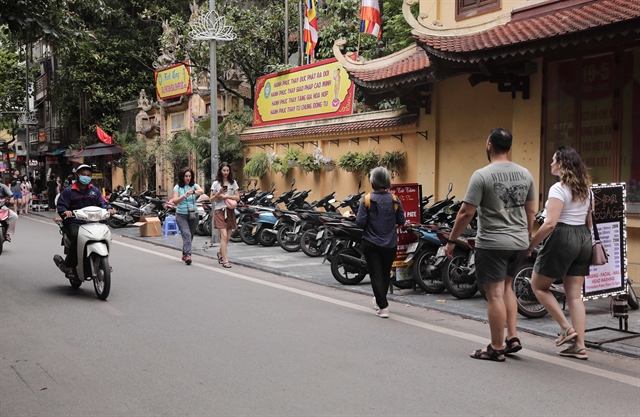 |
| Motorbikes park on the pavement on Lý Quốc Sư Street, Hà Nội. — VNA/VNS Photo Thành Phương |
Flexible, humane approach
These activities are often seen as pavement encroachment and obstructing pedestrian pathways, leading to repeated sidewalk clear-up campaigns over the years.
During the campaigns, informal stalls on pavements are removed in an effort to restore order. However, a few weeks after each campaign, everything typically returns to the way it was.
Urban experts argue that these campaigns fail because they target symptoms rather than root causes – street vendors are barred from operating on the streets, but no alternative space is provided for them.
Meanwhile, strong and widespread demand for the services they provide means clear-up campaigns have limited effectiveness in the long term.
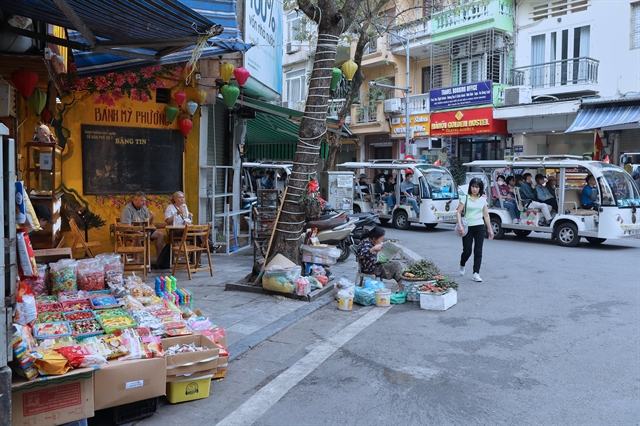 |
| Multiple pavement clear-up campaigns have been conducted over the years in Hà Nội, with limited effectiveness. — VNA/VNS Photo Lê Đông |
The reason for the ineffectiveness of clear-up campaigns is “not because people intentionally violate the rules, but because the policies are not fully attuned to actual contexts. Sidewalks are not merely a space to regulate – this is a social, cultural and economic crossroads,” said Deputy Director of the Hà Nội Department of Finance Lê Trung Hiếu.
Data from the Hà Nội Urban Planning Institute shows that more than 60 per cent of informal economic activity in the inner city takes place on pavements.
These include food and beverage stall owners, shoe shiners, locksmiths and street vendors. While operating informally, they provide services that are essential, accessible, affordable and fast, said Hiếu.
Pavements are the clearest reflection of both the pace of development and the contradictions in the capital city today, according to Hiếu.
He said: “As Hà Nội pursues its goal of becoming a smart city, tens of thousands of small businesses continue to exist in a grey zone – without permits, without taxes and without legal protection.”
In a sense, Hà Nội’s sidewalks are carrying a part of the city’s social welfare workload, the deputy finance director explained. It accommodates informal workers and sustains a familiar rhythm of the thousand-year-old city’s daily life – a feat that few other metropolises have been able to replicate.
He suggested that instead of yet another enforcement campaign, Hà Nội could take a more flexible and humane approach to governing sidewalks.
Instead of imposing blanket bans, the pavement could be classified and opened for use depending on time, location and function. Fees collected from the use of this public space should be reinvested into its infrastructural improvements, with transparent and fair pricing.
“If we keep focusing on ‘reclaiming’ sidewalks, we risk erasing part of the city’s identity and losing the chance to build an urban model where people genuinely know how to share public space,” said Hiếu.
Smarter measures
Case studies from other countries in the region and across the globe have shown that smart sidewalk regulation can lead to successful co-existence on this public space.
In Bangkok, authorities have set a specific rule that says if business activities are allowed on one side of the pavement, the opposite side must be designated exclusively for pedestrians.
Here, vendors must register themselves and receive a management code. They are also required to maintain at least 1.5 metres of clear walkway.
Singapore has also installed a system of cameras and sensors that monitors pavement encroachment in real time.
Meanwhile in Paris, businesses may only operate on the pavement when pedestrian paths are unobstructed. Local residents can report violations directly through a mobile app, with data publicly updated for collective monitoring.
According to Hiếu, these examples show that when sidewalks are managed transparently and efficiently, people become more mindful and cities become more livable.
“Sidewalks are not merely passageways – they reflect mutual respect among citizens, between residents and authorities, and between a modern city and its memory,” he said.
He suggested that each local business could be issued a digital permit linked to a QR code displaying its allocated area, operating hours and usage fees.
Cameras and sensors would automatically monitor compliance, enabling violations to be handled without forced intervention. In this way, sidewalks would no longer be an informal place but part of an intelligent urban ecosystem, managed through actual data rather than rigid rules.
Hiếu also stressed the need for a strict ban on motorbikes occupying pavements in front of shops.
Businesses must arrange parking within their own premises or at designated parking lots along the street, he said. For cars, a policy could be issued to allow 30 minutes of free parking, followed by high fees over time to encourage quick turnover.
“In such a context, sidewalks would no longer be mere transit spaces but storytelling places – a living cultural database where past and future coexist,” said Hiếu. — VNS
Society
 Society
 Society
 Society
 Society
 Society
 Society
 Society
 Society
 Society
 Society
 Society
 Society
 Society
 Society