 Society
84 individuals investigated for transnational online frauds
1.
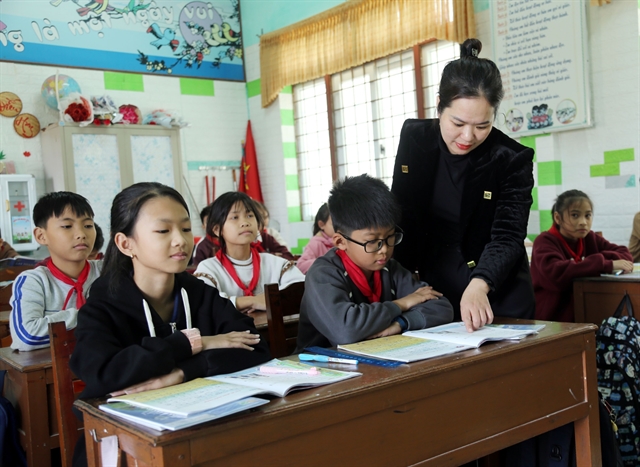 |
| Fifth-grade students at a primary school in Quảng Trị Province receive reading instruction from a teacher. — VNA/VNS Photo |
MANILA — Việt Nam’s fifth-graders again posted the highest regional scores in reading and mathematics in a major Southeast Asian learning assessment, even as their performance slipped slightly compared with the previous cycle, according to results released in Manila, the Philippines on Thursday.
The 2024 Southeast Asia Primary Learning Metrics (SEA-PLM) survey – involving Cambodia, Timor Leste, Laos, Myanmar, Malaysia, the Philippines and Việt Nam – tested thousands of grade-5 students across the region in reading, writing and mathematics.
The assessment is coordinated by the Southeast Asian Ministers of Education Organisation (SEAMEO).
SEAMEO reported that overall learning outcomes in the region have remained broadly stable since 2019 despite the pandemic shocks. Reading performance held steady, while maths scores edged up slightly.
Việt Nam's students recorded an average reading score of 323.5 – the highest among participating countries, but down nearly 4 per cent from 2019. Maths scores averaged 334.6, also the region’s top result, though about 2 per cent lower than five years earlier.
Two-thirds of Vietnamese pupils reached the survey’s high proficiency benchmark in reading, far above the regional average of 40 per cent. In mathematics, 88 per cent reached the top tier, compared with a regional average of 36 per cent.
Việt Nam also led the region in the share of students meeting the minimum proficiency levels aligned with the Sustainable Development Goals: 86 per cent in reading and 95 per cent in maths.
Yet the broader regional picture is less encouraging. SEAMEO highlighted that only half of pupils across Southeast Asia achieve minimum proficiency in reading, and just one-third do so in mathematics.
The organisation warned that learners at the very low proficiency levels are improving more slowly than their peers, and that gender gaps, socio-economic disparities and language barriers continue to shape outcomes.
Early-learning opportunities and strong school resources were linked to better results, while students performed more strongly when the language used at home matched that of the assessment.
Teacher qualifications have improved, SEAMEO noted, but pedagogical skills remain uneven.
The findings come as several Southeast Asian governments face declining education budgets and the narrowing of the region’s demographic dividend – the shrinking window during which the workforce makes up a large share of the population.
Việt Nam’s Deputy Minister of Education and Training Phạm Ngọc Thưởng said the SEA-PLM data set was 'important and meaningful' for countries seeking to build long-term education strategies.
Việt Nam, he said, is entering a new phase of development that demands deeper international integration, innovation and digital transformation, with education positioned as a national priority.
He added that lessons from regional and global assessments would continue to inform Việt Nam’s reforms in teaching, learning and student evaluation as the country pushes to raise quality and reduce inequality in its schools. — VNS
Society
 Society
 Society
 Society
 Society
 Society
 Society
 Society
 Society
 Society
 Society
 Society
 Society
 Society
 Society